
Carrying a Premature Baby, personal story
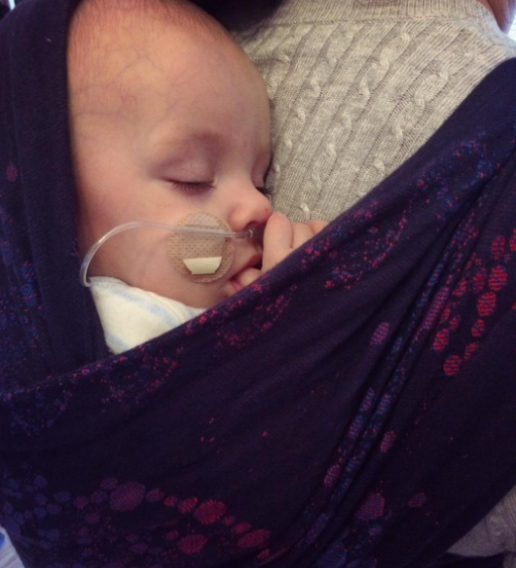
This is Kay and Alex's story of carrying a premature baby. She tells us about their lives together and what role slings have played in their rocky journey. It is a truly inspiring story of great courage and endurance and I am honoured to have played a small part.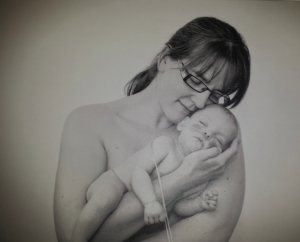
"For as long as I can remember I have wanted to be a mum, but my real journey to parenthood started 5 years ago. I decided that I didn't want to wait for the "right person" to come along and started looking into fertility treatment for single women. Unfortunately the process wasn't was easy as I expected; after lots of tests and surgery I discovered that I had endometriosis which may affect fertility..
I started out doing IVI with donor sperm but after two attempts with no success it was suggested that IVF might have a better chance of working. I decided to take part in the egg-sharing programme to reduce the cost and hopefully help someone else too. During this time there was a lot of compulsory counselling to ensure I was aware of all potential outcomes. I'm very lucky that I have a fantastic support system of family and friends around me, especially my parents.
The first attempt at IVF was not straightforwards, I got 14 eggs, (7 of which were donated), but only one was fertilised. This was put back and I got a chemical pregnancy but miscarried. I also got a relatively rare condition called Ovarian Hyperstimulation Syndrome (OHSS) which made me really ill and I had to be hospitalised on numerous occasions. Due to the poor fertilisation rate it was thought that I had poor egg quality so had to pay the full cost of IVF treatment (as a single woman I was not entitled to any NHS treatment.)
On the second IVF attempt, medications were reduced to try lessening the risk of OHSS but because doctors were anxious about this, the egg collection was done too early and 5 eggs were lost during retrieval. This attempt was unsuccessful. I again got OHSS but much milder this time. The emotional rollercoaster or IVF is unimaginable and the hormones of treatment don't help! You spend all your time so focused on preparing to become pregnant, trying to stay positive, eat well etc, then once the embryo is implanted you have the longest two weeks praying you are pregnant and counting down to the day you can take a pregnancy test... but as soon as it is test day comes you don't want to do the test because you are until then "Pregnant till Proven Otherwise" ( PUPO). Internet support groups become your sanctuary because others undergoing IVF can understand what you are feeling, while your family and friends sometimes don't understand why you put yourself through so much. IVF became my only focus.
After the second attempt I had an eight month break to save up as I had used all my savings. I decided that the next would be my last attempt and I would do everything I could to try to help it work so I would have no regrets. I changed my diet (cutting out all processed food), saw a nutritionist, had regular massage (including Mayan abdominal massage) and acupuncture. We changed the IVF regime to one that had a higher chance of success but also a higher risk of OHSS. It was a risk I was willing to take. I had partly given up hope of this round working, as I got two fertilised eggs out of 19 when I began getting the OHSS symptoms again on day 2.
I did a home pregnancy test two days before test day..... and it was positive!
I didn't know how to react, so burst into tears before laughing maniacally then calling my best friend and my parents. The excitement wore off quickly though when I was admitted to hospital with OHSS at just 4+1 weeks. At a point when I had hoped that the hard part was over, it turned out that this was just the beginning of another difficult journey.
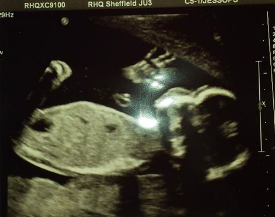 At 18 weeks pregnant, I began getting tightenings. As a midwife, I knew that Braxton Hicks could start early, so I just assumed it was this. though I also worried it might be something more. At 19+4 with continued tightenings, I was seen by my consultant for review and thankfully everything looked ok and possibly just a urine infection causing all this. I was reassured two days later when I had my anatomical scan and everything looked good with a healthy active baby.
I continued to have tightenings but tried to ignore them as everything else seemed OK. Then exactly two weeks later after my scan at 21+6, I started with the smallest amount of bleeding. Again I was reassured as baby seemed OK and it had settled, possibly caused by a cervical erosion, and just to observe. I continued spotting on and off but nothing major, until I was at work on a shift on labour ward at 23+1 weeks pregnant.
I had a significant bleed and was terrified. I felt it was too far on in the pregnancy to lose the baby now but it was far too early to be born. I burst into tears. I am so grateful that I was at work surrounded by fantastic colleagues. I was admitted to the antenatal ward for observation overnight and I didn't go home again.
I continued to have tightenings and bleeding to varying degrees over the next three weeks. Getting to 24 weeks was a major milestone and I was given steroids to mature the baby's lungs. At around 25 weeks my waters went though because of the bleeding it wasn't obvious. Baby was breech and because of the situation I kept being told I might be taken for a Caesarean if bleeding increased or I went into labour. I saw paediatricians who told me stark statistics about survival rates and disability. As a midwife I knew these things but as a mum it just didn't sink in. I was tearful and losing hope. At 25+5 I had a major bleed that got me taken to labour ward and starved in case it continued and and I needed theatre. I spent the next two days in high dependency being observed and in denial.
Writing it down now it seems so silly but even given the bleeding, tightenings and water break it still never clicked to anyone that the pain I was in could be labour. At exactly 26 weeks I was found to be 7cm dilated. Two hours later I had a vaginal breech delivery complicated by the head getting stuck.
Alexander Benjamin was born weighing 1lb 12 oz and in a very poor condition.

The room was full of people but no-one was saying a word. Looking back at his notes now it says it took 18minutes to stabilise him before taking him to intensive care but it didn't feel that long to me. It seems awful to think about it now but at that point once Alex was born all I felt was relief. I was glad the pregnancy was finally over after months of feeling ill and stressed. I had spent the last few weeks trying to detach from the pregnancy as I feared the worst, but in the moment when Alex was taken away and we (myself, my parents and my friend) were left alone the silence said it all.
 I know it can often take up to an hour to get a baby settled into neonatal unit with all the lines, Xrays etc so we patiently waited. After nearly two hours I went to ask if we could see him.. the midwife came back saying the consultant wanted to come and talk to us first. I know the language of medical professionals and I honestly thought we had lost him. The consultant came round and told us that "Alex is a very sick little boy" and that the first 24hours would be critical. I think the adrenaline stopped me from feeling the full effects of the situation but looking back now at pictures and videos of those first hours has me choked up. Alex was beautiful to me, but so frail. You can count every rib and due to the manipulation of delivery his leg is almost black with bruising. He was covered with monitoring leads and various IV lines plus on a ventilator to keep him alive. He was put under phototherapy immediately.
Only I was allowed to touch him but couldn't hold him yet.
 My first hold came on November 17th, aptly, World Prematurity Day. I was nervous about pulling a line or hurting him but also so excited to hold him! He was put skin to skin down my top and his ventilator tubes taped to me to keep him safe. I can still smell him now and it brings me to tears. As a parent you take for granted the milestones you will see; the birth experience you imagined, the crying baby just born and put skin to skin at once. I didn't get these, and my milestones with Alex are different, but even more amazing after the challenges he has faced. We spent 135 days in the neonatal unit and I was there 12 hours a day for 133 of those days. (Two days I was ill from sheer exhaustion and wasn't allowed in.)
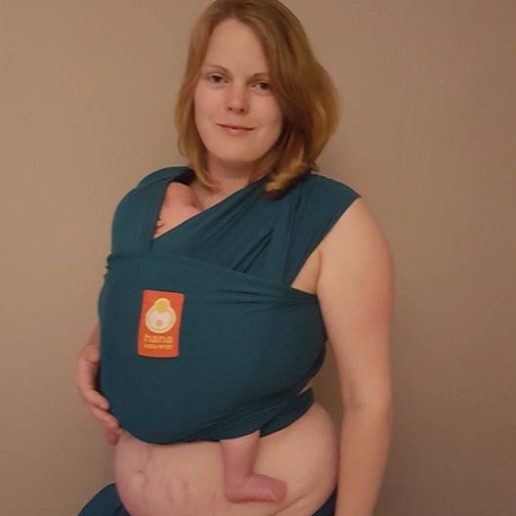
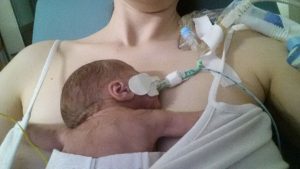 I spent my time holding Alex as much as I could and when he was too poorly to be held I touched him through the incubator and spoke and sang to him. I felt being physically close would help us both bond better, especially after an awful pregnancy and so much separation. I was already aware of the Sheffield Sling Surgery due to friends attending and had contacted Rosie early on in pregnancy as I had planned to carry my baby in a sling. Once Alex was over the first big hurdle of coming off the ventilator at a month old, I got back in touch to find out if slings could help us while still in the NICU. The physiotherapist on the unit was very in favour of using slings and gave me a Vija top to try, but I felt it was more comfy just using my strappy top as we got so tangled with the wires.By the time we moved to HDU it was a slightly more relaxed environment with staff that seemed more in favour of breastfeeding and skin to skin. I decided, after discussion with Rosie, to buy my first sling, a Hana stretchy wrap.
It felt complicated at first getting used to the technique of wrapping and because of all the monitoring it would often take someone else to help me get all the wires sorted, but once Alex was put into the sling he fell straight to sleep. I noticed that often his heart rate and oxygen sats would improve too and it made me even more determined to keep him close.
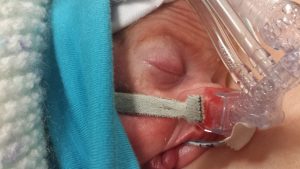
Our journey through special care gives me mixed emotions. On the one hand I would never wish this experience on anyone. The constant stress, not just for myself but also family and friends around me. The fear that if I leave, something might happen. Every time the phone rang panic would set in and don't even get me started on the paediatricians coming up to the ward!
However, my life has changed completely in so many good ways. I have realised and experienced how fantastic the care is from my colleagues. I have become closer to my family and friends and I love watching my parents with Alex. I feel I will be an even more sympathetic and understanding midwife and I hope my practice will change to support women who go through similar experiences. Most of all I have realised my dream of becoming a mum and to the most incredible little fighter I have ever met.

I feel I have a strong bond with Alex and many people have commented on how well I can read him. I believe it is because of staying close to him as much as I have and having him in the sling has facilitated this.
Alex has Chronic Lung Disease and came home on oxygen in March. He is doing incredibly well on the lowest level now, but transporting the oxygen has been a bit of a challenge for me. The canister is heavy and the container rucksack has narrow shoulders so has hurt my shoulders; trying to balance that weight against Alex has not been easy. At times I have felt isolated simply because of that. However I have met some wonderful people on my journey through special care and in the sling community (often the two groups mix!) and we wouldn't be where we are now without these challenges.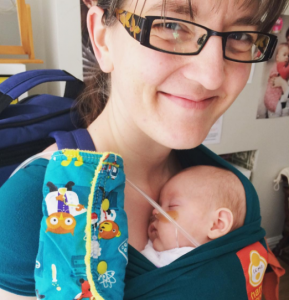
We are still using our Hana wrap, and I've been trying out a snuggly Sleepy Nico! I've learned how to use woven wraps; we are beginning to back carry; the end of the oxygen is in sight! Time to tuck Alex up into the Sleepy Nico and reconnect after a long day.
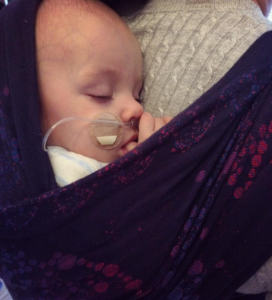

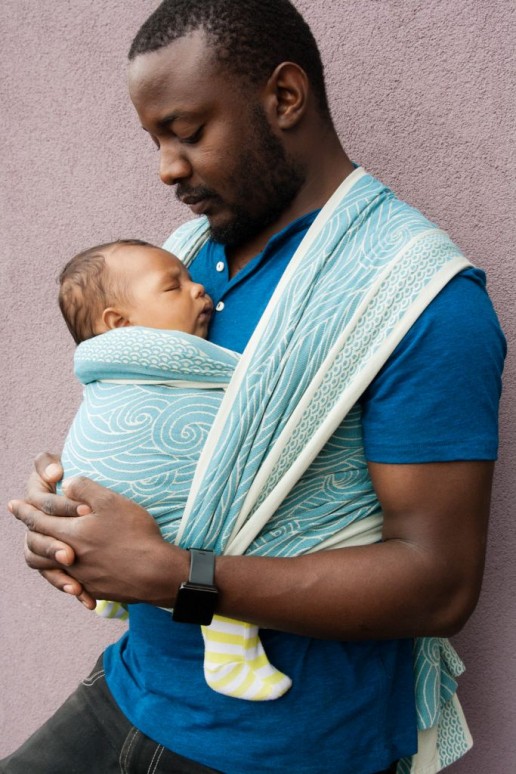
Woven Wraps
Many people love woven wraps. They come in a huge range of patterns, colours and fabric types, and can be used from birth to toddlerhood and beyond. They can be very comfortable to use, due to the wide weight distribution, and one wrap can be used by more than one person without needing to adjust the height of straps or buckles, thus they can be excellent value for money. They can also be used to carry two children together!
Like all carriers, woven wraps need to be used safely and the TICKS guidelines should always be followed. The most important consideration is to protect baby’s airway; a baby’s neck should never be folded in half and two fingers should fit between their chin and their chest.
The most frequently adopted position for carrying young babies is upright and facing the parent, with legs slightly spread apart (the M position) and head well supported, as this will also protect growing hips and spine. Typically this will be the “front wrap cross carry” which is easy to learn.
Woven wraps can be tied in many, many ways and can therefore also be used for other front carries, hip or back carries as babies grow.
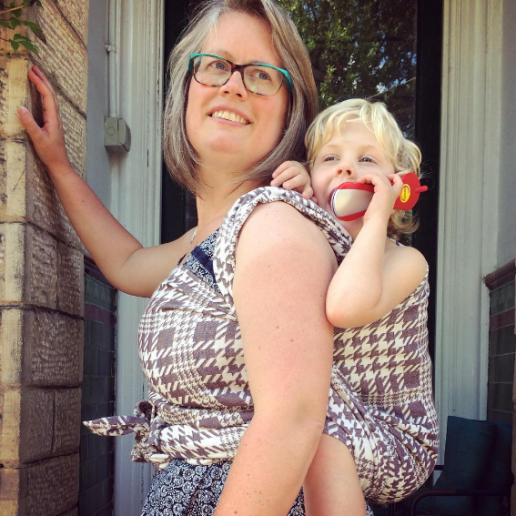
The snugness can be very useful for parents suffering from post-natal depression; that extra “wrapped-around” closeness can aid oxytocin release and assist with bonding.
Children often find great reassurance in the closeness and will often fall asleep during the process of wrapping! Wraps can also be used for creating great visibility so curious children will enjoy them just as much!
What are Woven Wraps?
Woven wraps have been part of normal family life for countless generations all around the world.
Modern woven wraps are long parallelograms of fabric that have been woven on a large loom. The loom is pre-loaded with threads that run vertically up and down (the warp) and then another set of threads (the weft), which are woven horizontally in and out of the warp threads to create patterns.
Many are still handwoven, by small communities around the world that have been using these skills for centuries. The Western market is waking up to the value of supporting such fair trade and sustainable businesses that lift people out of poverty. Some small artisan businesses make handwoven wraps one by one, it can be a very slow process!
The majority of wraps sold in the West are machine woven. Special techniques are used to ensure the wrap has a great deal of strength and durability, making them different from other woven cloths such as tablecloths or clothes. Some are pre-treated to make them super soft from first use, others come “loom-state” and need a bit of breaking in to become floppy.
Woven wraps, for many, are a very comfortable sling choice. Spreading the wide fabric around your body helps to distribute the weight of your child very well, and there is much more control over positioning and snugness (which all add to comfort levels).
Types of Fabric
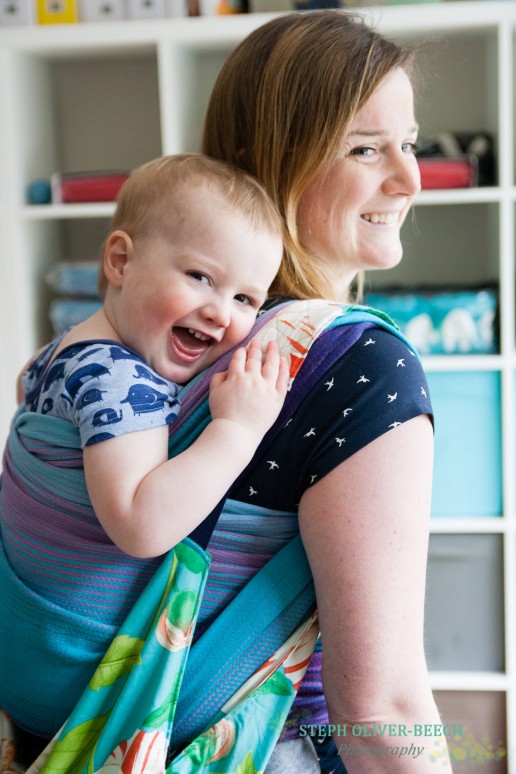
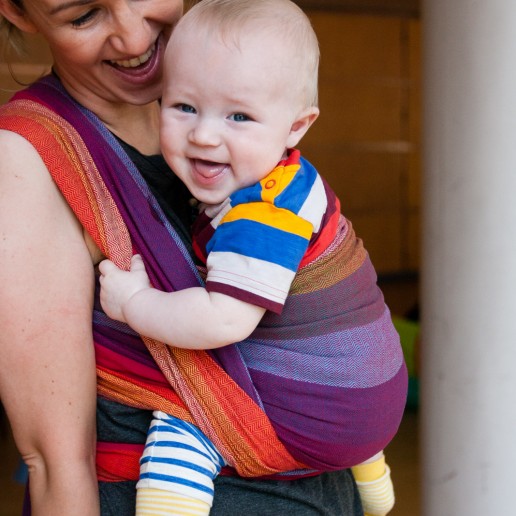
Most wraps are woven with cotton threads, as cotton is easy to care for, soft, strong and supportive. Some wraps are woven as blends of cotton with other fibres, such as wool, linen, hemp, silk or bamboo. These fibres can add features such as extra supportiveness, grippiness, softness or glide, and people will often have their preferences. Some wraps are thinner and cool to wear, some are dense and blankety for extra comfort.
Sizes of Wrap
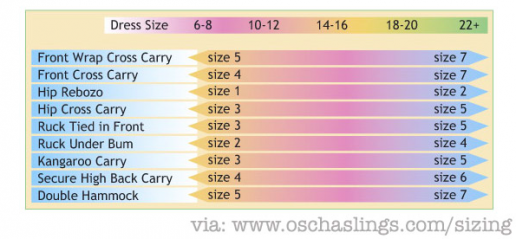
Woven wraps come in a range of sizes which are numbered (in the same way shoe sizes are) to help people identify which length suits them best. Most people will start with the standard size 6 (4.6m) which allows most types of carry with most sizes of parent and child, and one wrap may be all you need to do every kind of carry you wish to! Larger and smaller sizes may find slightly longer or slightly shorter wraps work better.
Some families enjoy learning to use shorter sizes and being creative with the passes to make the most of the length!
How do I put my woven wrap on?
The type of carry you choose to use can change frequently depending on the need of your child; light snuggly front carries in the early baby days, other front, hip or back carries as they grow, single layer cooler carries, multilayer carries for warmth or greater support; a woven wrap allows all these variations. Wraps work well for carrying a toddler during pregnancy, or carrying two children together, known as ‘tandem carries’.
People often ask which wrap they should begin with. We usually advise to pick something that you love the look of, and start with a cotton wrap size 6 because cotton is easy to care for and often soft to the touch and moves with ease.
Stripes or gradations can help with learning how to make the passes, avoid twisting and recognise which sections to tighten around your baby. Many good brands these days sell wraps that are already soft and ready to use from the first wash, rather than needing a lot of work to soften up (known as “breaking in”).
Many people begin with a Front Wrap Cross Carry, which is easy and supportive and can be used for all ages. The video shows you how to do a front wrap cross carry with a woven wrap with a newborn; as their hips are not ready to be spread widely, the “lexi twist” is helpful to keep them in the narrower M shape.
As baby grows, the more standard Front Wrap Cross Carry with various extra passes is a well-loved option.
Learning how to use a wrap does take a little practice. Some parents find it comes easily and have taught themselves. Others need a few goes to get it right and find a consultation or workshop with their local sling educator where they are taught in person helpful.
With premature or especially small babies you may find it helpful to have some help in person. Your local UK sling educators can be found listed on Sling Pages.
Please note that horizontal cradle style carries are no longer recommended due to airway risk.
Front Wrap Cross Carry with a Lexi Twist (for newborns)
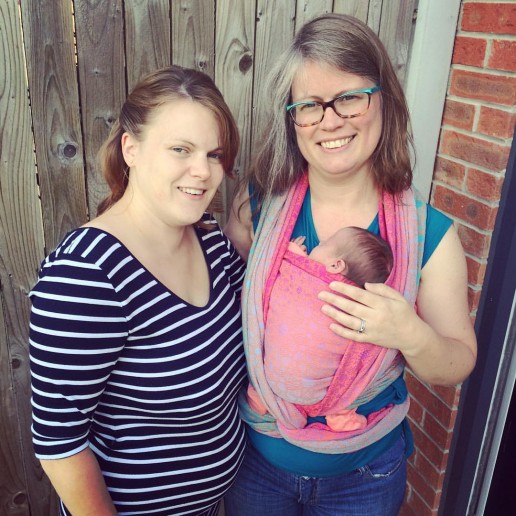
Lexi twist with a 4 day old
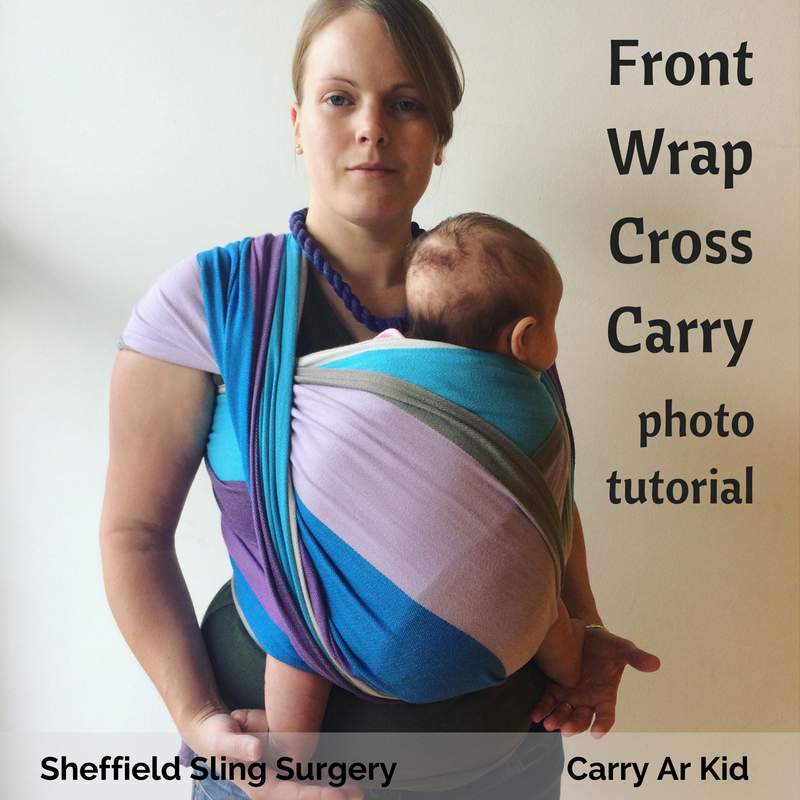
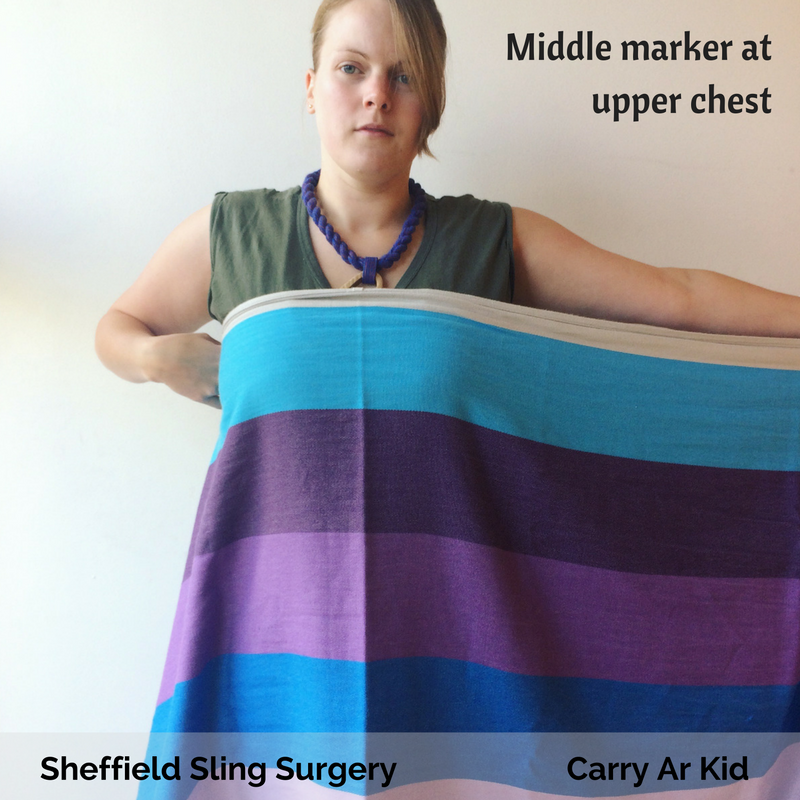
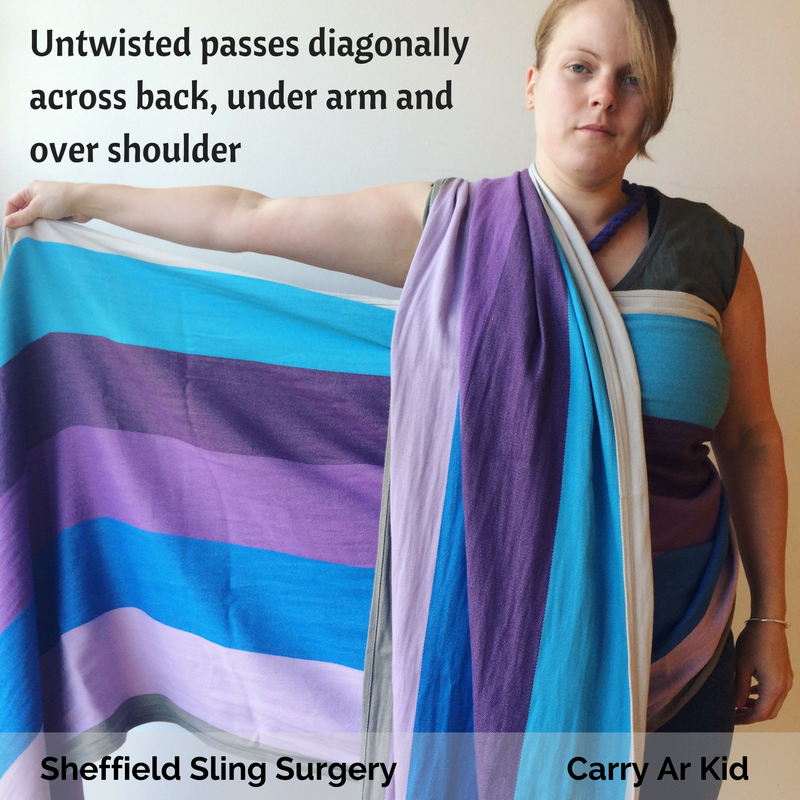
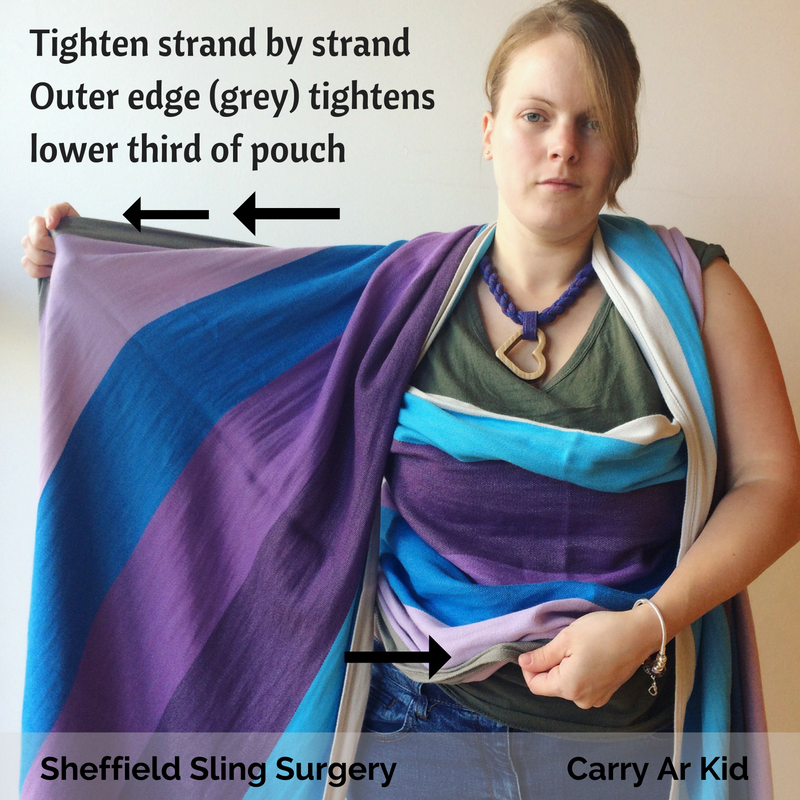
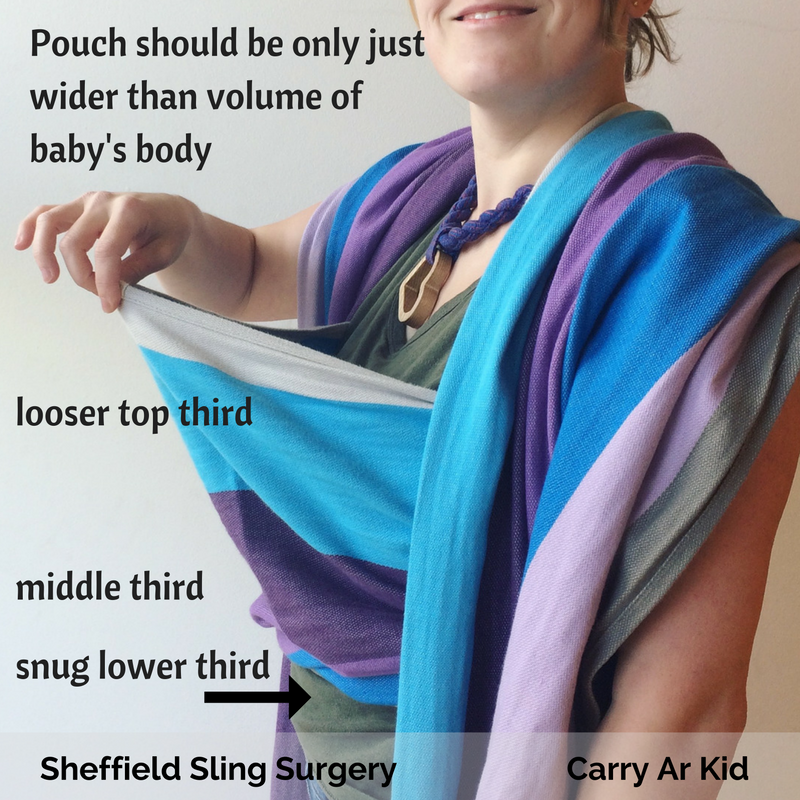
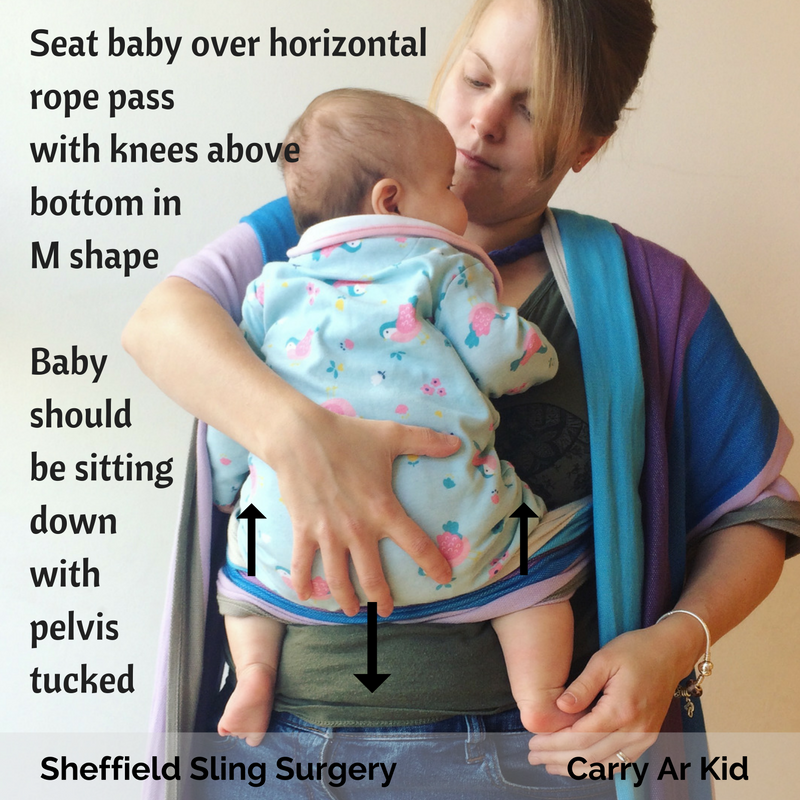
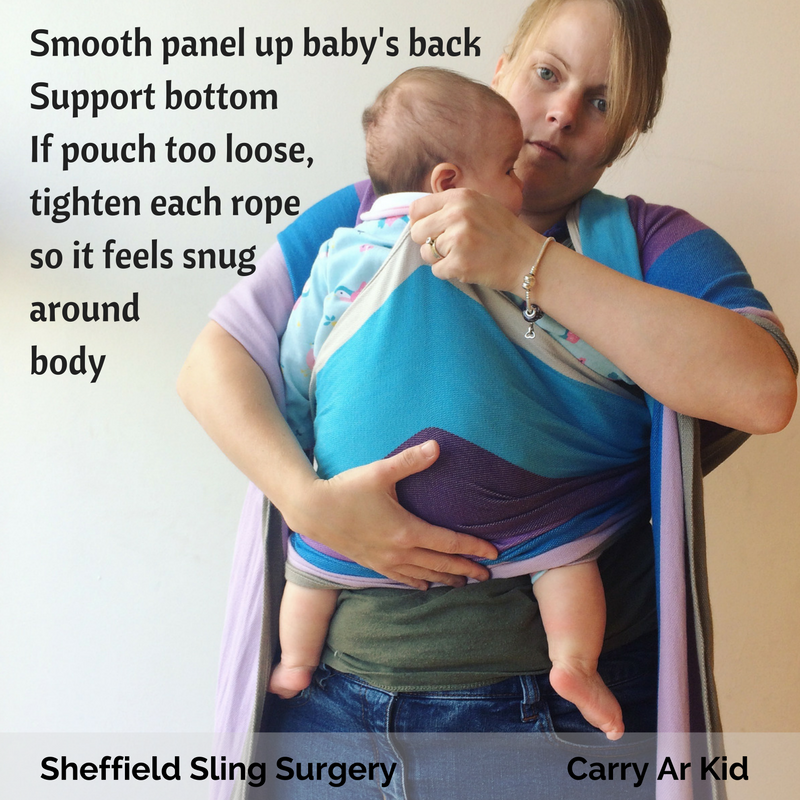
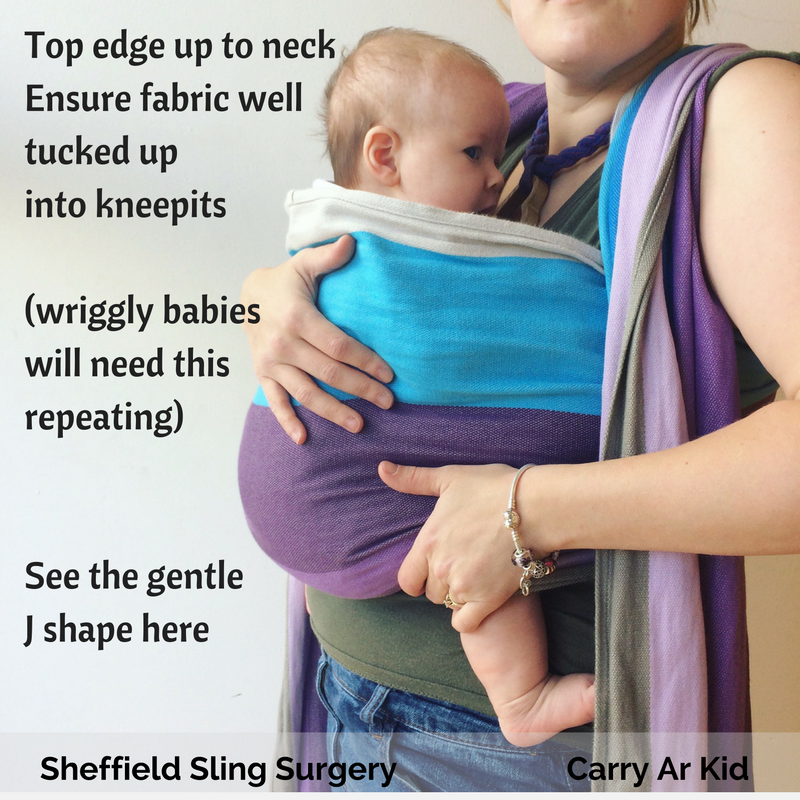
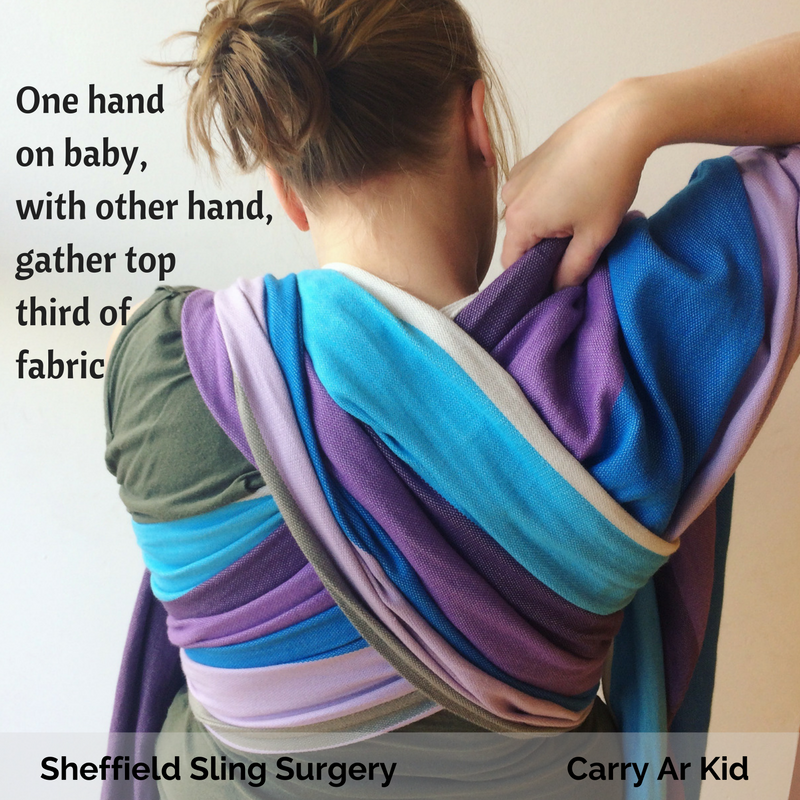
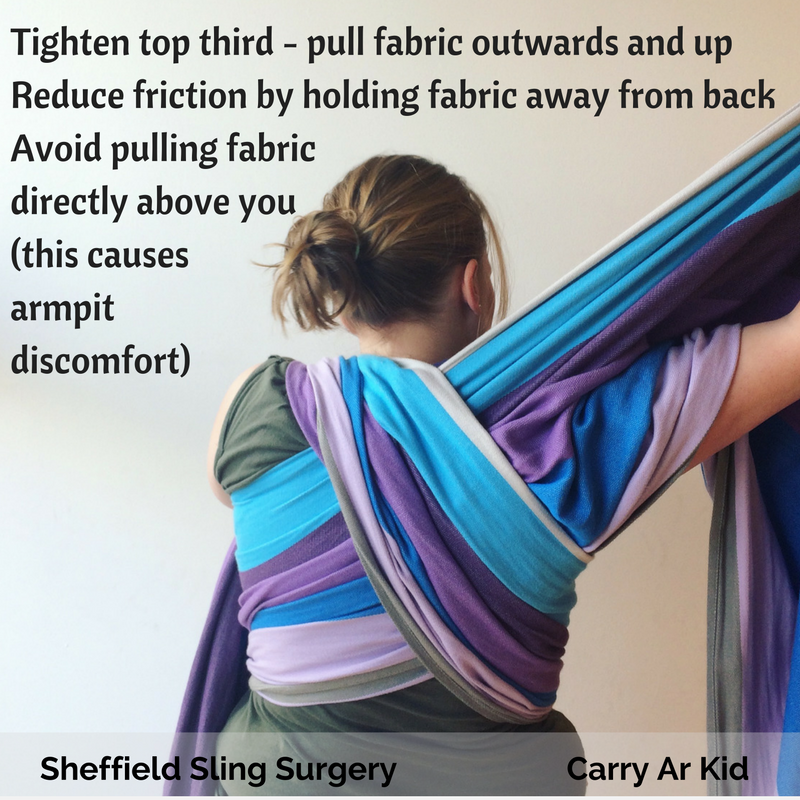
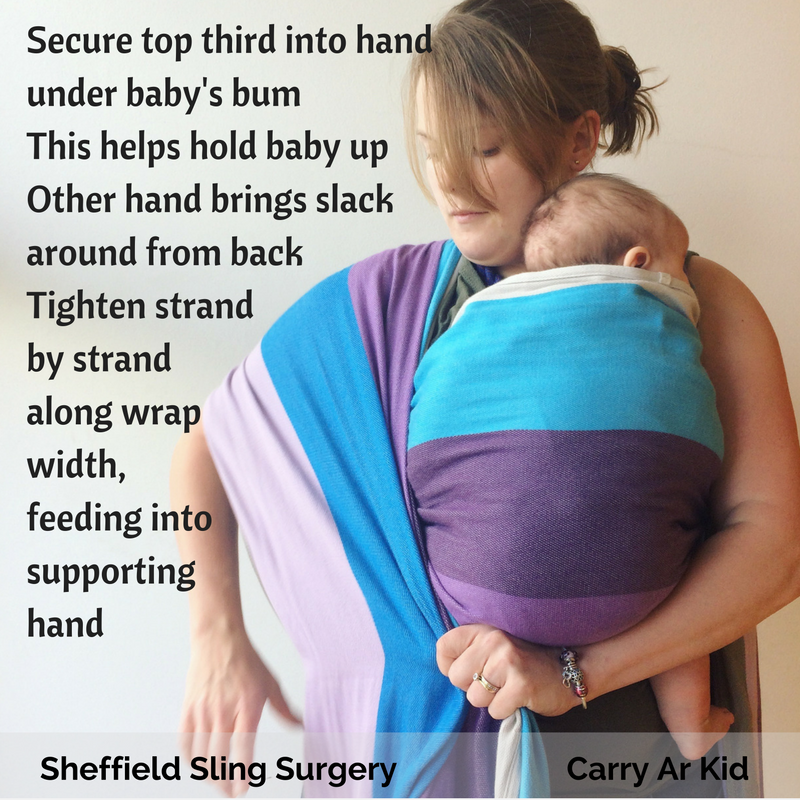
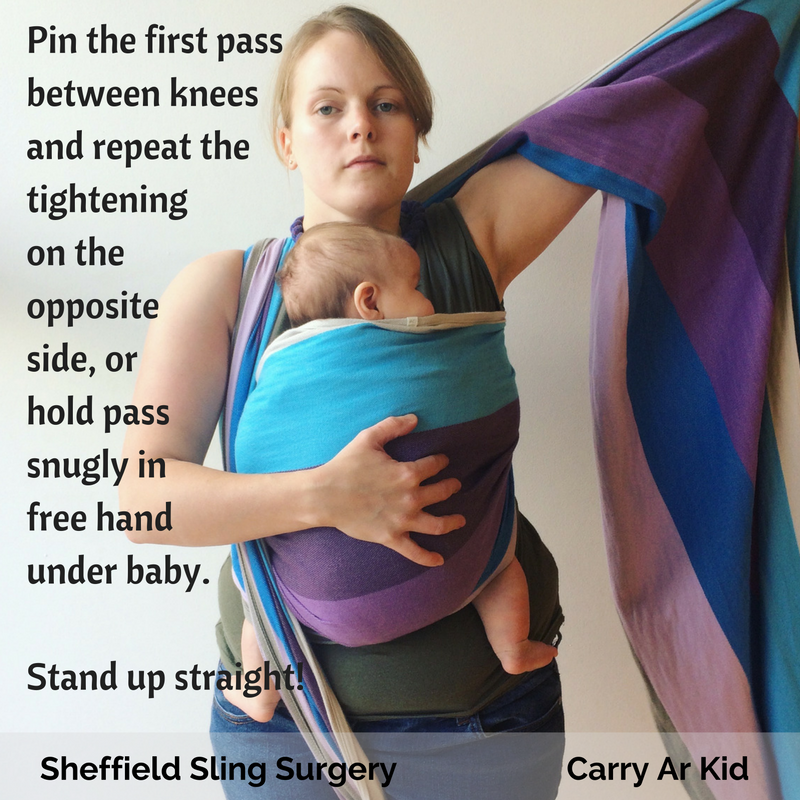
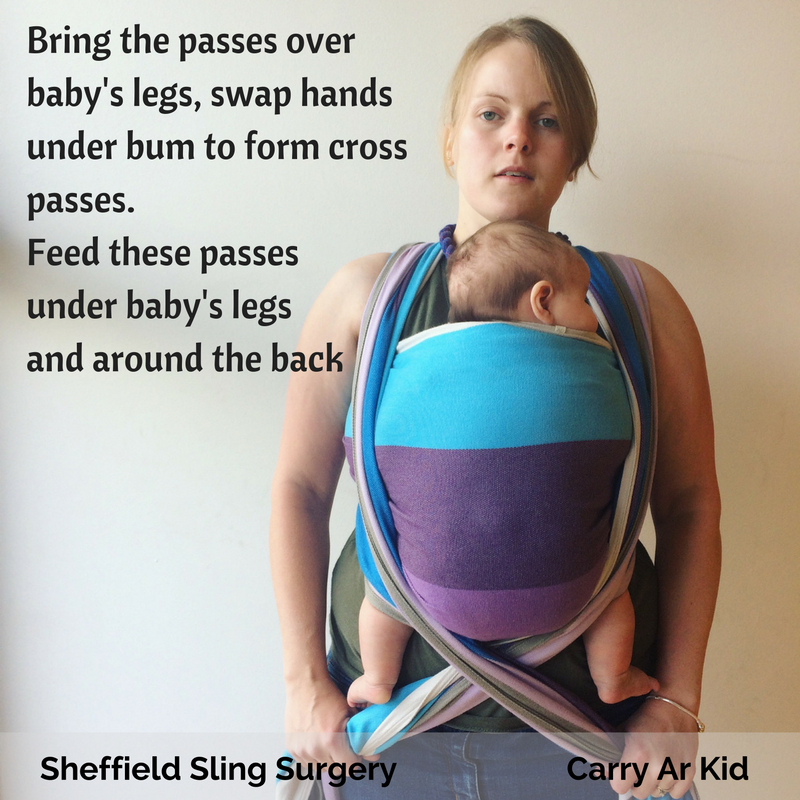
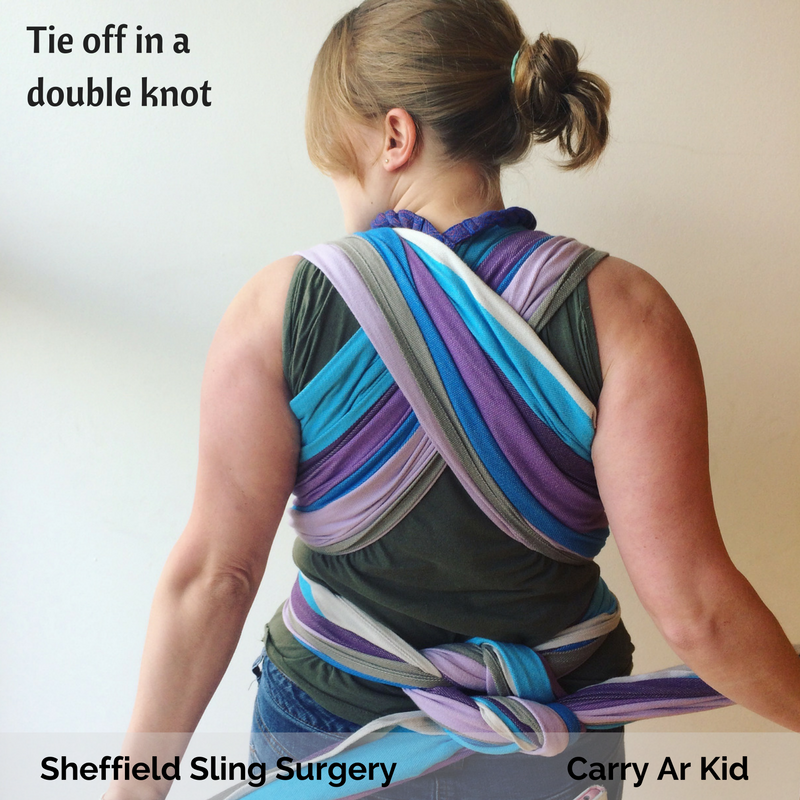
Here is a photo tutorial for a Front Wrap Cross Carry with an older baby. Please click/swipe through each image.
Here is a separate link to the photo tutorial.
Arms out / arms in
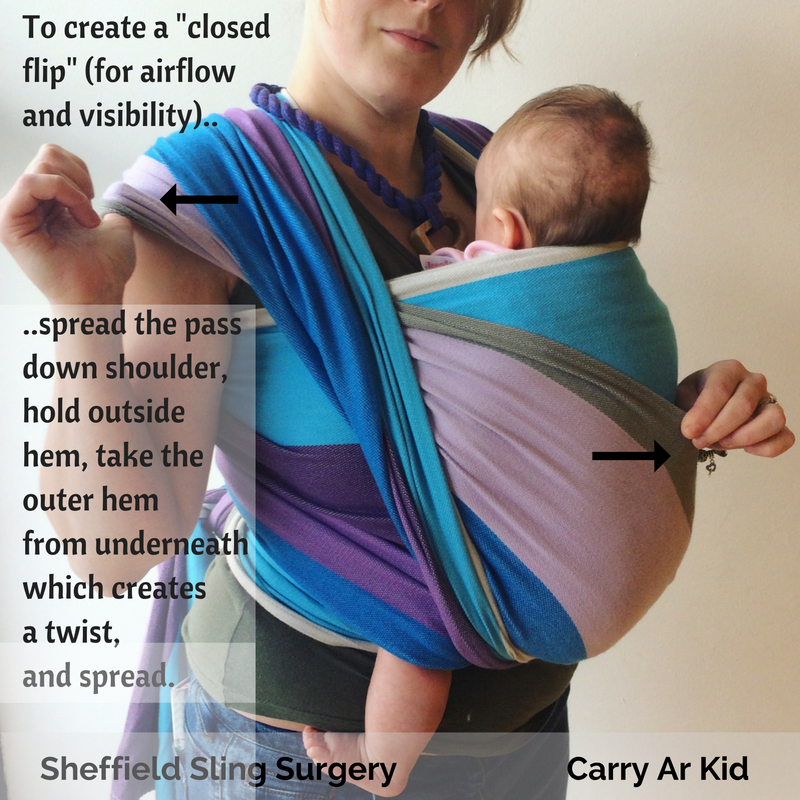
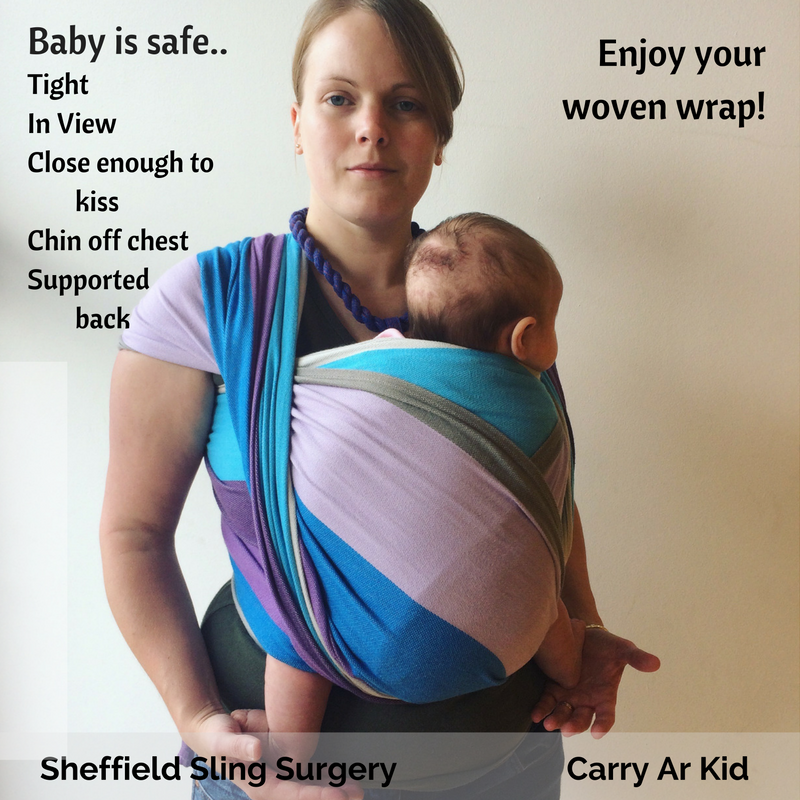
Shoulders folded out for free airflow
Top Tips!
- Practice tightening the fabric strand by strand. This is key for ensuring the top, middle and bottom sections of the wrap are snug around you and your baby.
- Prepare the pouch for your baby; a little snugger at the bottom third to help hold knees up, and the middle and top sections only just wider than the volume of your baby's body, so it is snug as you pull it up.
- Hold your baby straight in the centre of your chest and bring his legs through the rope pass on the front.
- Make sure he is sitting in the M shape and hold his chest close to you as you go.
- Wrap arms in if possible, and bring older babies' arms out later, once the carry is finished. Toddlers may prefer being wrapped arms out.
- Hold each tightened pass snug, or pin it between your knees as you do the other side.
- Try to stand straight whilst you are wrapping. If you lean backwards or to one side you will find the wrap is not tight or that your baby is leaning inside the carrier.
- The top and middle thirds need to be snug to avoid slumping.
- If you find any slack while wrapping, remove it.
- Ensure there is no fabric over your baby's face; you can fold the fabric out of the way, down your shoulder.
Common Queries about Woven Wraps
Feeding in Wovens
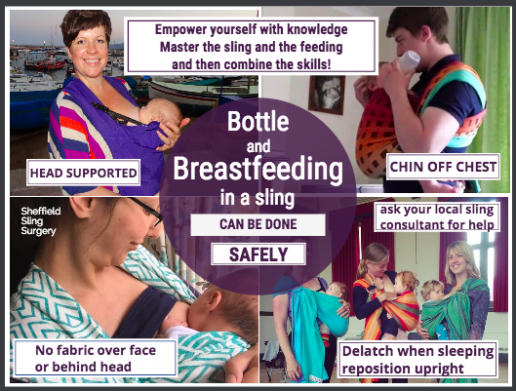
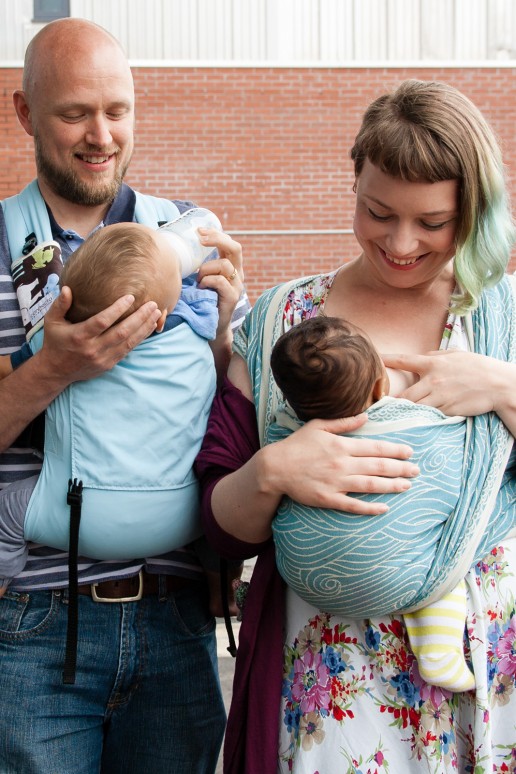
Feeding is possible in woven wraps, with a little care to ensure baby’s airway is well protected. Typically, for breastfeeding, this involves loosening the wrap in stages so baby is lowered gently to the nipple. No breastfeeding is hands free, and it is usually a good idea to get some help and advice from people who are familiar with how to do it. Please note that when baby has finished feeding, he must be returned to his safe snug upright position, close enough to kiss.
You can read more about how to breast and bottle feed here.
When can I start hip and back carries?
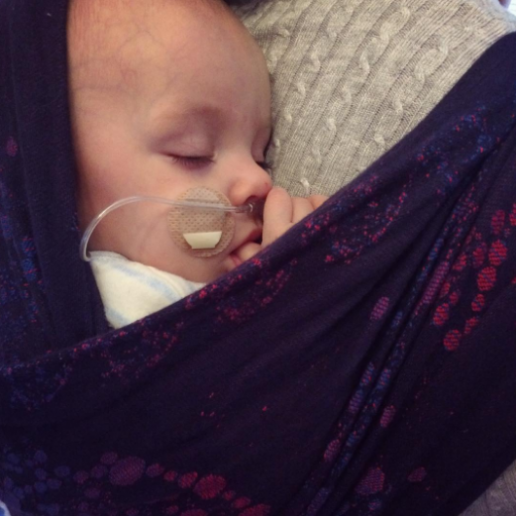
Babies can be carried “off centre” on the front from early on, as long as their natural tucked narrower M shape position is preserved. Lateral hip carries tend to work best when babies begin to sit comfortably the parent’s side, this is typically about 3 months or when baby begins to roll.
Woven wraps are so very mouldable, strand by strand, that some confident sling users will begin wrapping their babies of a few weeks old on their backs. They know they can ensure a good head, neck, back and hip support and keep baby high up to feel their breathing on their necks. It can be hard to do well and is an advanced skill.
As babies get older, back wrapping becomes easier to do, until they become wriggly! The more practice you get, the more confident you will feel, and your baby will feel more secure. There are some excellent video tutorials online such as those by Wrap you in Love, but sometimes getting some help from a professional can make it all much easier!
Read more here about beginning to back carry.
Can I carry both my children in a wrap?
Woven wraps are fantastic for carrying twins, or a combination of baby and toddler! Little ones can be carried together on the front in a single wrap, for example.
Many areas have twin and multiples support groups; it would be worth getting in touch with them, and asking your local sling educators if they can help you too!

Troubleshooting your Woven Wrap
- Carry feeling too loose or too low? You are likely to have not quite got all the slack out as you wrapped at the beginning. Quite often you can untie the knot at the back and, while supporting your baby, bring each pass back to the front. Retighten each pass and tie off again.
- Baby folding over or slumping over to one side? This is likely to be looseness in the middle third; leading to an unsupported back.
- Baby's head leaning back? This is usually due to looseness of the top third of the pouch not keeping shoulders and upper body held chest to chest. This can be quickly and temporarily fixed by feeding the slack of the top third around the side and up over your shoulders, and then twisted into the side cross passes.
- Baby's face buried in fabric? Ensure the middle third is snug (looseness leads to slumping over. You can fold the shoulder passes out for airflow and visibility, and use the other side as a hood if tolerated.
- Baby wants to see the world? You can learn to flip the cross passes across baby's body for visibility.
- Baby feeling heavy? Spread the cross passes across baby's bottom from knee pit to knee pit to add extra lift.This can be done in a flipped fashion to ensure visibility too.
- Shoulder passes digging near your neck? Spread the fabric broadly across your shoulders to redistribute weight.
- Red marks at back of baby's neck? This is usually due to over tightening of the top hem of the pouch; it is the top third that needs to be snug to support the shoulders.
- Baby leg straightening? Ensure you have positioned the cross passes in the knee pits in the M shape with knees above bottom, and that these passes are snug to maintain position. You can also learn how to do some alternative carries that have early under leg cross passes (such as the front cross carry).
Shoulder spread
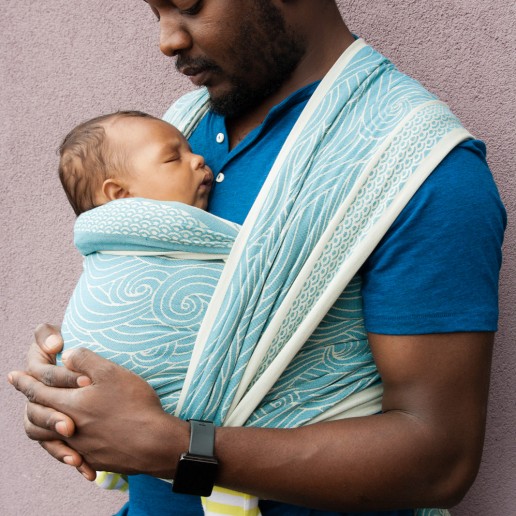
Left side "open flip"/ right side "closed flip"
If you need some more support, your local sling educator can be found listed on then Sling Pages.

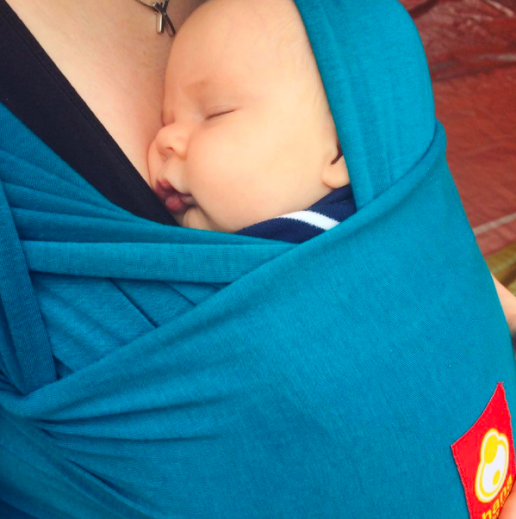
Stretchy Wraps and Close Caboo
I am a big fan of stretchy wraps and their variants (like the Close Caboo). They come in all shapes and sizes, and are usually to be found cuddling a tiny baby close to someone’s chest. Many babies adore the security and safety of the wrap and fall quickly to sleep. For many parents, they are the first slings they own, for good reason.
Like all carriers, stretchy slings need to be used safely and the TICKS guidelines should always be followed. The most important consideration is to protect baby’s airway; a baby’s neck should never be folded in half and two fingers should fit between their chin and their chest.
The most frequently adopted position for carrying is upright and facing in, with legs slightly spread apart (the M position) and head well supported, as this will also protect growing hips and spine. The stretchy wrap will provide gentle mouldable support and can be adjusted to provide head support.
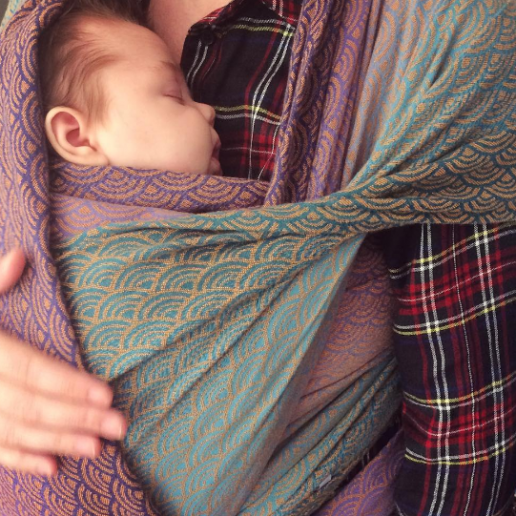
Babies often sleep in stretchy wraps/Close Caboos, when well positioned, as the closeness and snuggliness of the layers of fabric (always at least two layers of fabric with a stretchy!) mimic the close conditions of the womb during pregnancy, and being in contact with a parent’s skin and near a parent’s heartbeat and able to hear a parent’s voice is extremely reassuring for babies.
The most common style of carry is the pocket wrap cross carry (where baby’s legs are on either side of two cross passes). Once you have the hang of it, it is quick and easy, and the wrap can be left on all day and baby popped in and out.
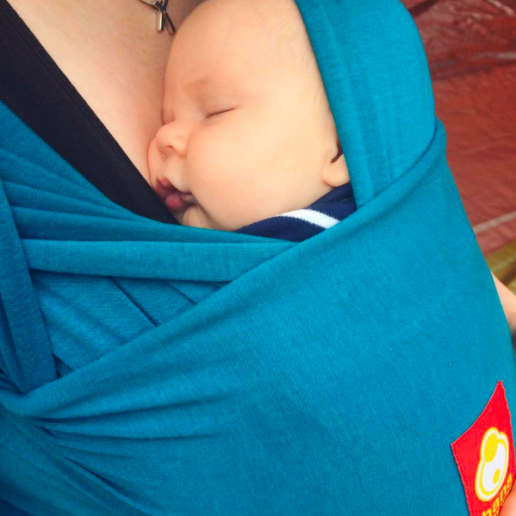

What is a Stretchy Wrap? (see further below for the Close Caboo)
A stretchy wrap is a length of fabric, usually made of soft and stretchy machine knitted cotton, that is usually between 4 and 5m long and about half a meter wide. Some have bamboo blended in with the cotton, which adds to the softness and comfort, and some have a small proportion of spandex, which adds to their elasticity and stretch.
They are suitable from birth, and in fact are often used for kangaroo care in hospitals with premature babies, and most people will find their stretchy wraps will be suitable for at least six months and often many more, especially for the days when active babies are sad and need all-over-cuddles or need some sleep. The gentle all-round pressure helps to reduce excessive stimuli and allow a baby to switch off and sleep.
Not all stretchy slings are the same (varying in stretchiness and ease of use) but by and large, they have the same purpose – to be a comfortable one-size-fits-most sling that a parent can pre tie before putting baby in. This means that the sling can stay on all day and baby can be tucked into it easily and quickly when needed, and taken out again very simply. There is no need to retie a stretchy over and over again during the day. The stretchy does not need to be removed for breastfeeding (see below for how to do this safely).
How do I put my stretchy on?
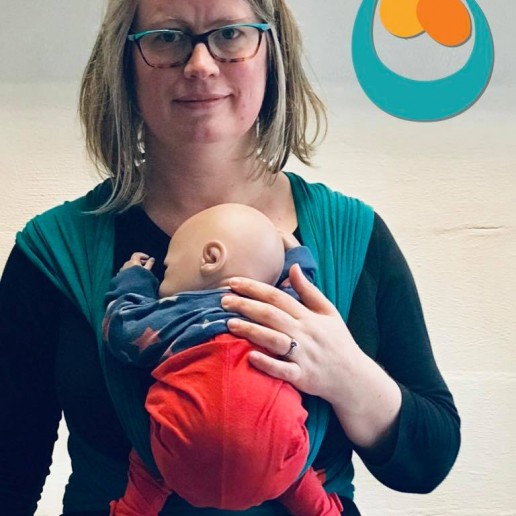
The key to success is in preparation; getting the tension of the passes right before baby goes in, and ensuring their position is correct. I always recommend that each pass is in place in baby’s kneepits to ensure baby is in the M shape and held chest to chest before the fabric is then spread across their body, one side at a time. These images show optimal positioning for a young baby in the wrap – each kneepit is supported in the M shape and baby is chest to chest in the gentle J shape.
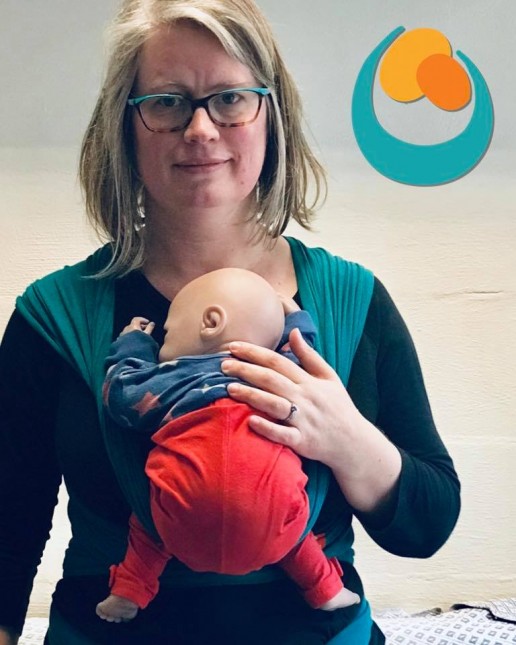
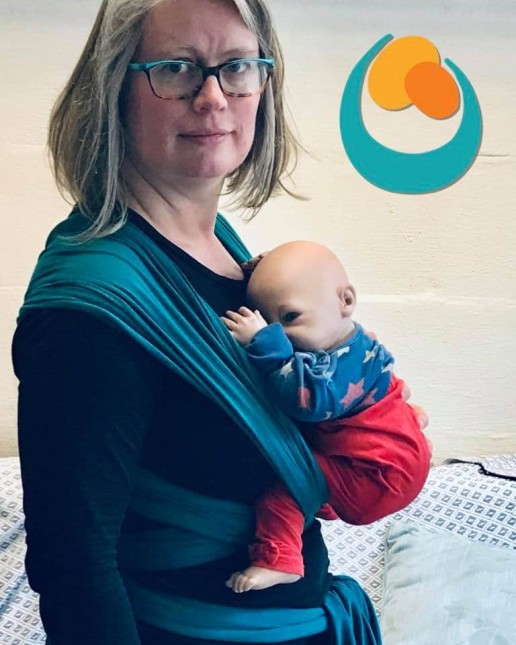
Here is a quick subtitled video showing how a young baby can be positioned well.
Many people worry that it looks fiddly, complicated or that there is too much fabric. But really, it is simple – you just tie it on the same way each time and pop baby carefully into the cross passes on your chest. The videos here all show just how simple it can be. I work with “two-way” stretchy wraps (they stretch lengthways and widthways and are easy to maneouvre).
With premature or especially small babies who still have their feet held very close to their bodies, other techniques (still using the same tie method) may be more suitable, such as this one (video link). Please get in touch with your local sling educator (www.slingpages.co.uk) for extra help.
Please note that horizontal cradle style carries are no longer recommended due to airway risk. Some older instructions unfortunately still contain this position.
Here is another video of the pocket wrap cross carry from Noah’s Arc Sling Library
And here is an audio described version of the above
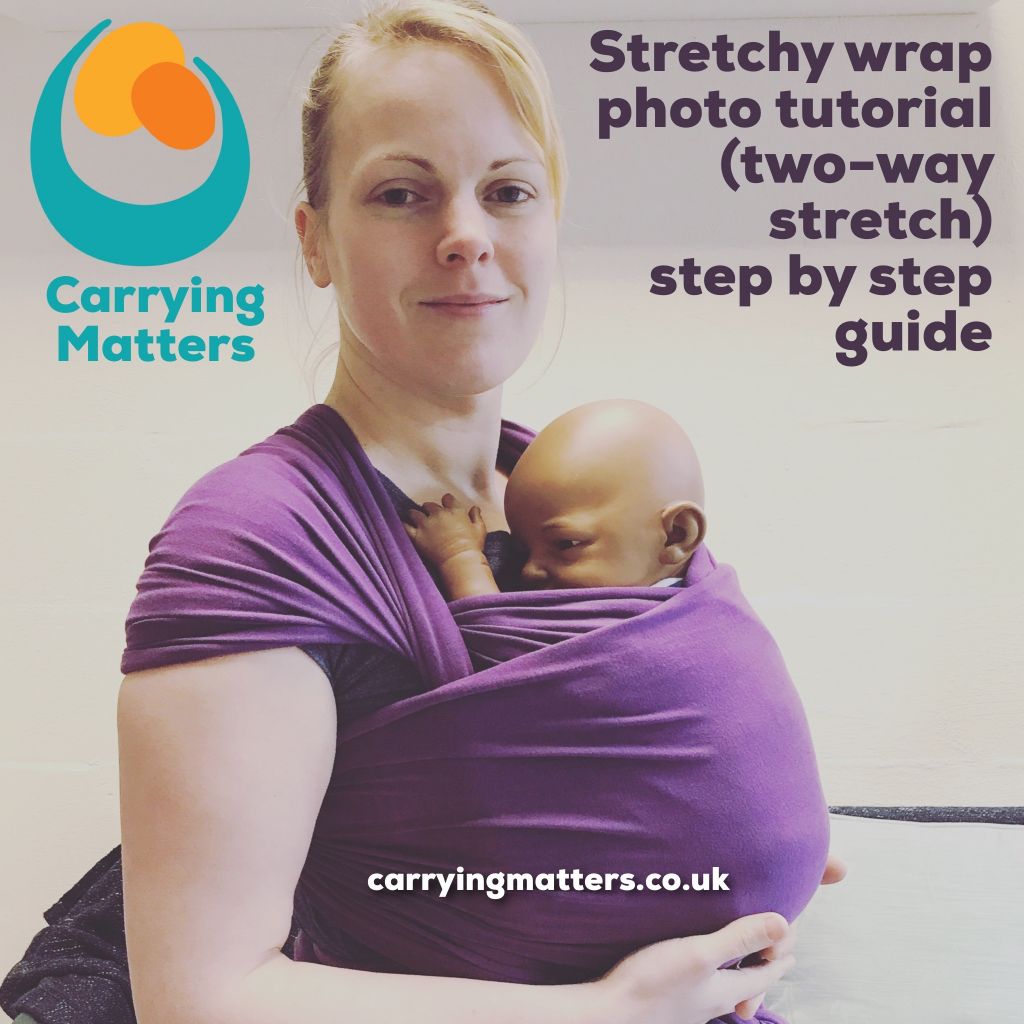
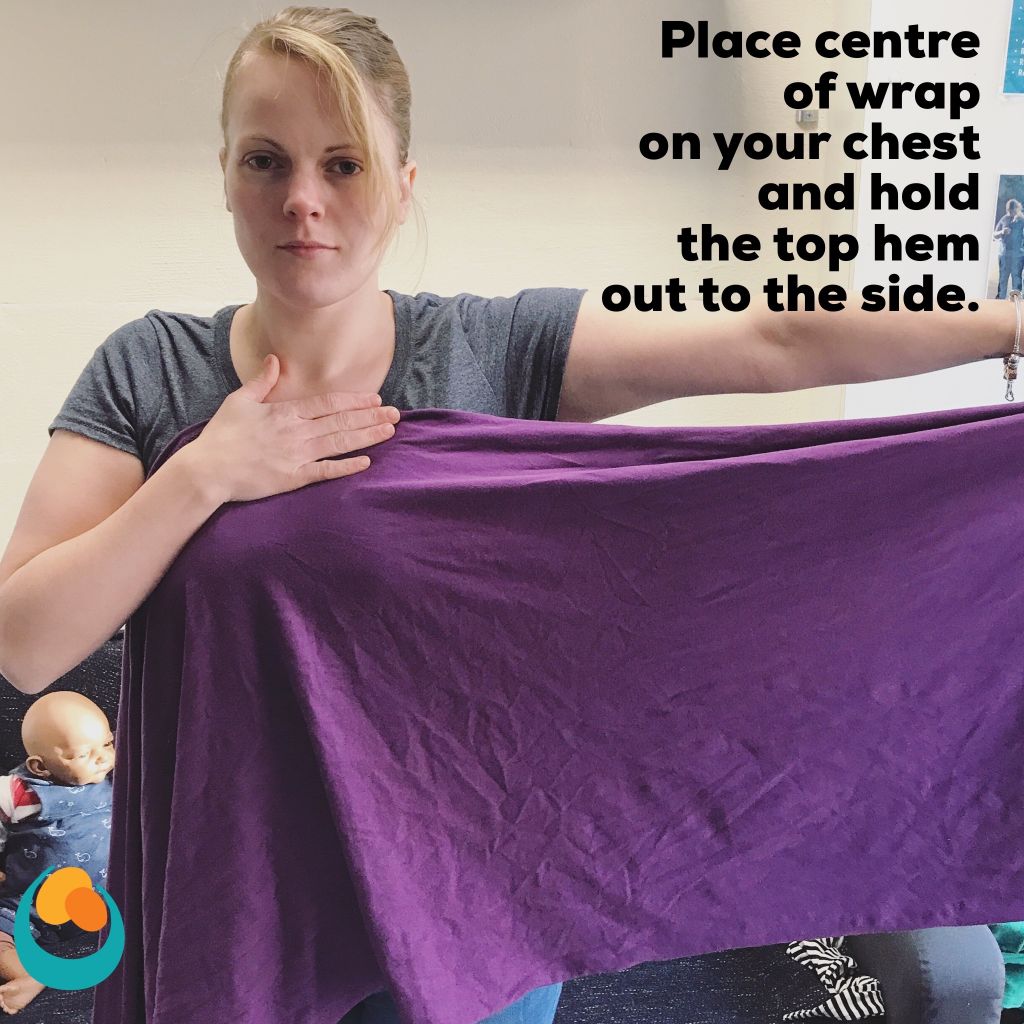
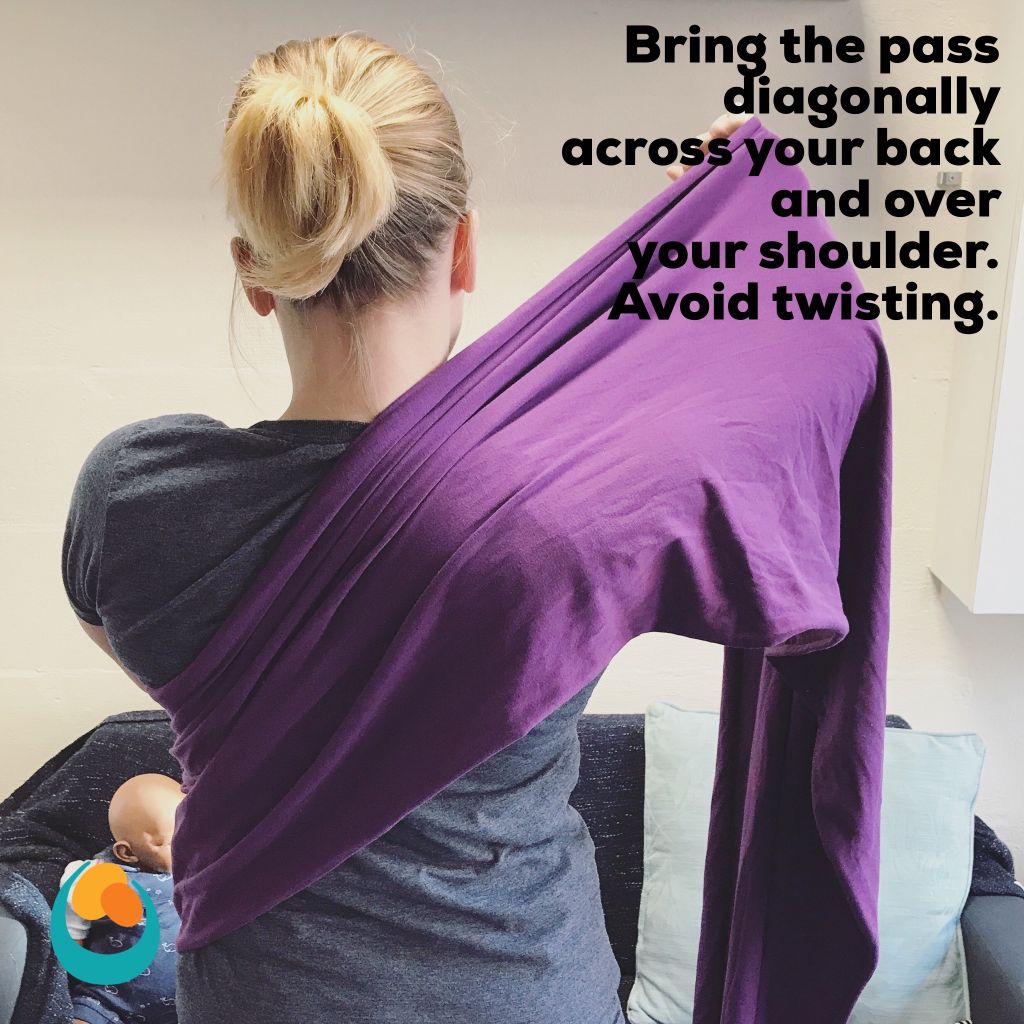
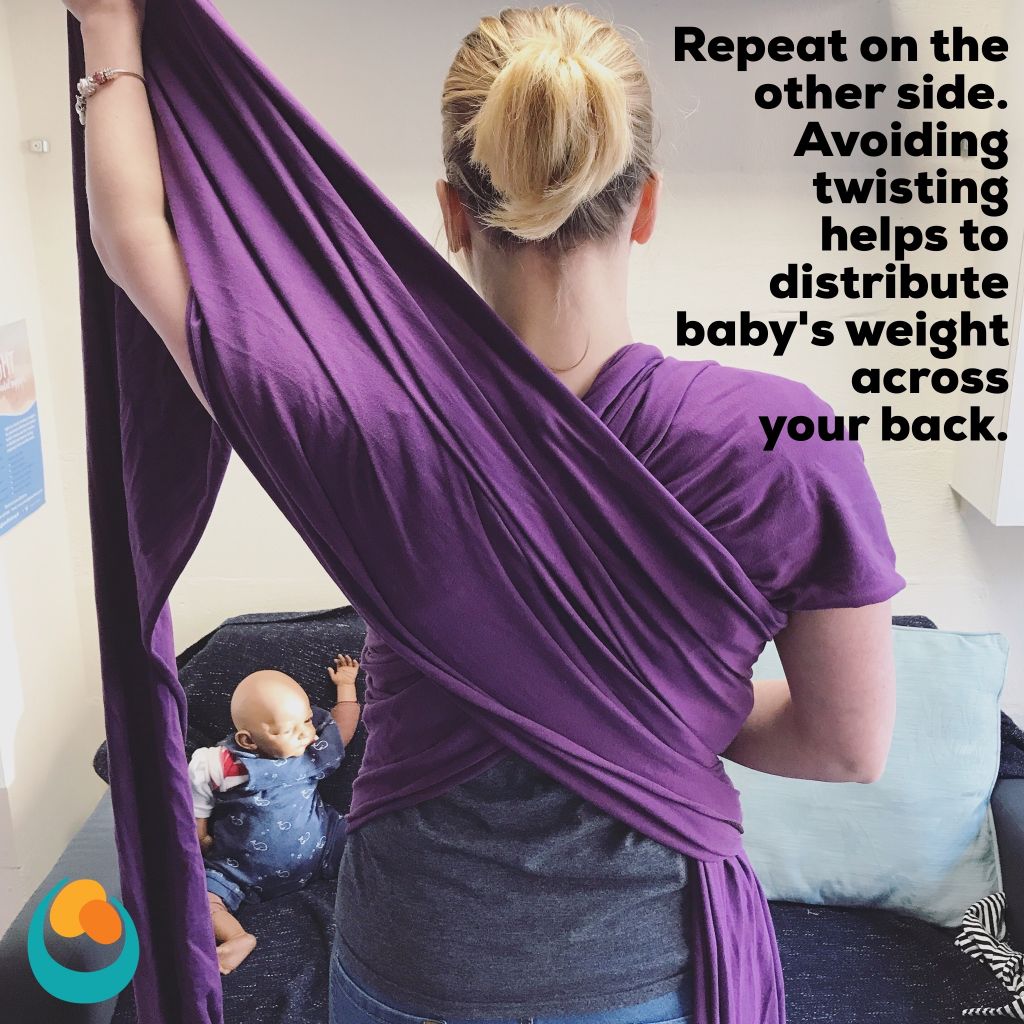
A step by step stretchy wrap photo tutorial guide; this is a two-way stretchy wrap. Two-way stretchy wraps stretch along their width and their length.
The key to success is in preparation; getting the tension right before baby goes in, and ensuring their position is right before spreading any fabric. Quick link to this tutorial here.
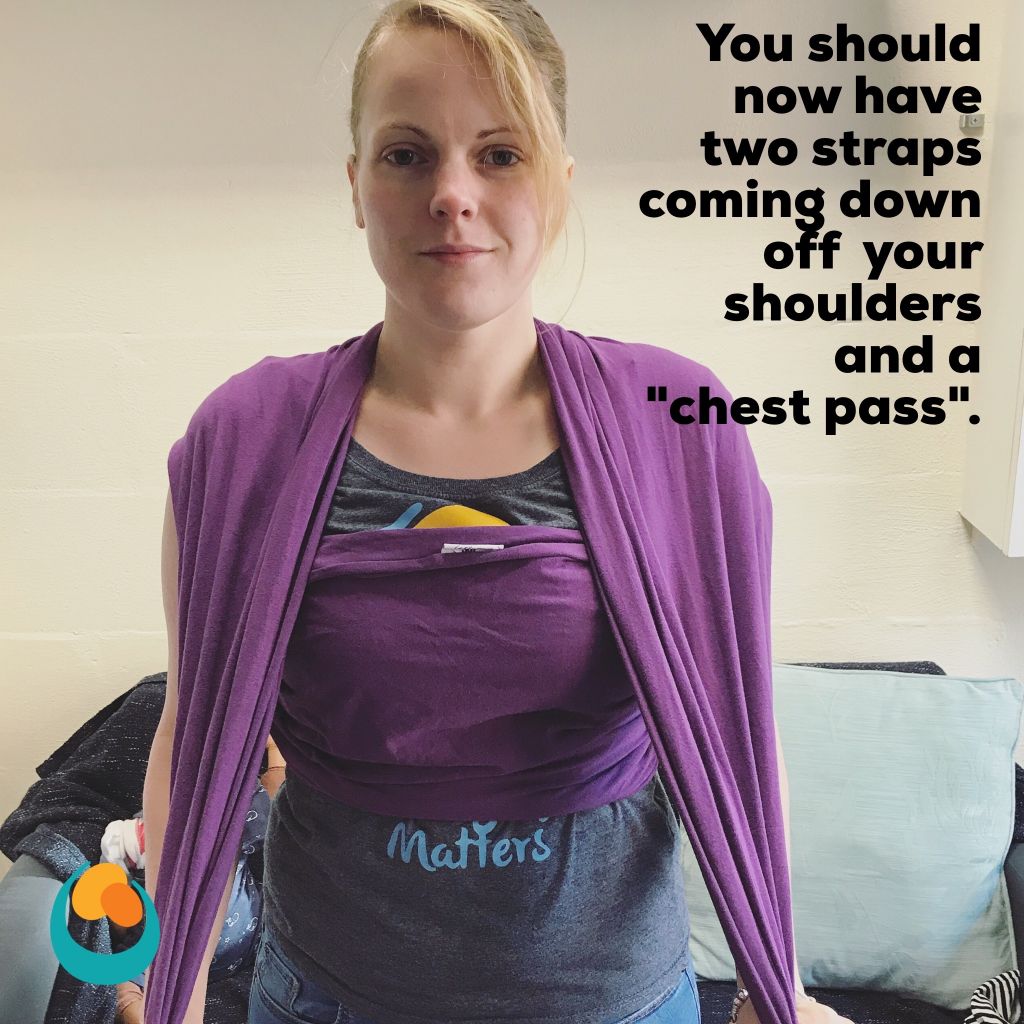
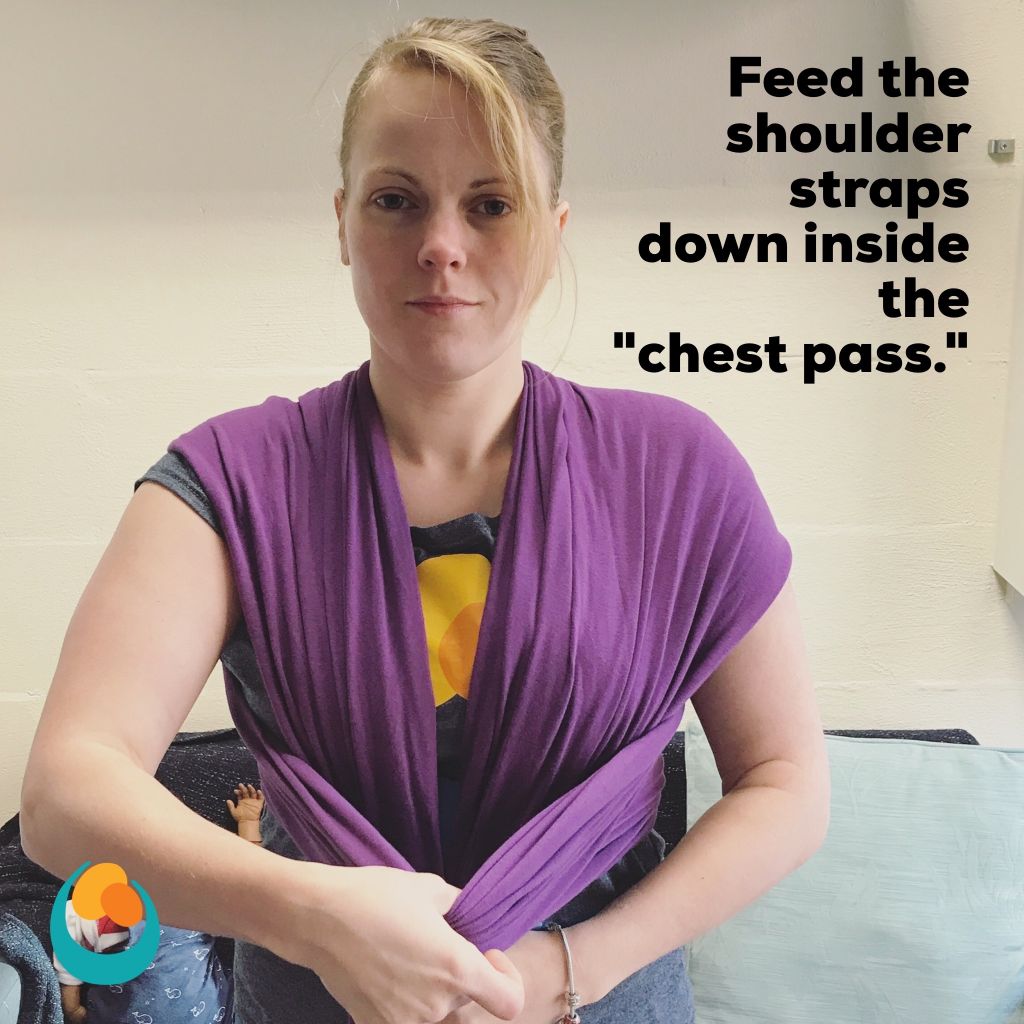
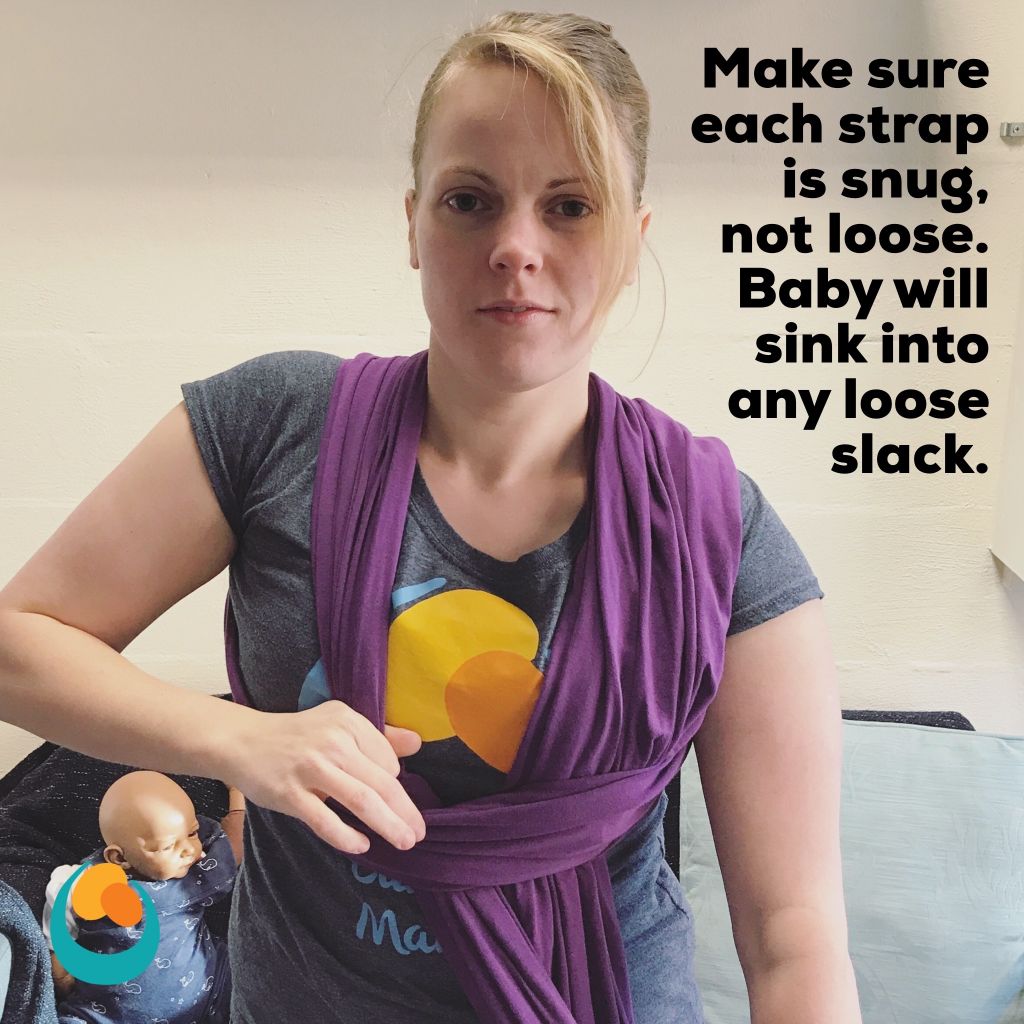
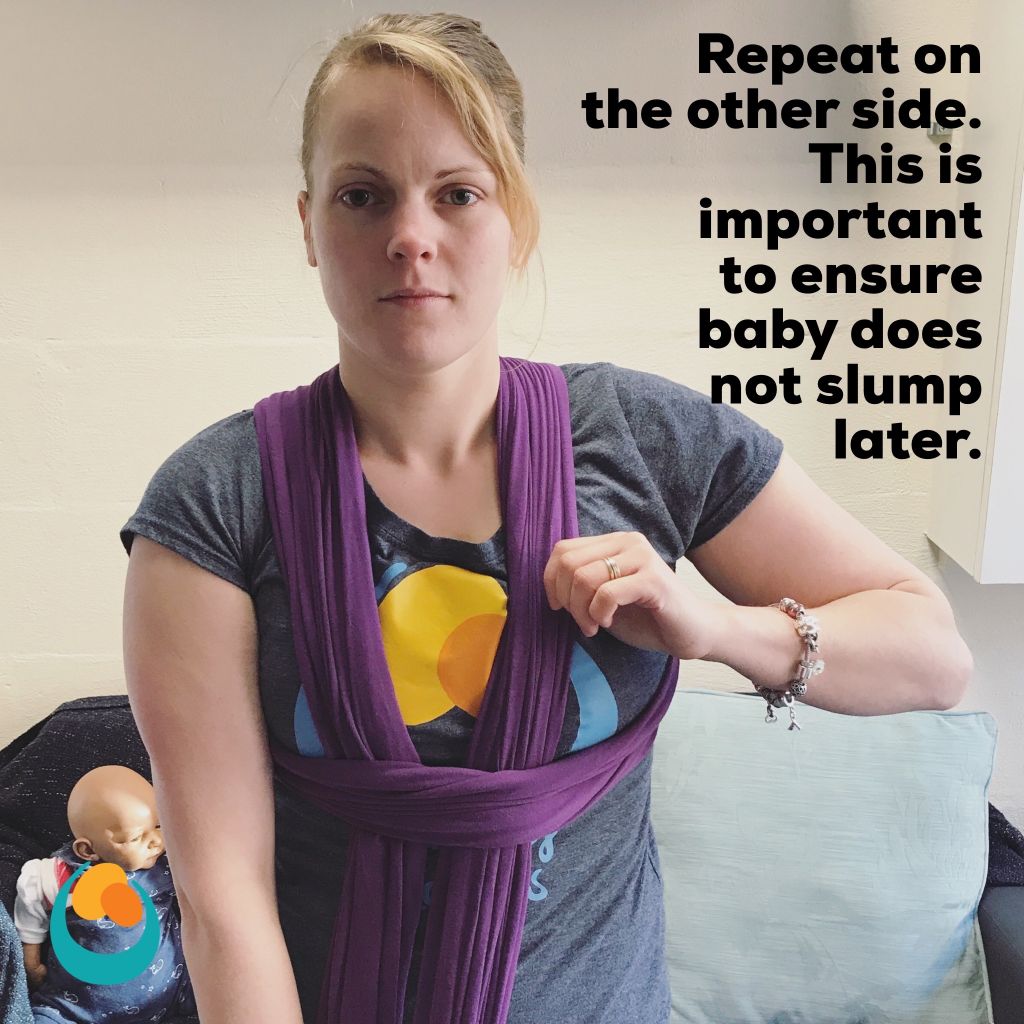
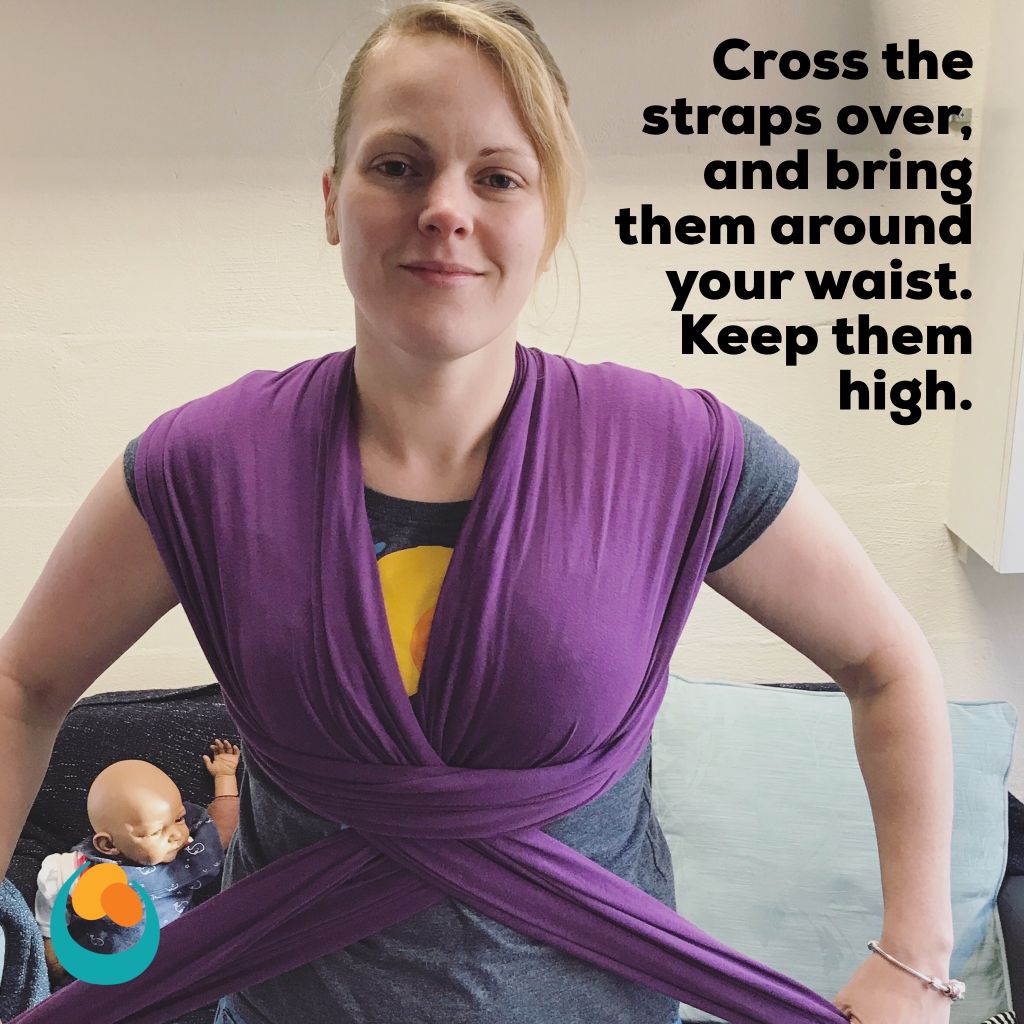
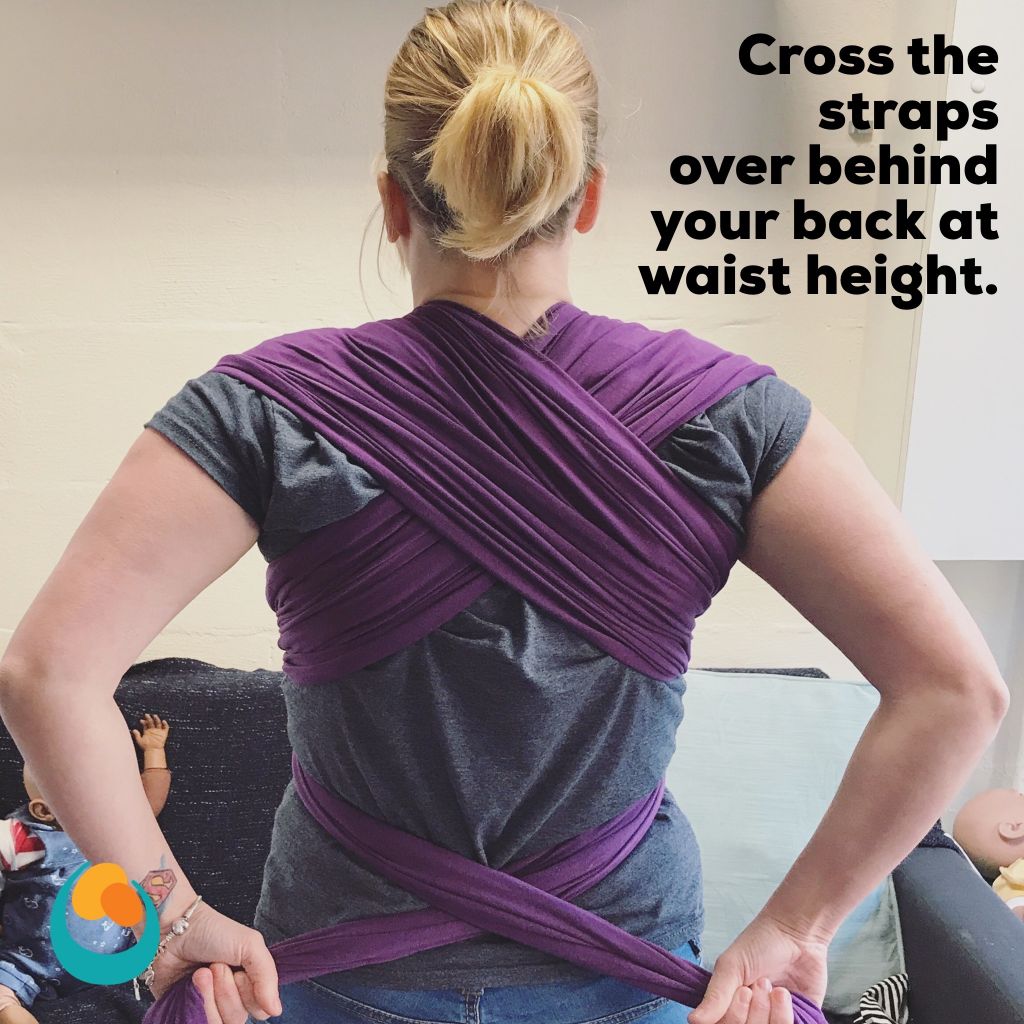
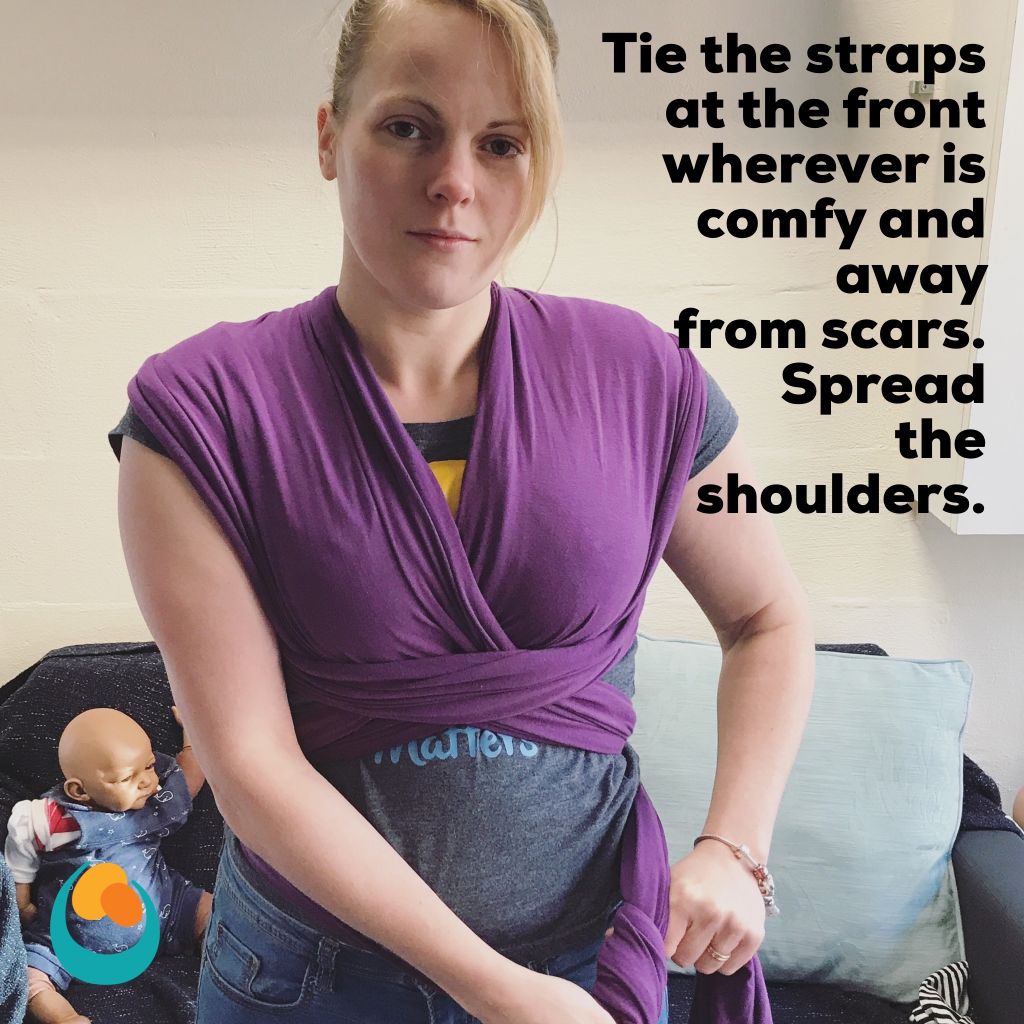
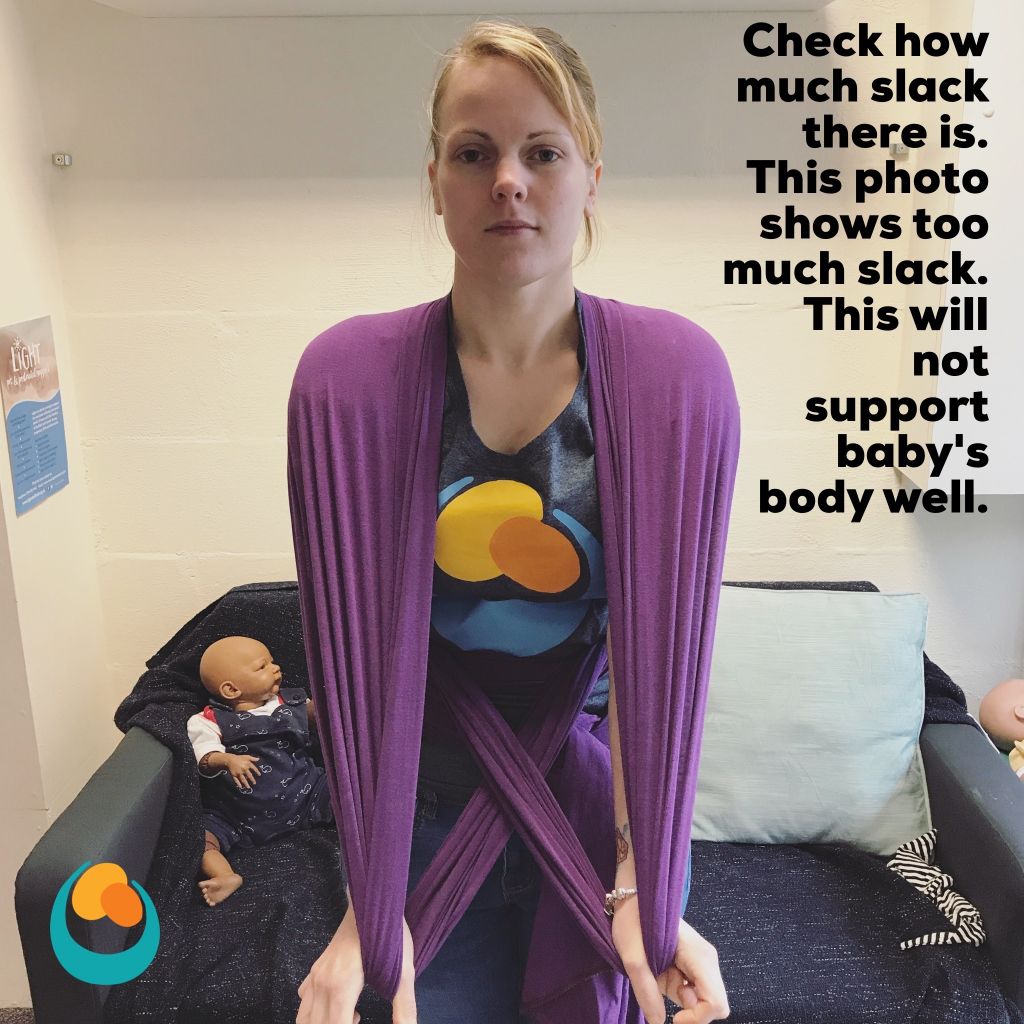
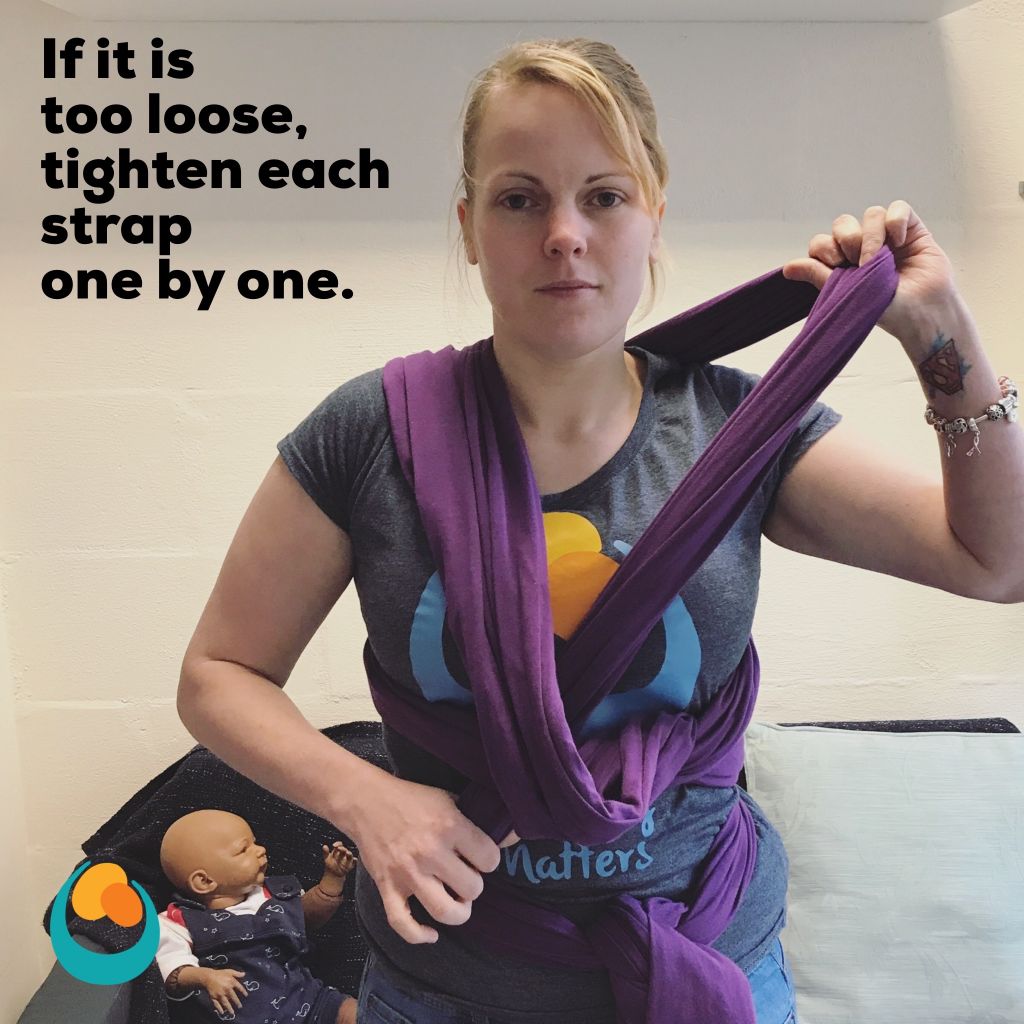
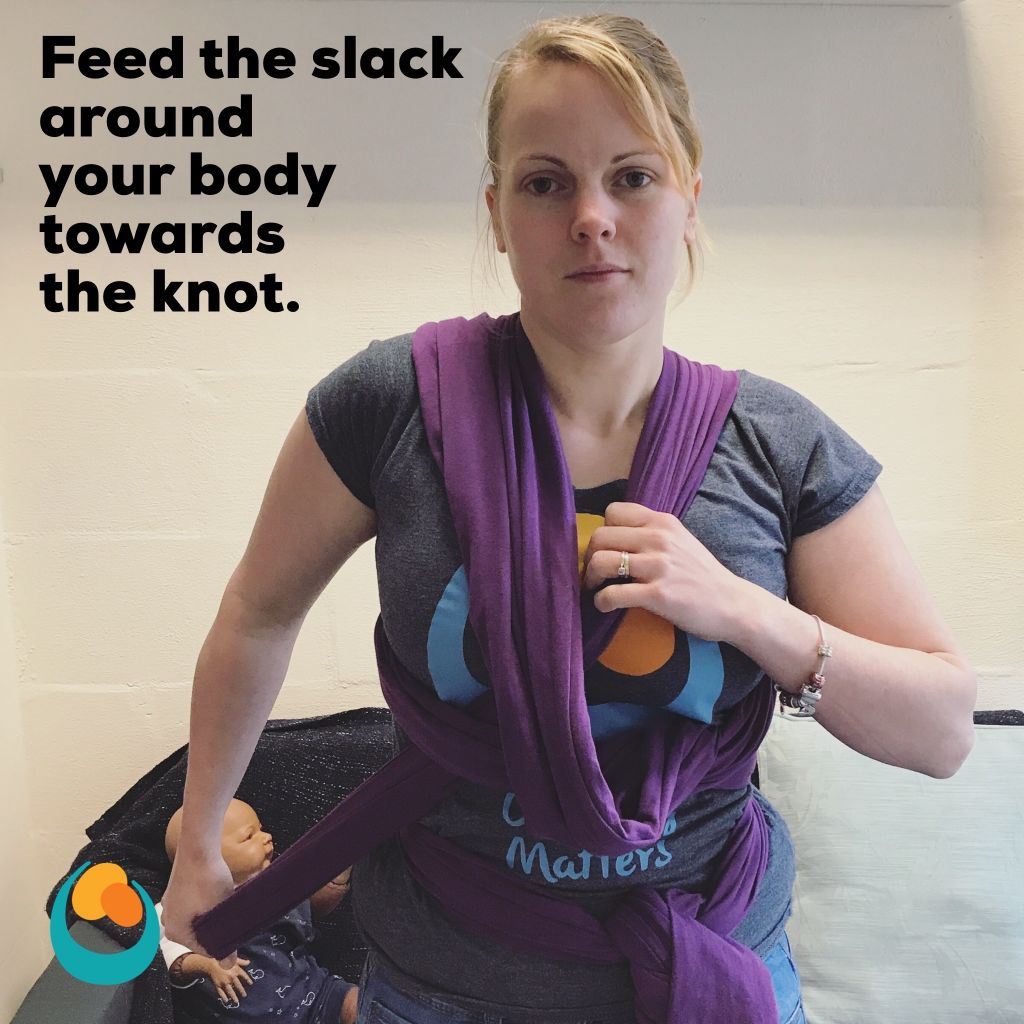
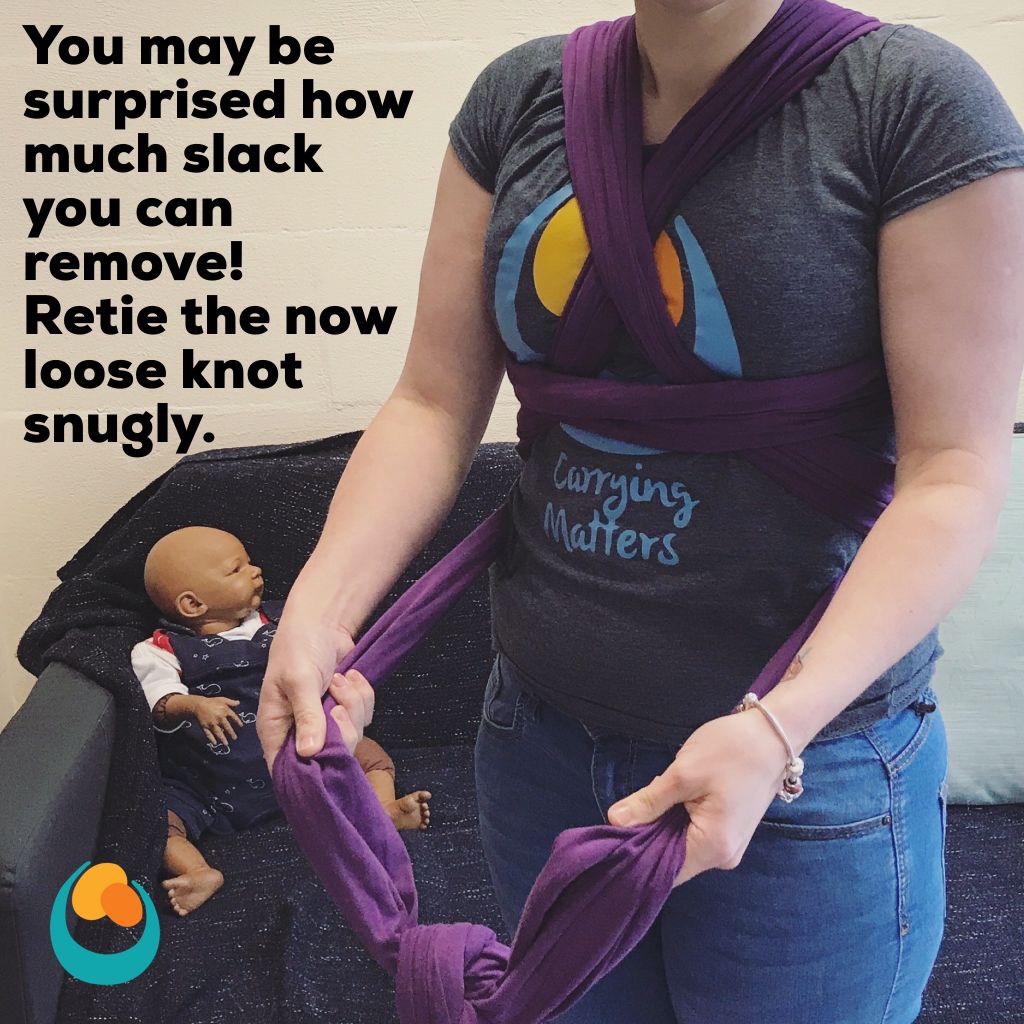
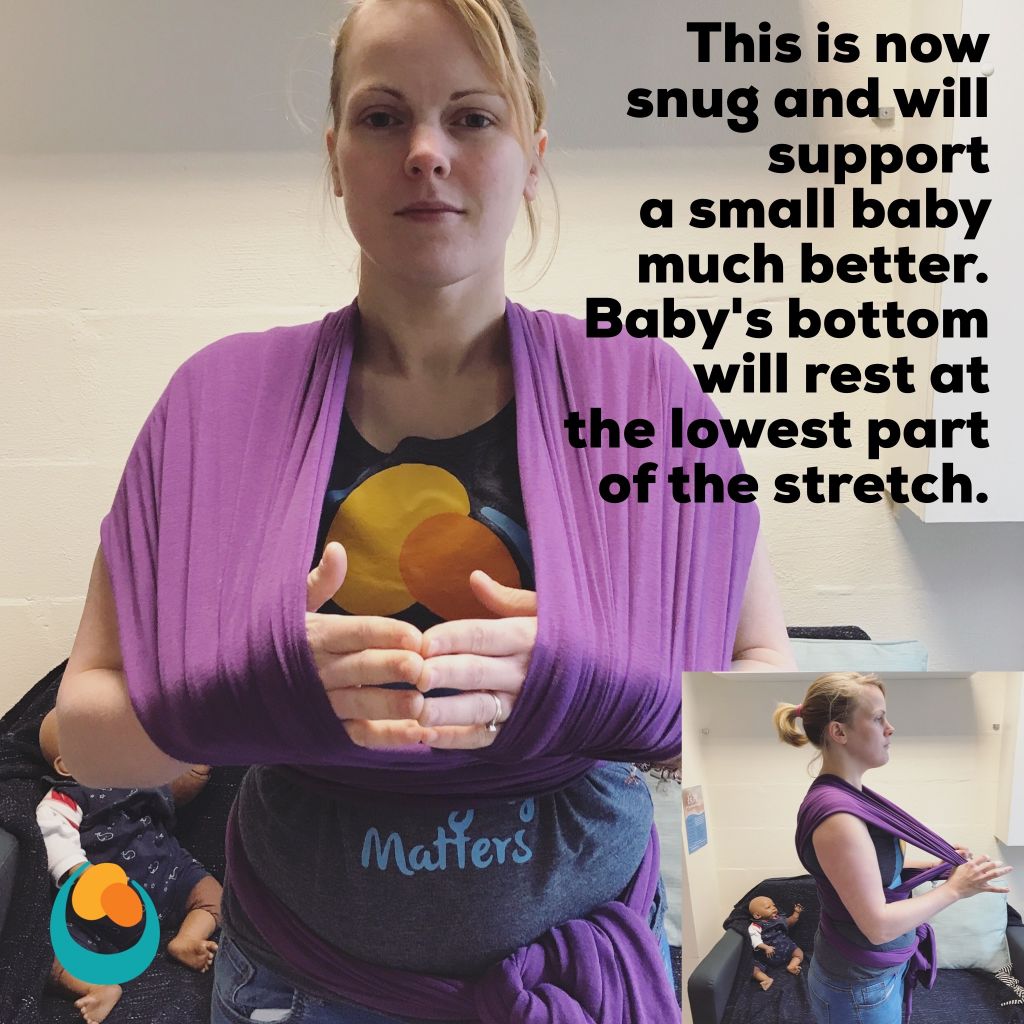
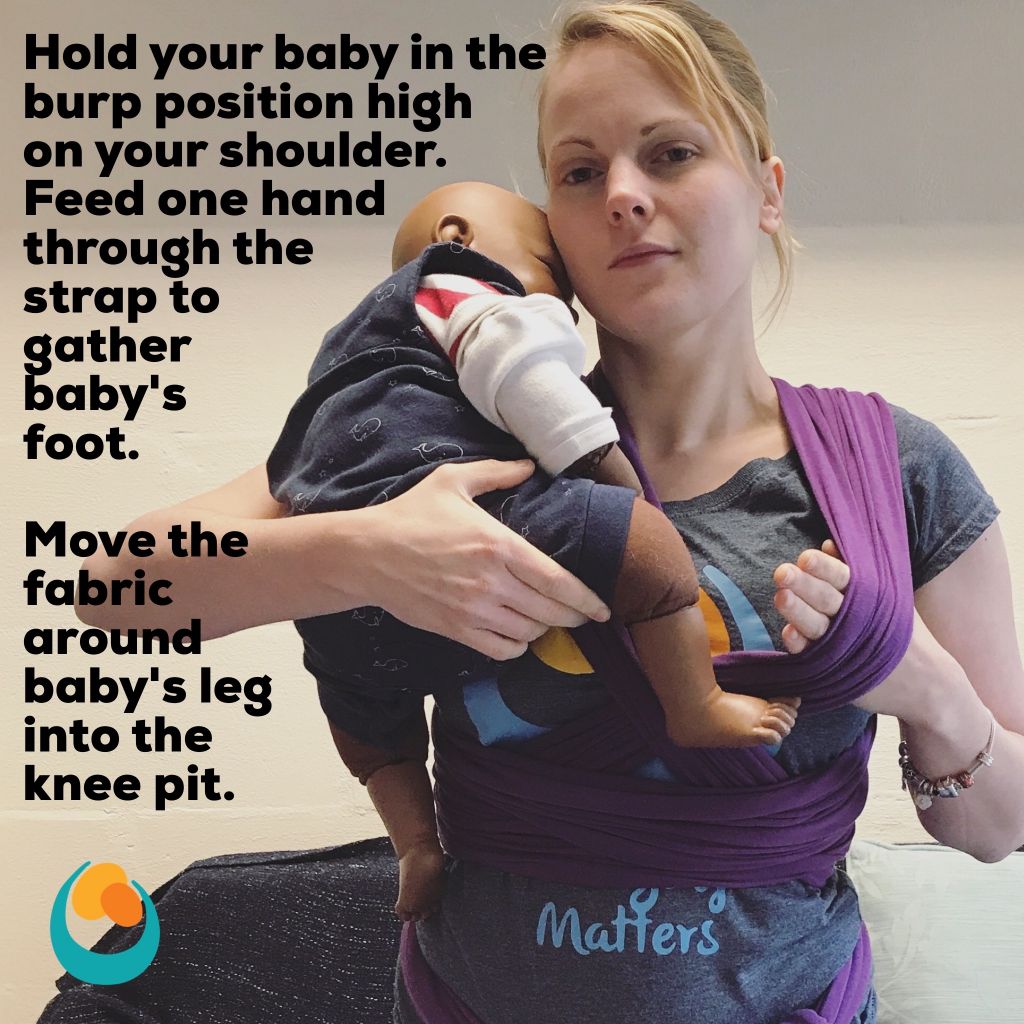
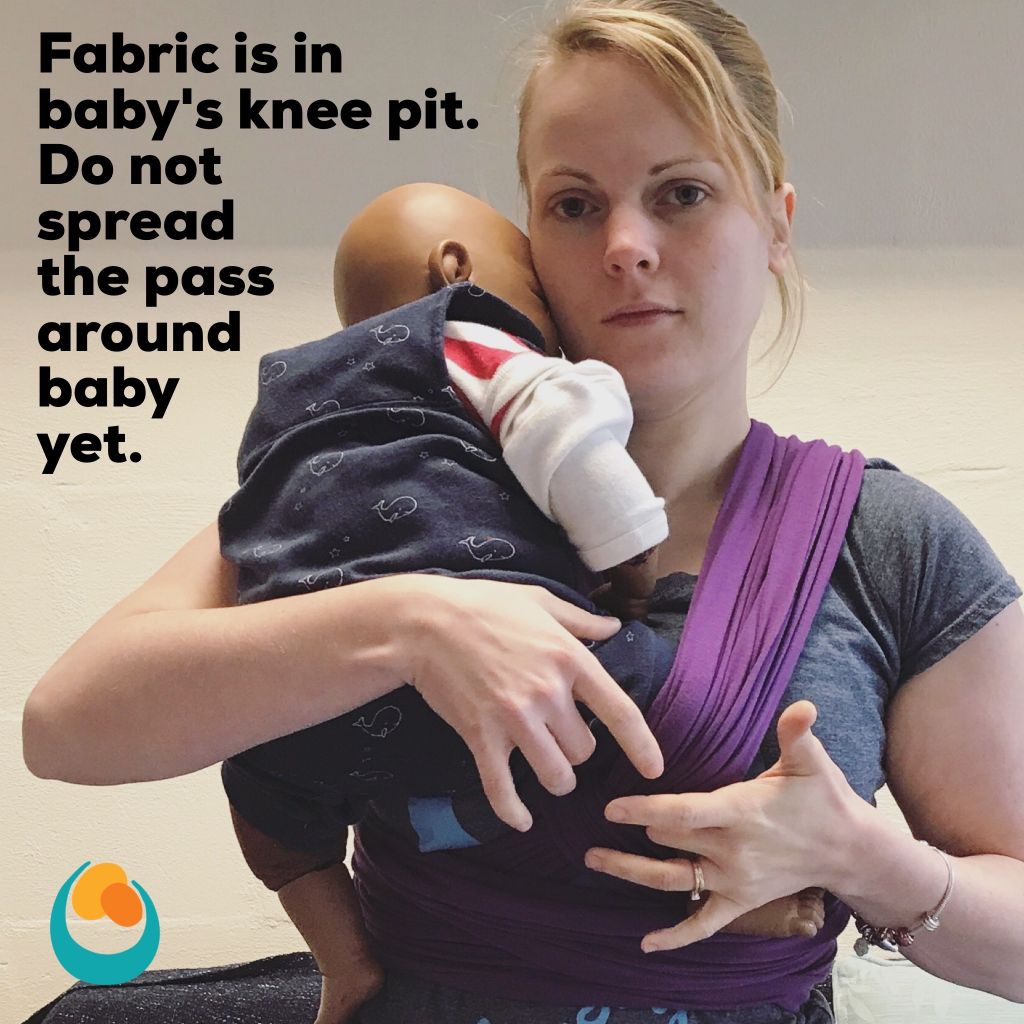
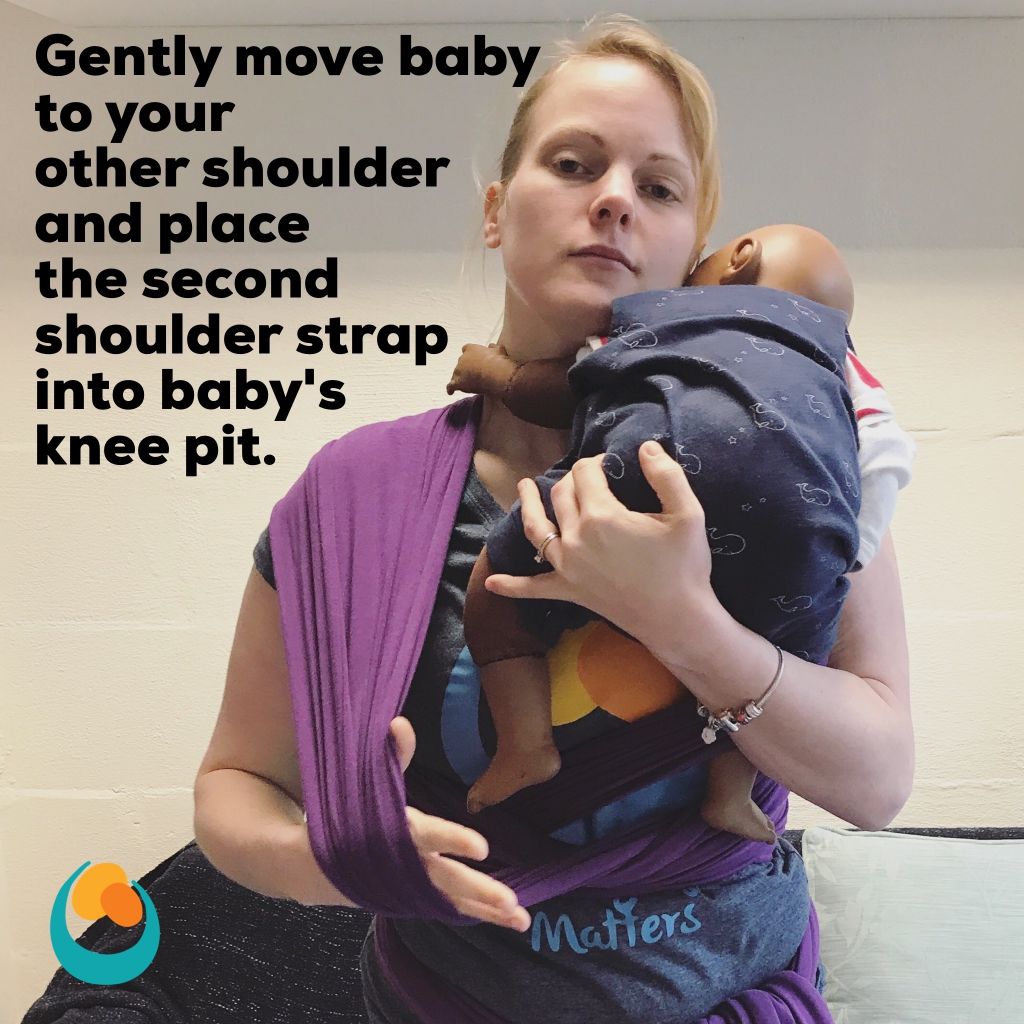
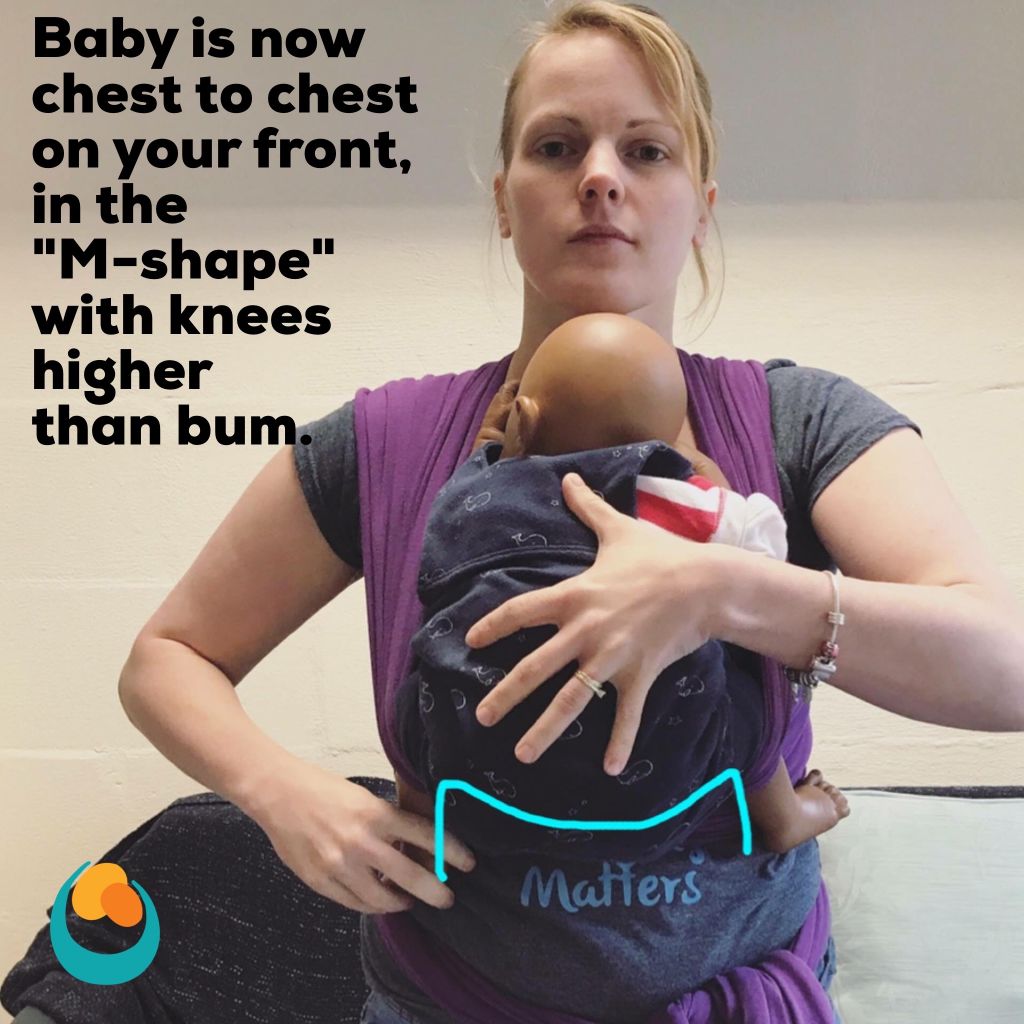
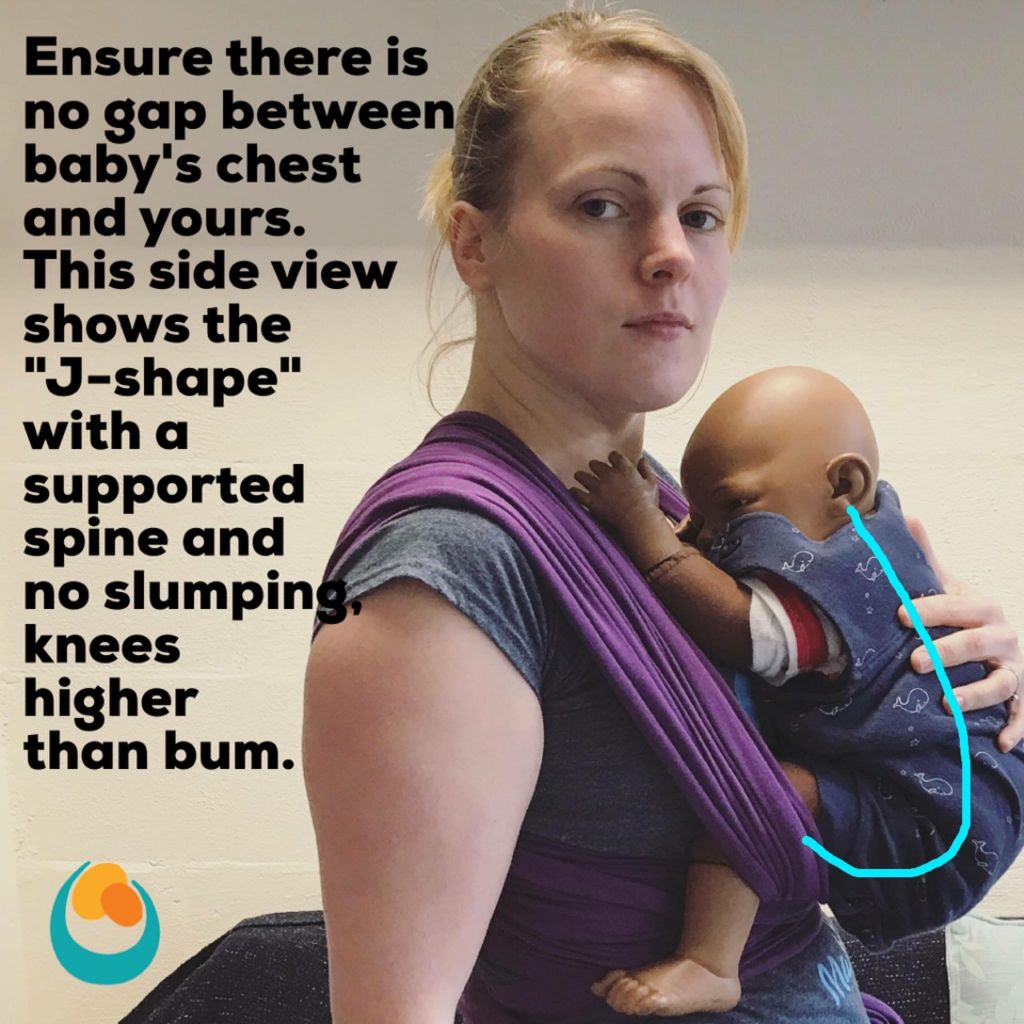
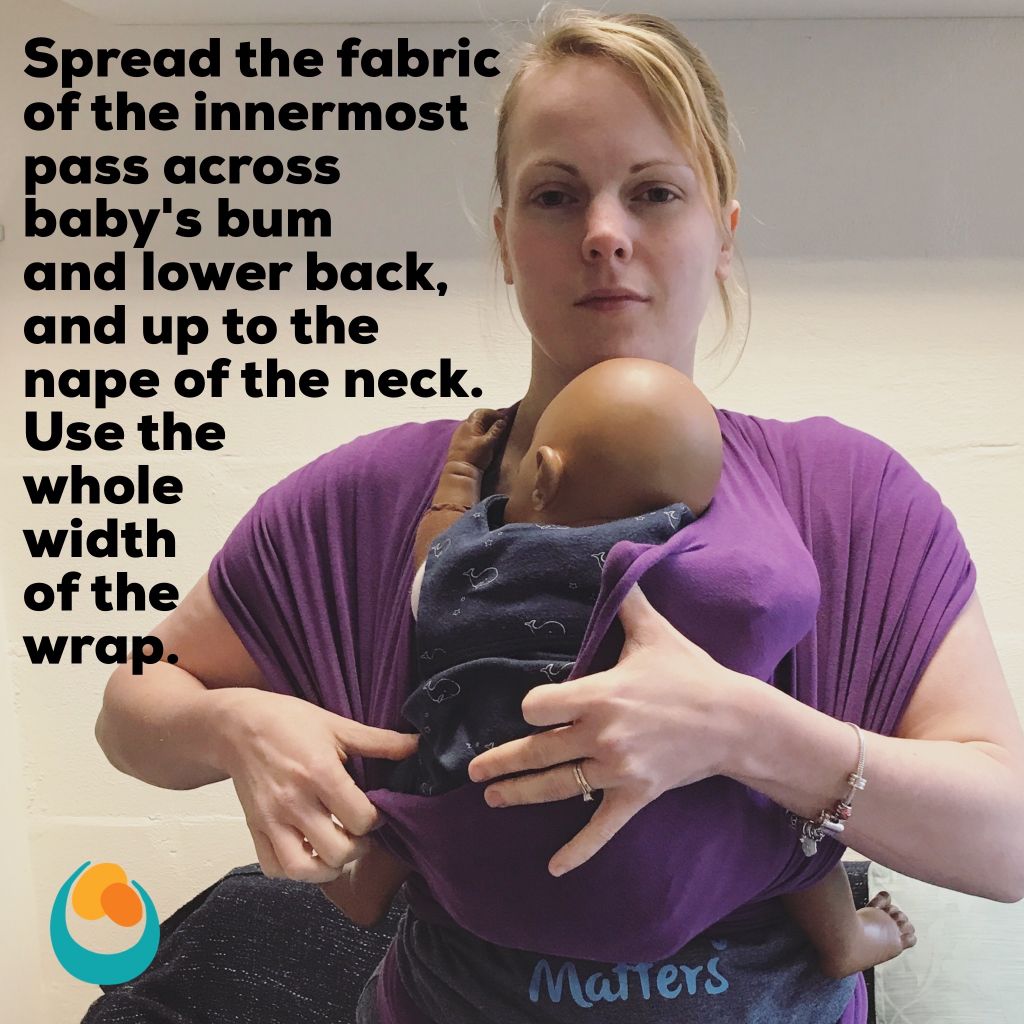
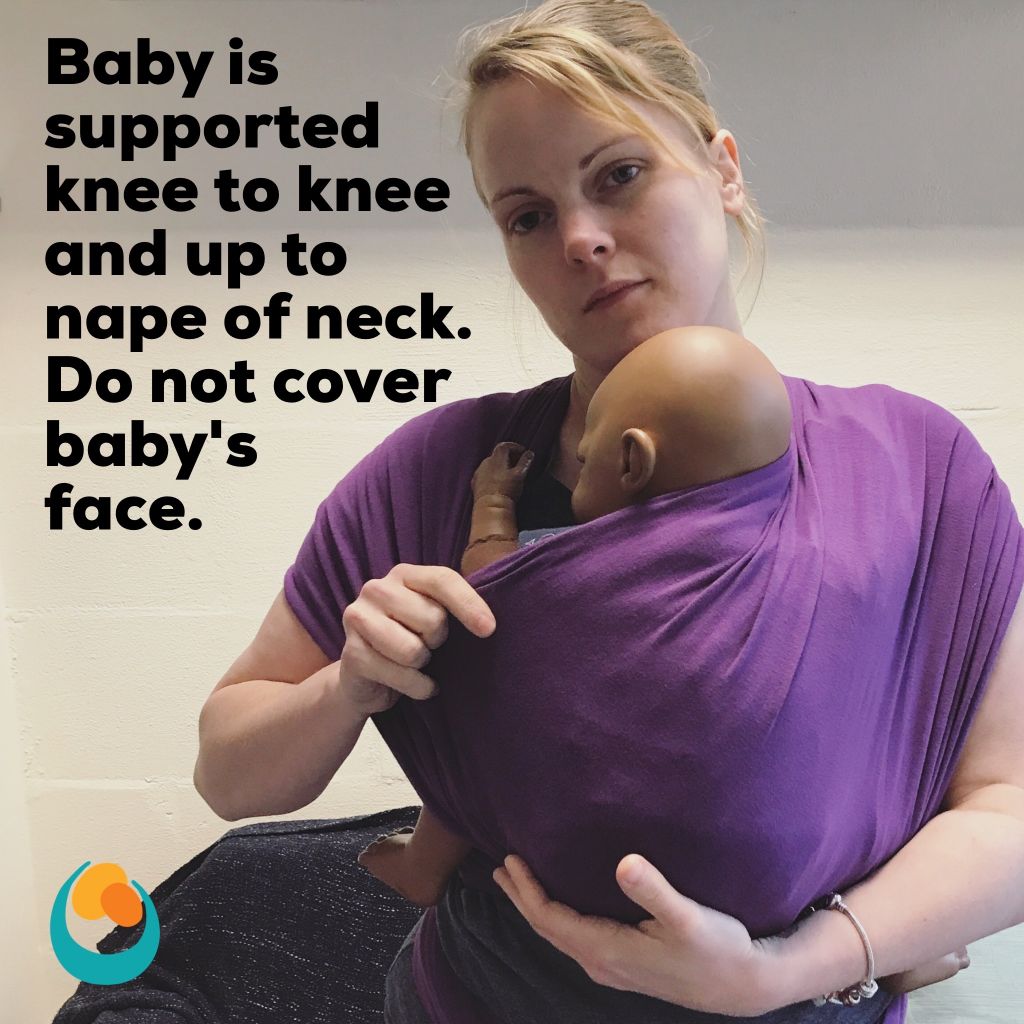
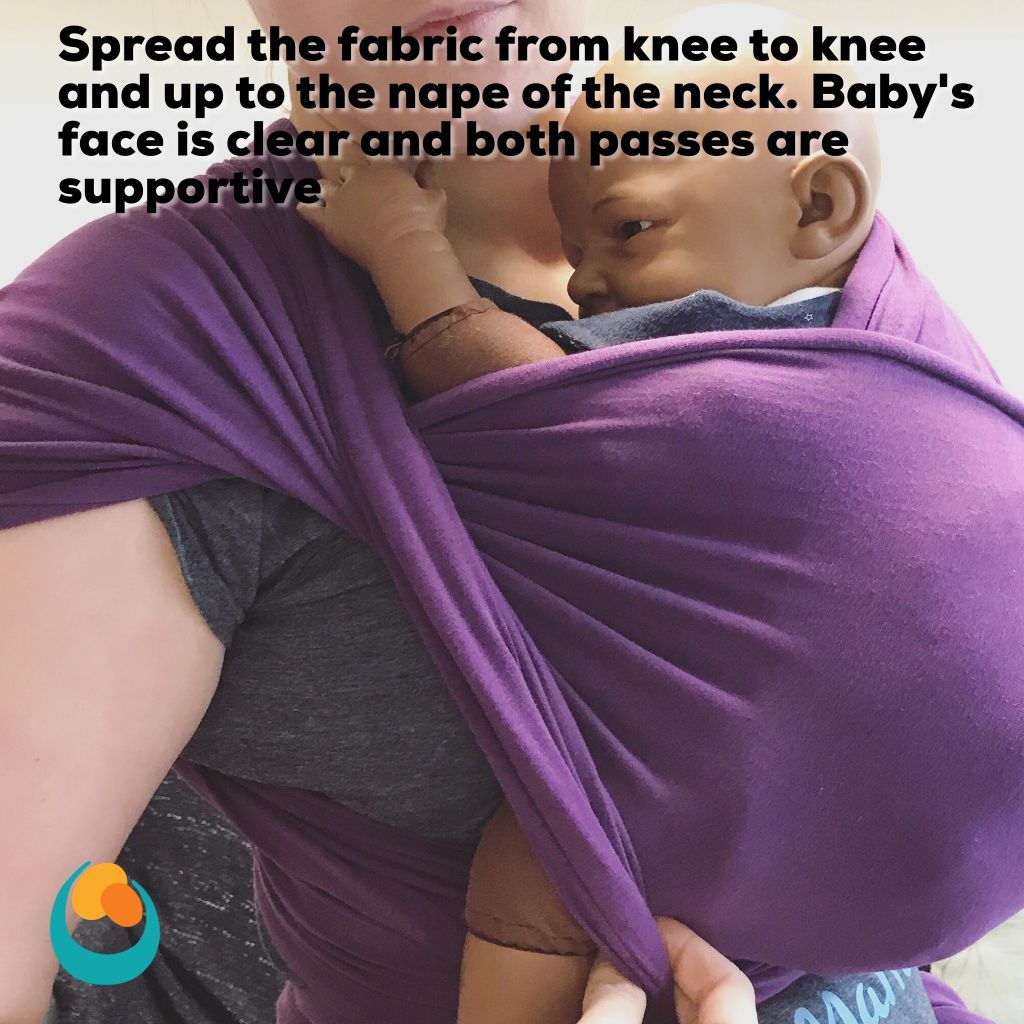
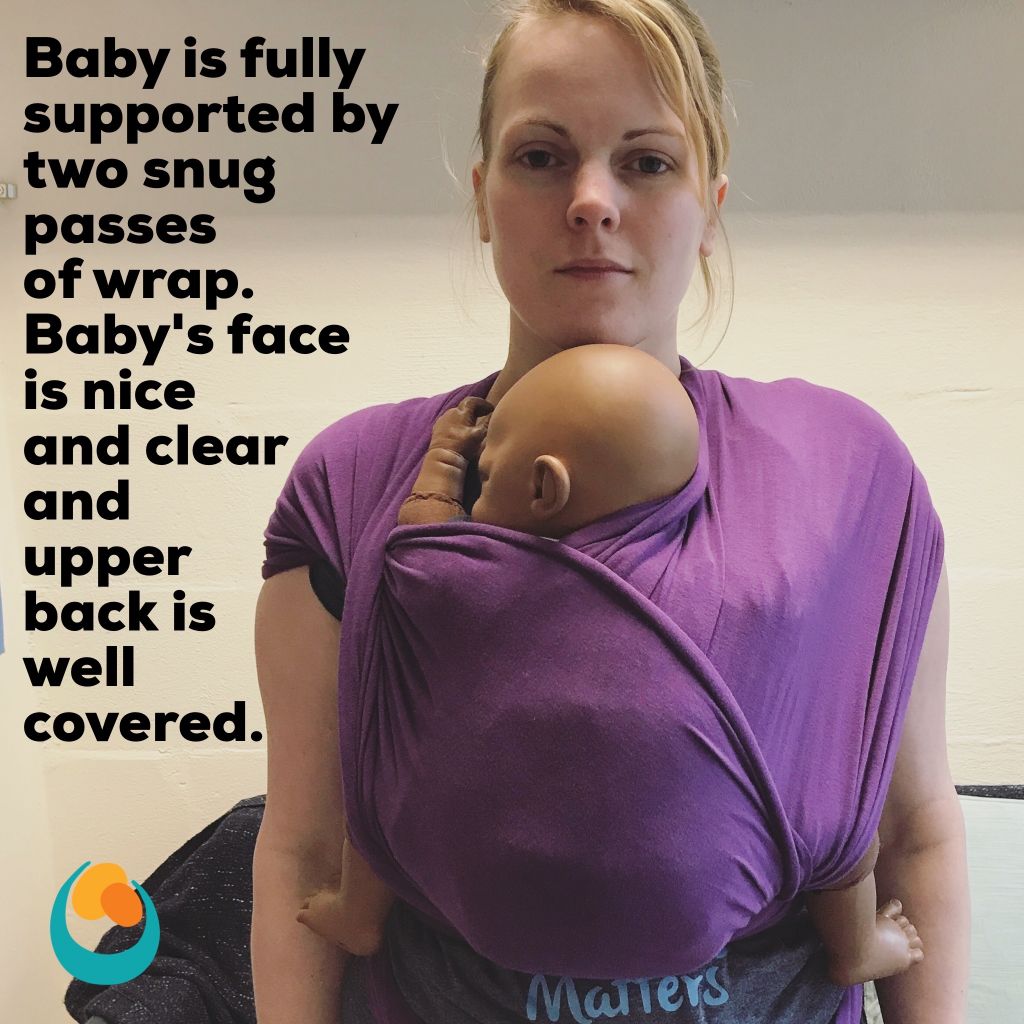
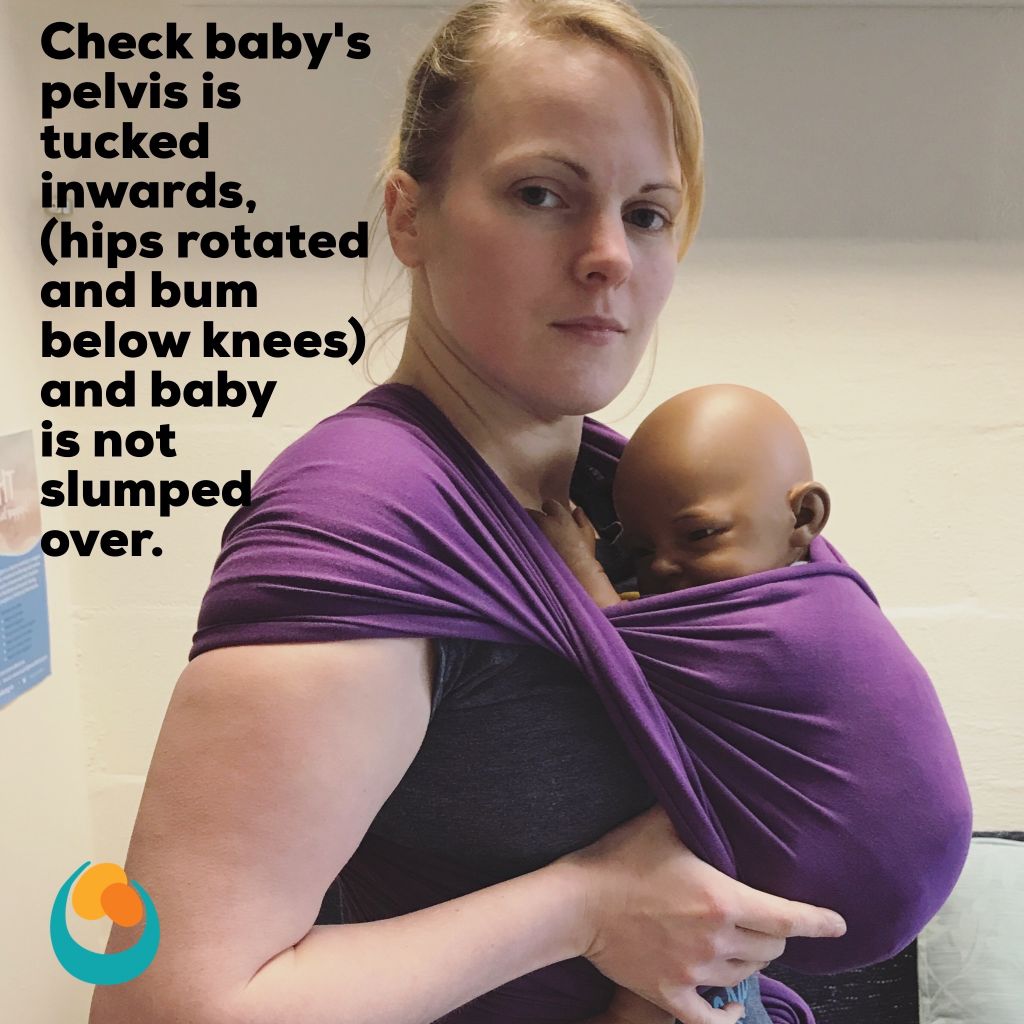
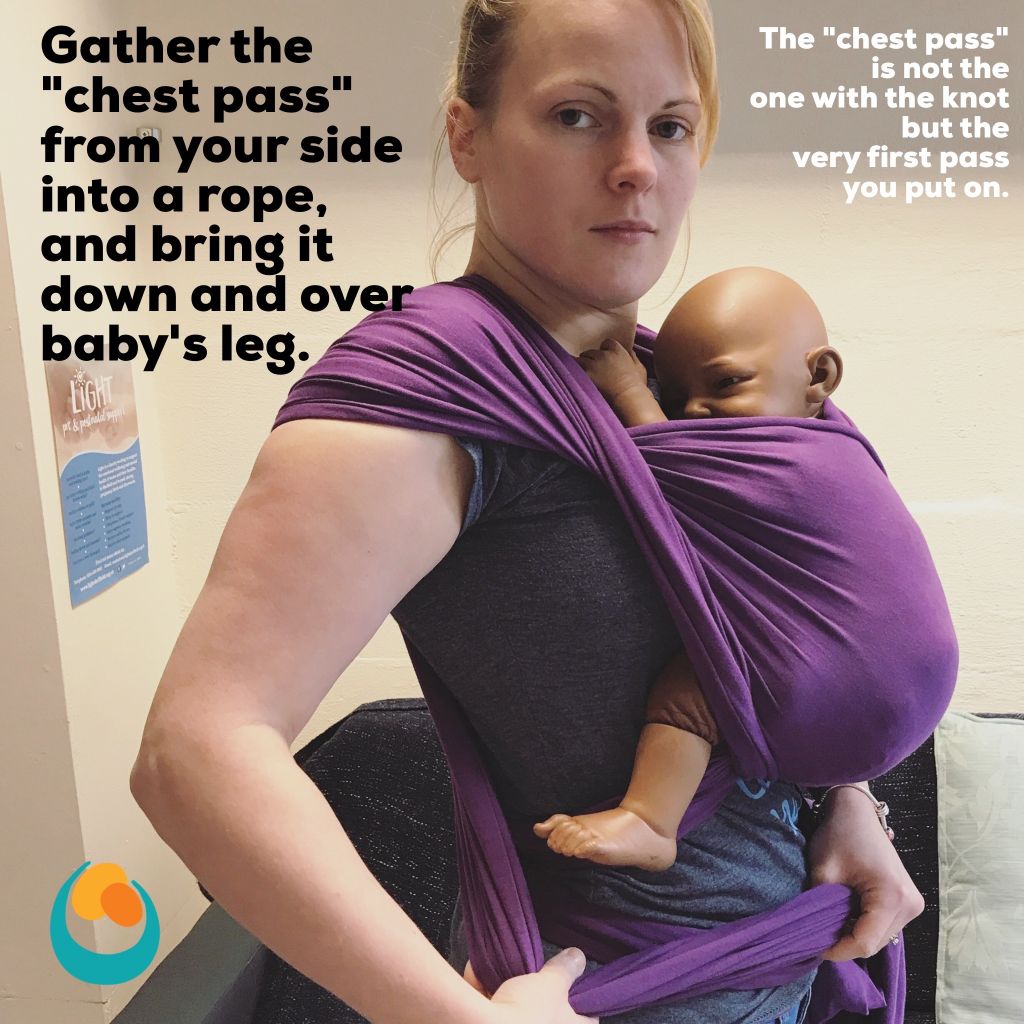
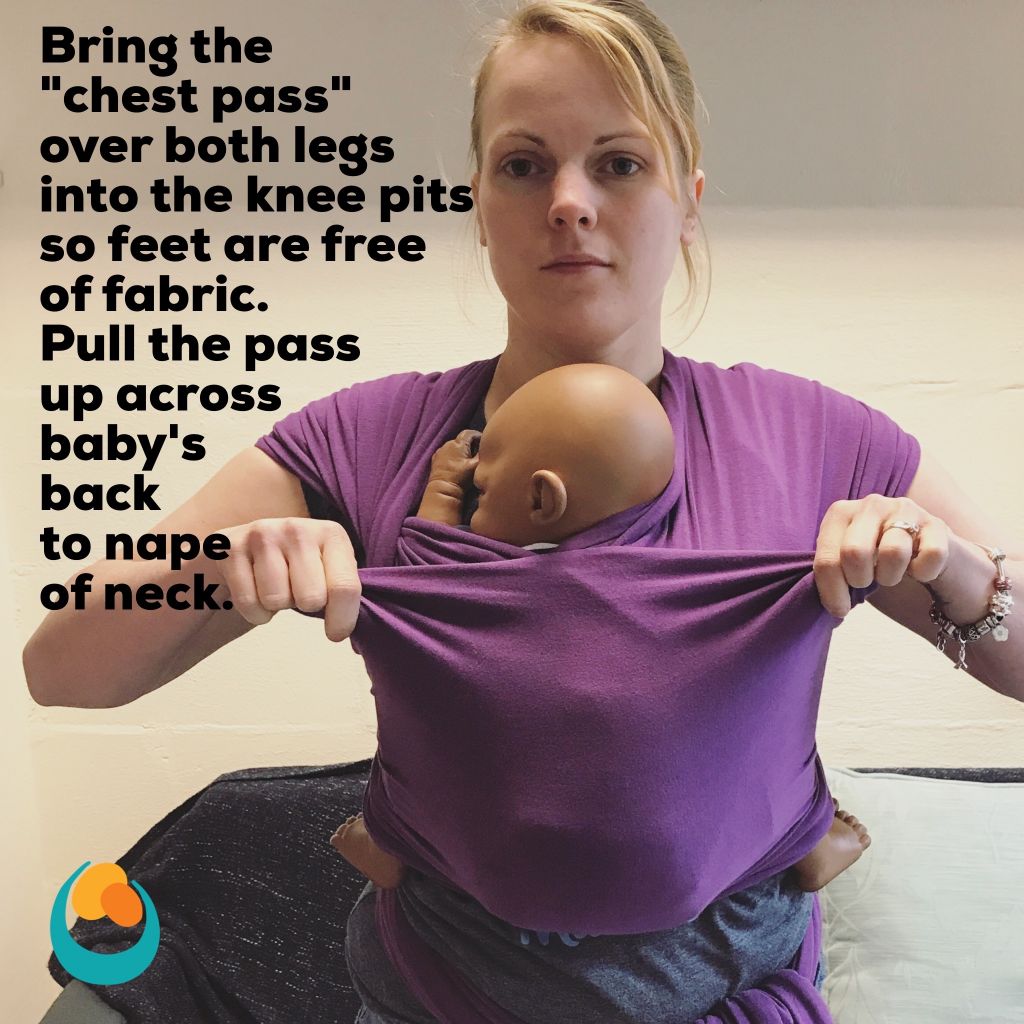
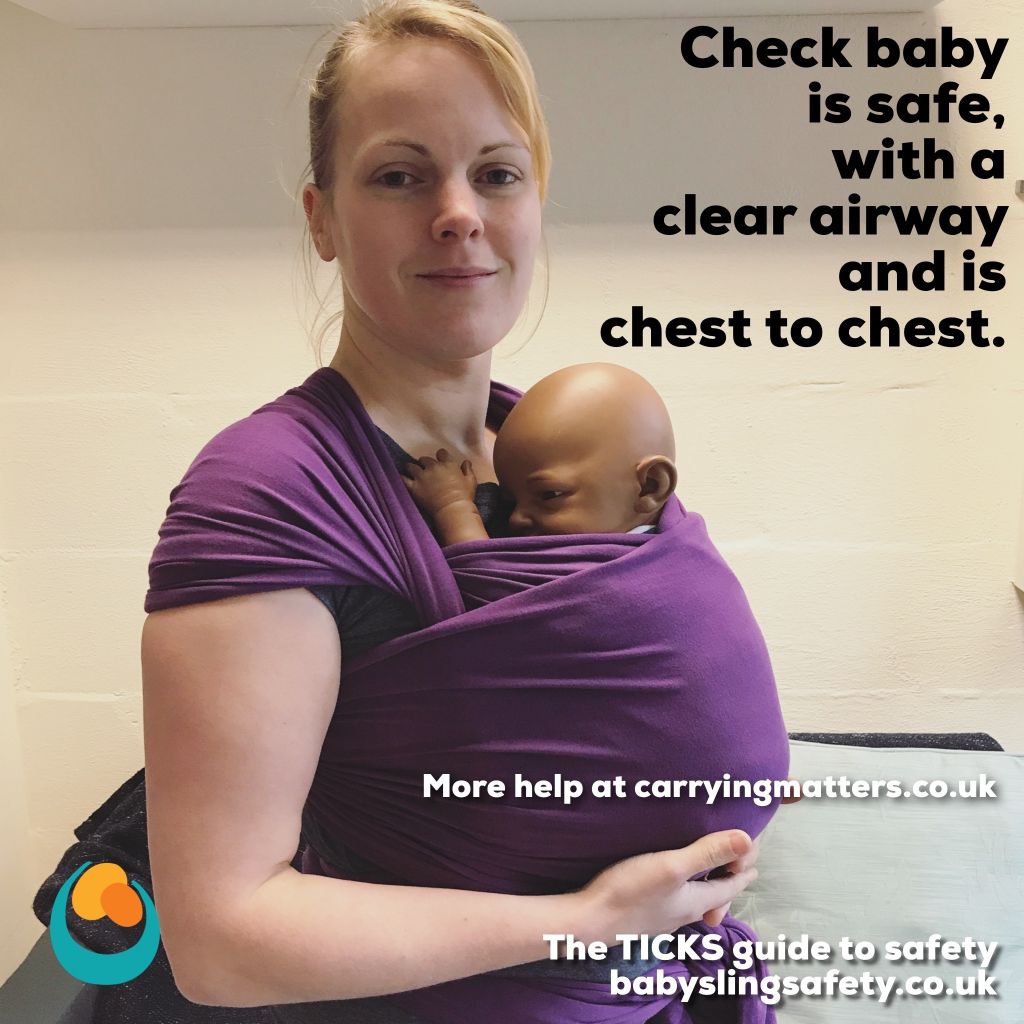
Video of the Pocket Wrap Cross Carry with a two way stretchy wrap (Hana, Boba, JPMBB), showing how to avoid slumping. This is the same technique as the photo tutorial.
A more detailed, slower video with doll can be seen on this YouTube link
How to take a baby out of a stretchy wrap without untying – this allows the wrap to stay on all day and baby can be popped in and out, rather than retying over and over again.
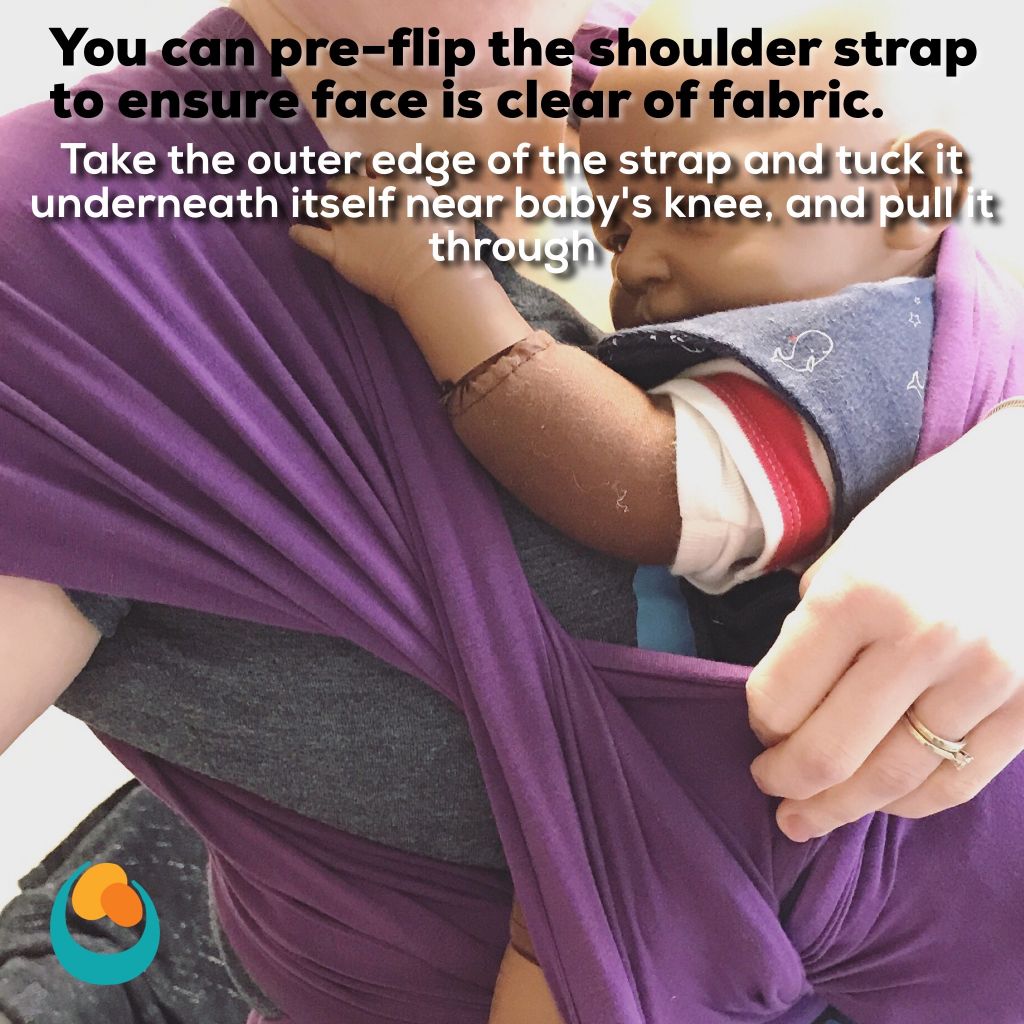
A short video for how to do the pre-flipped shoulder to keep fabric away from baby’s face. This is important to ensure there is no airway obstruction.
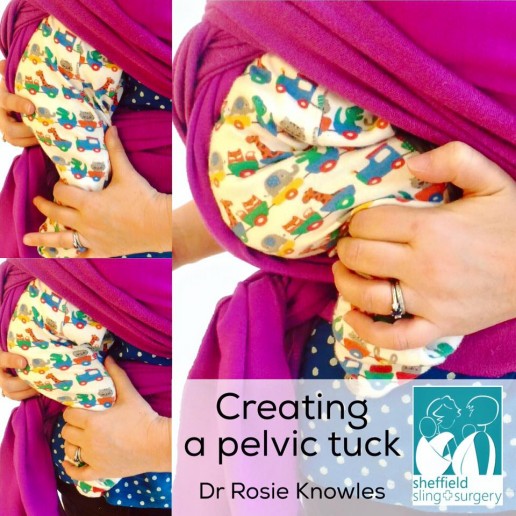
The pelvic tuck with stretchy wraps (and all carriers) is important, for baby’s airway support and also for comfort.
Passes in knee-pits and good M shape position
Top Tips!
- Make sure the fabric is snug. Slack fabric leads to slumping later. Take time to make sure all the passes are tight and when stretched out, are no looser than the volume of your baby's body.
- It will be much easier if you hold your baby in the secure M and J shape positions onto your chest before you put the carrier on.
- Put both baby's legs into each cross pass and ensure he is sitting down with the passes in his kneepits, and then straighten him up and check his position. His ribcage should be snug against your chest and his chin up.
- Then spread each pass one by one, kneepit to kneepit (this avoids sideways slump).
- Ensure there is no fabric over your baby's face; fold the fabric out of the way, ensuring each pass still comes up to the neck.
- Pull up the third pass to the back of baby's neck. Some people will fold the top edge over a rolled up muslin to provide a little extra neck support for active babies.
- You should feel like you can lean forwards (with one hand on baby's head) and baby should not swing free.
Post-natal stretchy use
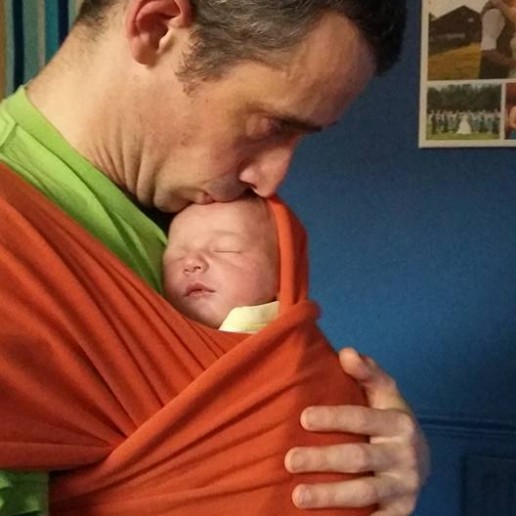
Dads use stretchies too
Common Queries about Stretchies
Breastfeeding in Stretchies
It’s possible to breastfeed in a stretchy, once feeding is well established and you are confident with your use of the sling. The video below shows you how you can use your stretchy as an aid for feeding without needing to unwrap each time. Please note that baby’s head is not covered by fabric and her neck is supported throughout. When baby has finished feeding, she must be returned to her safe upright position and not left to sleep in the horizontal position.
No breastfeeding is hands free, and it is usually a good idea to get some help and advice from people who are familiar with how to do it.
Can I face my baby outwards with the stretchy?
Forward facing out in a stretchy is not recommended for several reasons, even though some older instruction manuals show how to do it. Newer companies do not have this carry in their instructions. Why not?
- No head support can be created in this position, and babies have heavy heads in proportion to their bodies. A sleepy head lolling forwards may compress the airway and impede breathing, just as the cradle carry may do.
- A baby facing out has no support for the hips and legs (see this article for more)
- The spine is artificially straightened in the forward facing out position when it should be curved.
- Babies do not have the ability to “zone out” from all the conflicting sensory streams that comes from being held facing out. They need to be able to switch off and rest against a reassuring parent; this is hard to achieve facing out.
Read more here about facing out carriers; this can work well with older children.
How long will I be able to use my stretchy wrap?
That depends on the stretchy. Many people find that as babies get bigger and want to be able to see the world around them, they can find the all-over cuddle of the wrap a little restrictive for seeing. At this point, opening the shoulders out can help with visibility, but do keep a hand near any wobbly heads. Stretchies are great for older babies who are sad or uncomfortable and want a cuddle, or are ready for a sleep.
Most people will find the stretchy wrap works very well for the first six to nine months of age (a few will last into toddlerhood), and is just the start of a happy babywearing journey as their baby grows bigger. At this point, parents may begin to consider other carriers that have a wider vantage point. Some will allow more open shoulder strap angles, some will allow hip carrying, (such as ring slings or the Scootababy) and back carrying may not be far off!
Troubleshooting your Stretchy Wrap
- Feeling too tight? Baby should be close enough to kiss, able to rest his head on your upper chest just under your chin. You should feel able to take a deep breath without feeling constricted (one hand's breadth between your baby's ribcage and your chest.) Any looser and baby may begin to slump. You can often lower your baby by putting your hands inside the carrier under her bum and bringing her down a little. Many stretchy wraps will have a little give in them and as you walk, baby is likely to settle down a little lower naturally.
- Too loose or too low? Your stretchy is likely not tight enough; retie or see the video for how to tighten.
- Baby slumping to one side? This can be avoided by putting baby's legs into each cross pass in turn, just into the knee pits, and ensuring he is positioned right before you then spread each pass.
- Baby seems to be too curled up or folded inside the stretchy? This is likely due to the fabric not being snug enough, see the video for how to "unfurl" a slumping baby to keep their chest cavity well supported.
- Baby's face buried in fabric? Ensure stretchy is snug (looseness leads to slumping over. You can fold or flip the shoulder passes (see photo below) for airflow and visibility, and use the other side as a hood if tolerated.
- Baby wants to lean back and look at you? You can use a rolled up muslin folded into the top section to provide some neck support.
Unfurling a slumped baby
Stretchy too loose or too low and don’t want to re-wrap? Here is how to tighten it up to get baby back into a safe position.
Folded shoulders for airflow and a hood
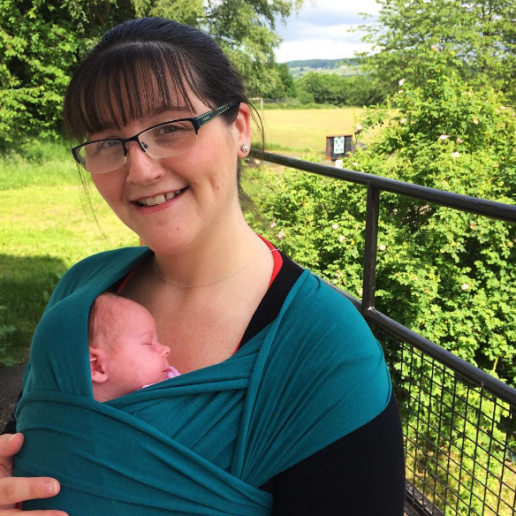
A rolled muslin forming a neck support
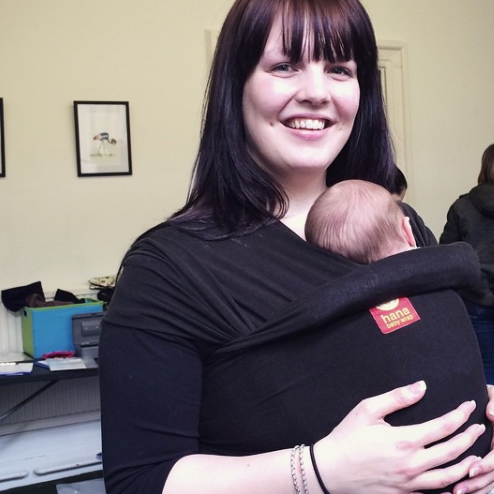
More videos (for one way stretchy wraps like the Moby) or the pocket double hammock carry for babies who prefer to be legs in can be found here on the videos page.
Carrying twins in a stretchy wrap
Many parents of twins will use a good, supportive stretchy wrap to carry their small twins, with one twin in each cross pass. It can take a little practice, do come and get some help!
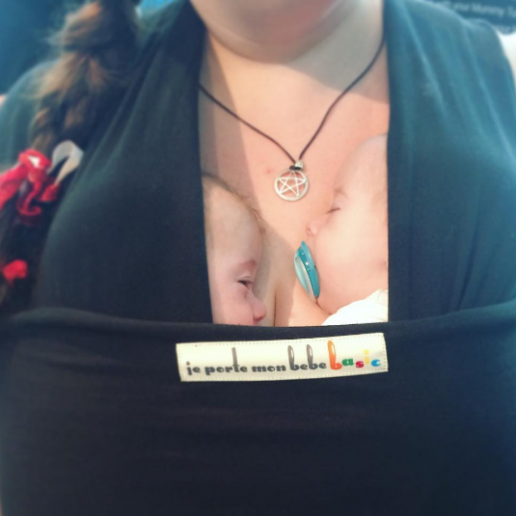
Putting twins in a stretchy wrap
There are many other ways to carry twins as they grow; get in touch with us to get some one to one help or visit our twin support group Peas in a Pod with one of our peer supporters for some simple advice and guidance.
Close Caboo Carrier
This is a semi-structured carrier made of one-way stretchy fabric that has the two cross passes sewn into position, and is tightened once baby is in by pulling any excess fabric through two rings at the side. There is less fabric than the typical stretchy, and it can seem simpler to put on at the beginning, which some people find useful. See the video for how to do it well and safely; the key is to prepare it properly, to fit your baby’s body right at the start. It is popular with those who find the tying and wrapping of a stretchy less to their liking but still wish for the cuddly wrap feel.
Common issues
- Each pass needs to be untwisted and pre-tightened into a hammock shape before putting baby in; too-loose passes at the beginning will mean that baby sinks and slumps.
- Ensure you have the cross piece on the back pulled down to the middle of your back, not resting by your neck.
- Try to get the passes the right snugness for your baby’s body before you put them in.
- Each cross pass must be tightened (or loosened) in strands across the full width of each pass to be effective and avoid slumping.
- The third part must be tied on to ensure good head and neck support.
Some people can find it harder to fold the shoulders out for good airflow and visibility, due to the fixed hem (this is easier with a good two way stretchy wrap). The preflip in the photo tutorial is an excellent solution to this!
Much of the advice and top tips for the stretchy wrap will apply to the Caboo too, see above.
Close Caboo

Click on the image for the photo tutorial
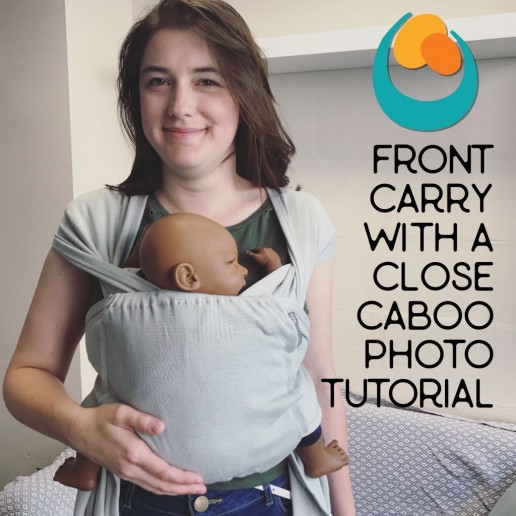
Putting on a Close Carrier
Vija Kangaroo Care Tops
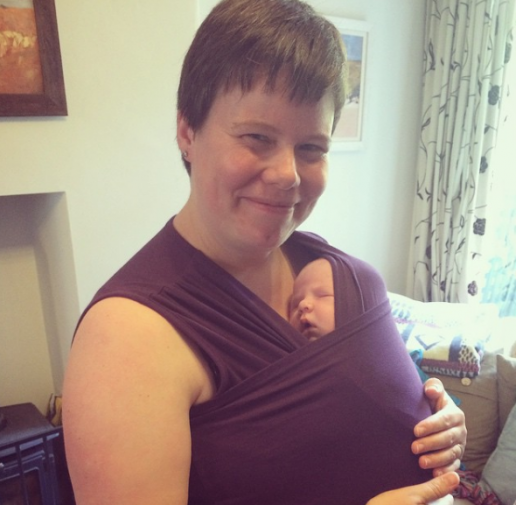
These special items of clothing are designed to hold a small baby close to parent’s chest inside some clever built-in pouches. They are very simple to use, and even come in twin form! More information here
Kangaroo Care shirt
If you need some more support, your local sling educator can be found listed on the Sling Pages.
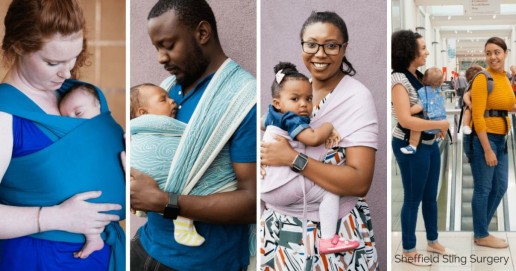
Using your carrier
Need some help using your carrier as well as possible or having a bit of trouble with getting it comfy? This page contains links to the types of slings, with guides on how to use them, top tips for comfort and troubleshooting help. You can also find safety tips and information about feeding in slings, as well as carrying in different weathers.
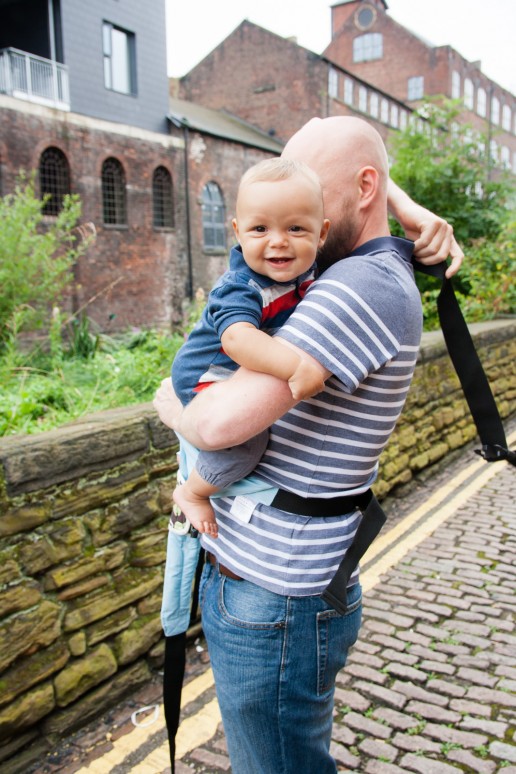
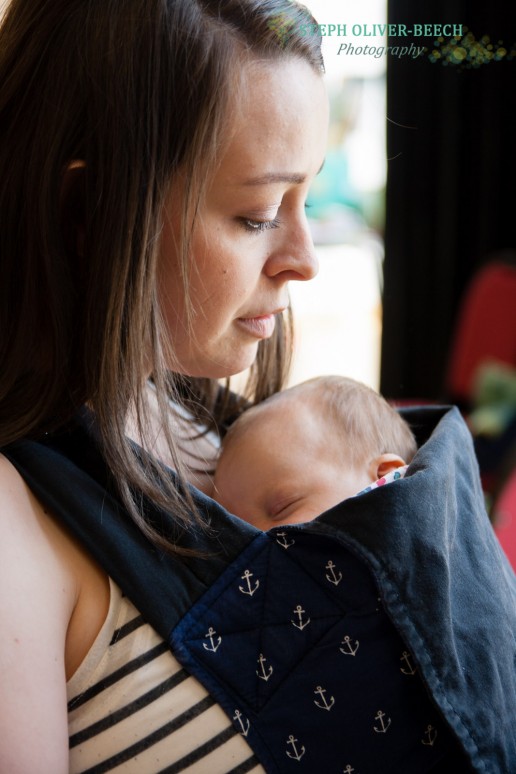
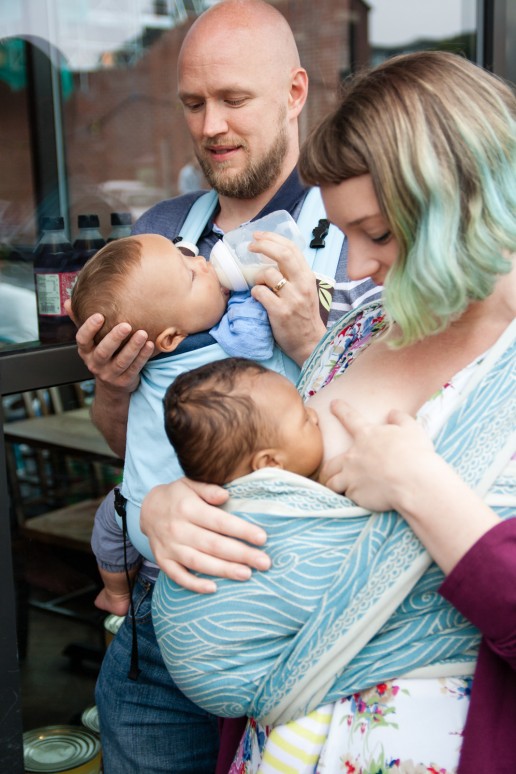
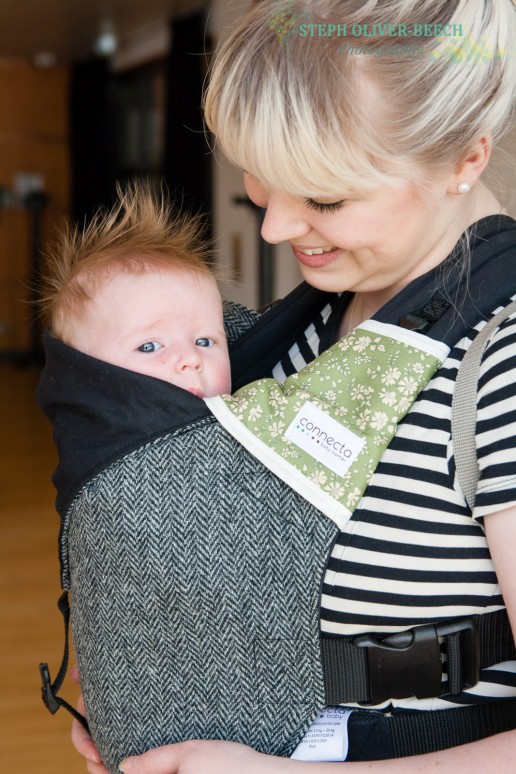
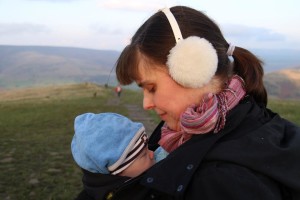

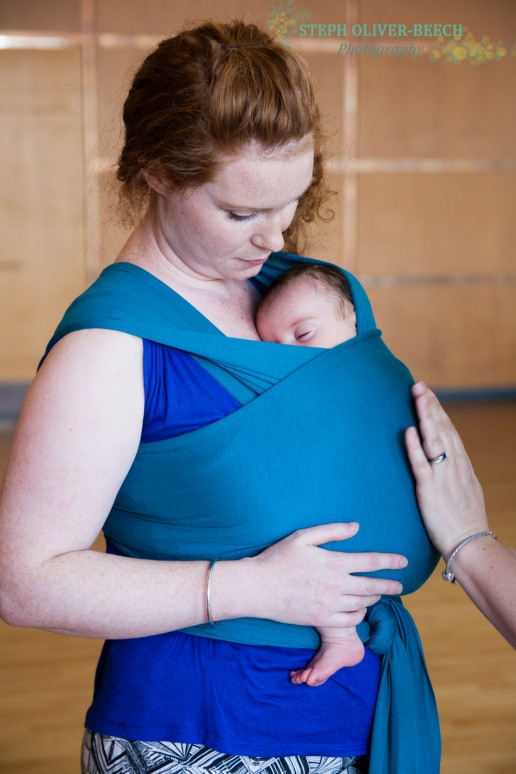
Guide to Slings
A guide to slings: choosing to carry your child is just the start of an adventure you can share together and both derive a great deal of enjoyment from! It can often feel overwhelming, trying to decide what to try first when there are so many options and everyone has their own favourites. Our guide to slings is designed to help you understand the basics of safe sling use and to know more about the major types of sling.
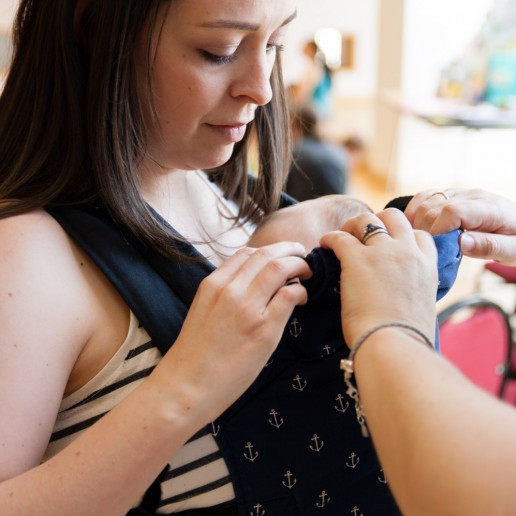
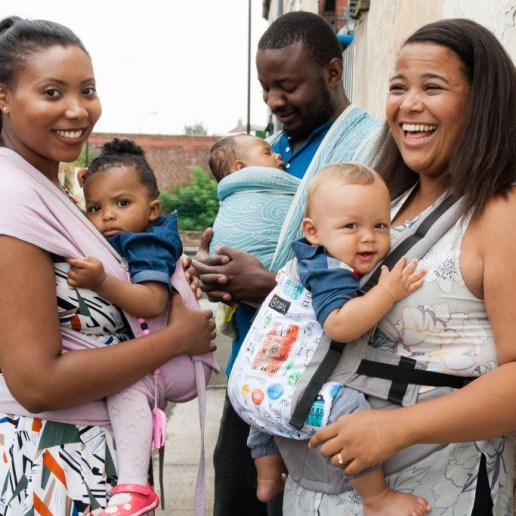

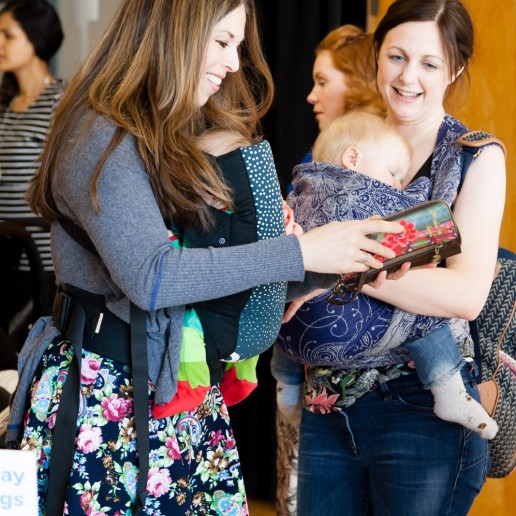
Useful videos can be found here and the photo tutorials here.
Read more about Common Queries here (such as facing out, carrying in the post-natal period, healthy hip positioning)
Read more about Carrying in Special Circumstances here (such as carrying while pregnant, carrying older children, carrying premature babies)
Do get in touch if you need some help.
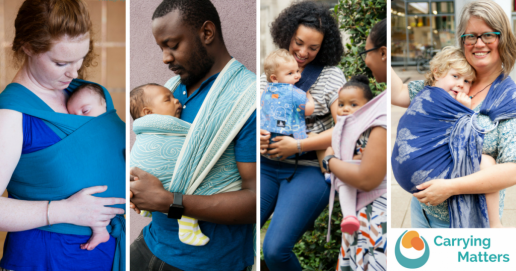
Types of Slings
Different slings suit different families at different stages; one type definitely does not fit all. It is like shoes; what fits your friend, or someone on the internet, may not fit you or your baby, choosing a sling is best done by trying things out!
Here is an introduction to each of the major types of sling, which will help you to assess which might suit your baby and your lifestyle best, and how to use it. Remember it can take a little practice for you both to get used to a carrier.
Welcome to Slings
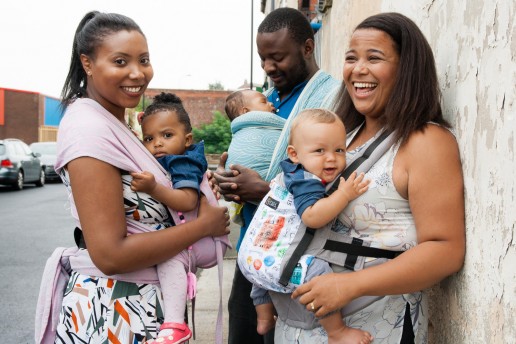
Welcome to the wonderful world of slings! You may be new to carrying and a bit overwhelmed about the choices available. You may be just starting out with your carrier and not sure if it’s the best or most comfortable option and wonder what else there may be. Read on for more information about how to make babywearing work for you, your baby and your family.
New to slings?
Not sure where to start when it comes to using a sling? This is a common concern among parents who have become convinced of the benefits of carrying their baby but feel a bit all at sea about the huge variety of slings and the confusing jargon in the sling community.
- There are many positive effects of using a sling with a very young baby; there is much evidence to suggest that skin to skin contact between mother and newborn (especially premature) babies can confer great advantages on both. The baby gains assistance with their physiological regulation of breathing and heart rate, temperature control is improved, and the contact helps to establish breastfeeding and promote more rapid growth compared to babies who are not held as close for as long. Furthermore, the baby will feel more secure in his developing relationship with his caregiver, due to the time spent in close contact.
- The caregiver enjoys positive effects too; he/she may find themselves more able to bond with their baby, due to the increased release of oxytocin, and post-natal depression may be reduced. Being able to be “hands-free” can really make a difference to a family’s ability to get around with their new baby, keeping them active and engaging with normal life.
- There are also many positive effects for society; such as a reduced burden of mental health and greater fitness.
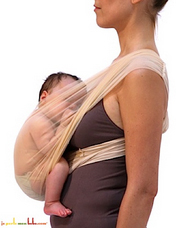
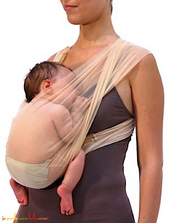
Firstly, make sure you choose a sling that allows you to carry safely.
This is especially important with young babies who are still small and in need of “fourth trimester” nurturing. In summary, a baby’s airway should be supported with the head well aligned with the spine, thereby avoiding curled-up into ball positions that could impair breathing. Carriers must not be too tall, do not be tempted to tuck your baby’s head down inside a carrier for “head support”.
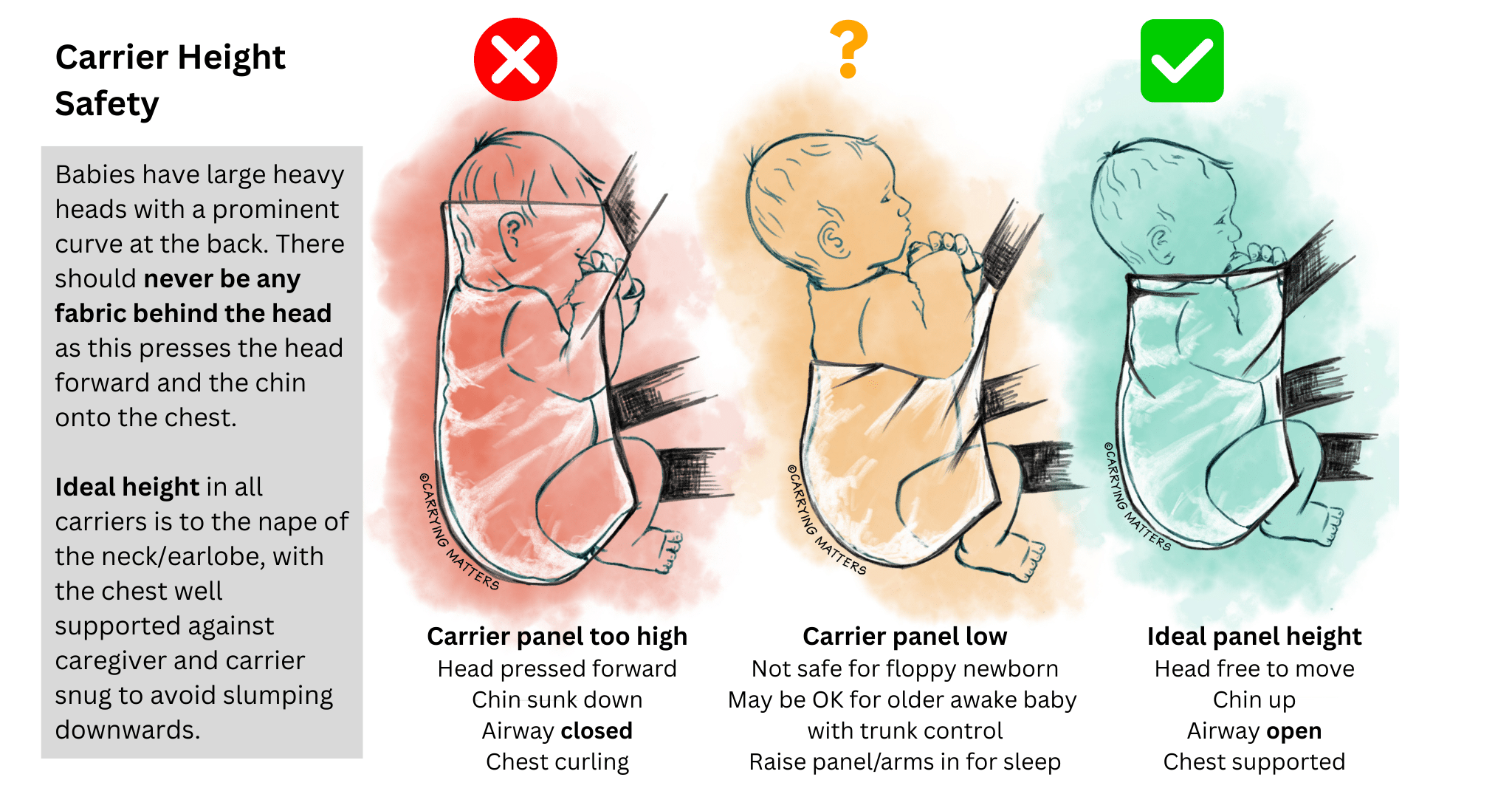 The safest place for a baby is upright, facing the parent, just as they are when carried in arms. His head should be resting against his parent’s upper chest, close enough to kiss, and supported snugly all around to avoid any slumping. Babies naturally adopt a squat position with a slightly curved lower back (you can see this in action when you lay your baby down to change their nappy).
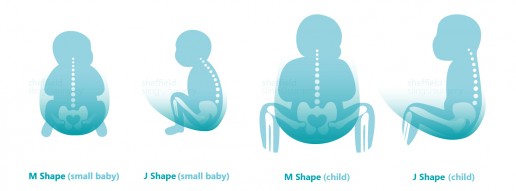
Ergonomic slings will respect this and carry a baby in a seated position, with the knees above the bottom. By bringing knees up, babies’ hips are rotated and do not need to be spread very wide to be resting comfortably, as the image shows. Narrow-based carriers (sold by high-street shops and online) are not always unsafe, but they are often suboptimal and may not be as comfortable for a baby to rest in as one that has a wider seat and encourages the knees to be raised.
Such hip-healthy positioning also helps to stabilise a baby’s back and protects the airway, as it reduces the amount of backward head lolling and uncomfortable straightening of a baby’s curved spine.
Click the link to read more about safe positioning in a sling and click here for information about healthy hip positioning.
This baby has just had her stretchy wrap removed; the sling has held her in the natural "in- arms" position
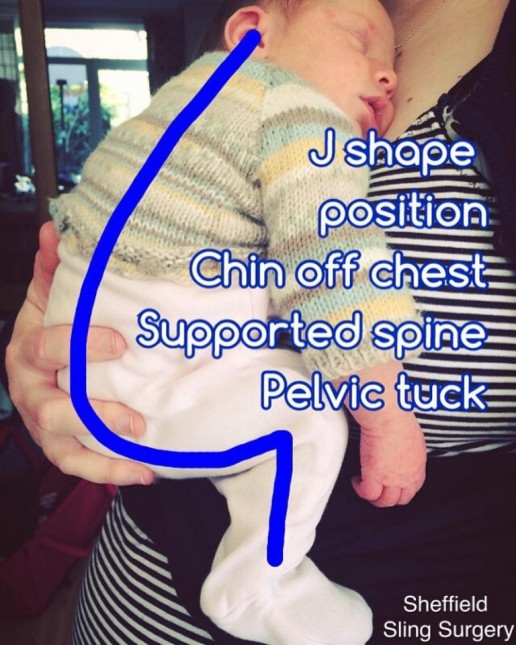
Safe, anatomically correct and comfortable positioning in arms and in a carrier
Secondly, choose a sling that is comfortable
Many parents find their high-street carriers can be less comfortable than they hoped, especially as their baby grows, and may stop using a sling at all.
Good slings have been designed to mimic in-arms comfortable carrying as much as possible, and many people find they are able to enjoy long walks with their children, up to pre-school age, with such an ergonomic carrier.
Broad weight distribution across the parent’s body matters; a child who is able to snuggle in and shift their weight closer to their parent’s centre of gravity will feel a lot lighter than one who is held in a stiff pocket, or held lower down and facing out (thus pulling away from the parent).
This applies in front, hip and back carries equally. Positioning makes a great deal of difference to your child’s and your experience of the sling, and is the most important factor in how comfortable it is.
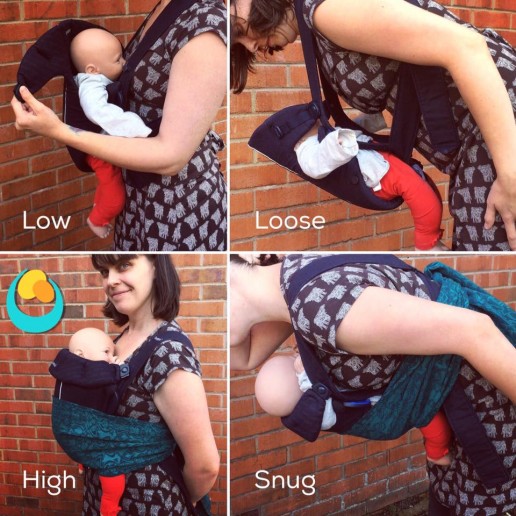
You can make your high street carrier more comfortable in a variety of ways, for example by ensuring your baby is higher up on your chest, held snugly, and using a scarf to redistribute the weight. Your baby should be held snugly enough not to swing free when you lean forwards.
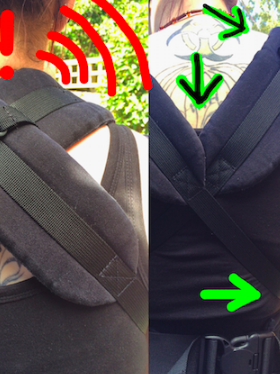
Features like the type of shoulder strap (wide or narrow, those that cross over on the back versus those that are more like rucksack straps), the shape and sturdiness of the waistband, and the type of fabric used can also make a considerable difference. It is always worth trying before you buy, and there are many sling libraries around the country that can help you do this. The Sling Pages has a full list for you to check your local resources.
"Scarf hack" for narrow based carriers
Thirdly, think about what kind of sling may suit you and your family best
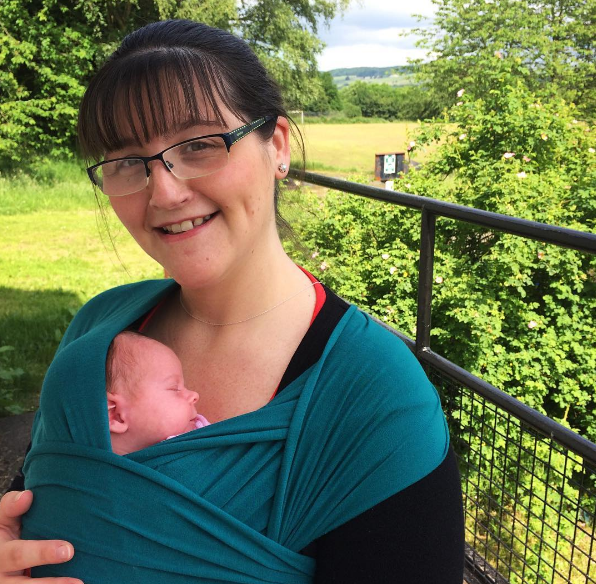

Stretchy Wrap
If you have a newborn or a baby under six months, most people will start with a stretchy wrap. This is usually a long piece of jersey style elastic fabric that is between 4 and 5 metres long, and can be wrapped around your body to create a snug pocket your baby can nestle into. Depending on the quality of the fabric, the stretchy wrap is usually used up to six months. It is often worth investing a little more for higher quality.
One size (usually) fits all, and it can be tied on and left on all day for convenience, popping baby in and out with ease without needing to take the sling off each time, many parents don’t realise this. It is possible to use the stretchy wrap as a breastfeeding aid, with care and attention to baby’s airway.
You can read more about stretchy wraps here, including how to use it well.
Close Caboo Carrier
This is a slightly more structured and less stretchy variant of a stretchy wrap, with a little less flexibility. It is put on, adjusted carefully, and then baby is popped into each of the cross passes on the front. The fabric can be tightened through the rings to achieve a snug fit. The Close Carrier can be used as a breastfeeding aid if required, with care and attention to baby’s airway, and most people will find it supportive up to three to four months.
Ring Slings
This is a piece of woven fabric which has one end sewn securely into two strong rings. They are worn cuppring one shoulder with the child sitting in a pouch on the opposite side of the parent’s body, with the loose end of the fabric threaded through the rings in such a way that the tension holds the fabric firmly and the weight is distributed across the shoulder and back.
They have the advantage of being lightweight and (once the knack is gained), quick to put on and take off. They can be very useful for those who need to be able to carry their child on the hip, or need something that offers the child a good viewpoint in all directions.
Ring slings made of woven fabric and with no padded rails are usually the best option, and shoulder style (pleated or gathered) is a very personal choice. They can be used from birth to toddlerhood, and it can be easy to breastfeed in a ring sling, with the appropriate attention paid to airway and positioning.
Hip carriers
Pouches are another kind of hip carrier which can be very simple, but need to be fitted to size; they can be a risk for babies under 3months if used badly.
The Scootababy is a buckled hip carrier with a waistband which can be used from approximately four months and up into toddlerhood.
Carrying aids and hip seats can make hip carrying easier but are not hands-free.
You can read more about ring slings and hip carriers here and your local sling library will be able to help too.
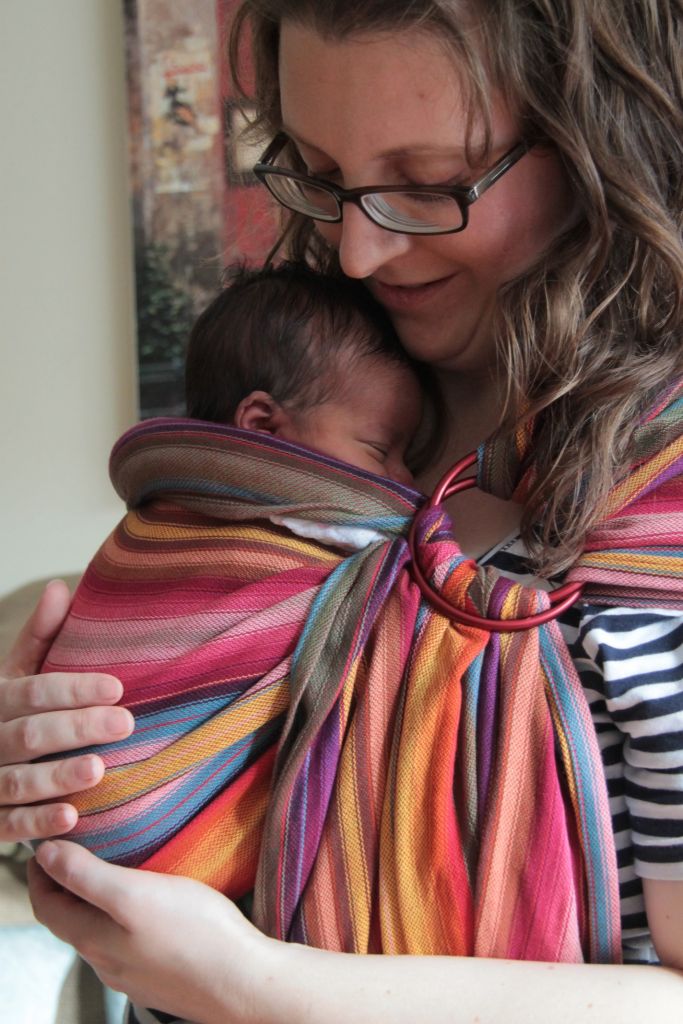
Woven Wraps
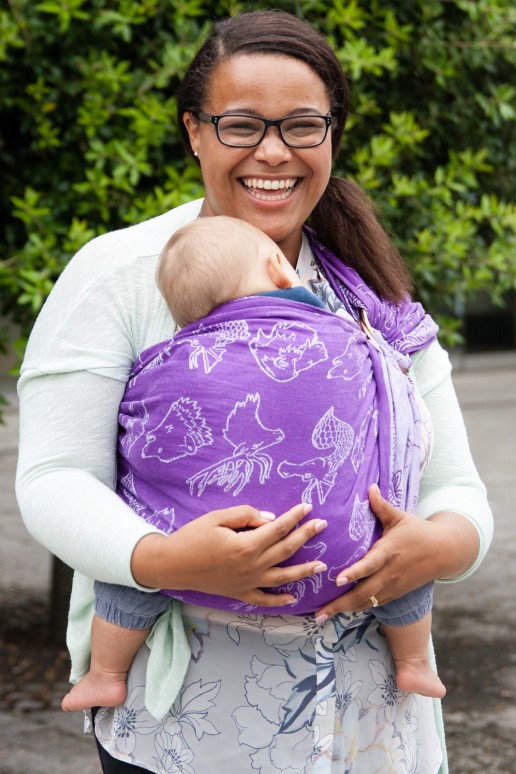
Woven wraps are excellent choices if you want great comfort and longevity. They can be used from birth to toddlerhood and beyond. Woven wraps are long parallelogram shaped pieces of fabric, anything from 2 to 7m long.
They are woven in a particular way to provide gentle all-around pressure, supportive but still soft and mouldable. Most woven wraps are made of cotton, some may contain other fibres such as linen or hemp, for extra support, and come in many different colours and designs.
Many women around the world use local woven cloths for many purposes as well as for child-carrying. These cloths and woven wraps feel very different from the fabrics you might find in a haberdashery shop; these are more likely to fray and tear.
Many people begin with a 4.6m wrap (known as a size 6) and learn a carry known as the Front Wrap Cross Carry. They can take a little practice but they allow a great degree of adjustability and weight distribution around the body. There are numerous ways to tie the same wrap, so they can be used on the front, hip or back at the appropriate ages. Your local sling and carrier consultant or sling library will be able to get you started!
Upright breastfeeding is possible, if done safely with the appropriate attention paid to airway protection.
You can read more about woven wraps here.
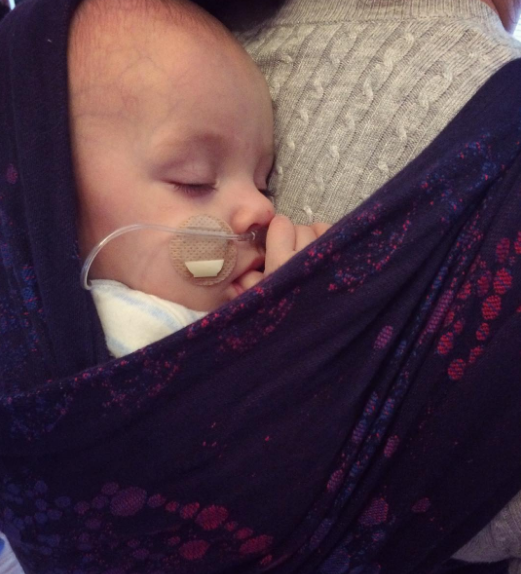
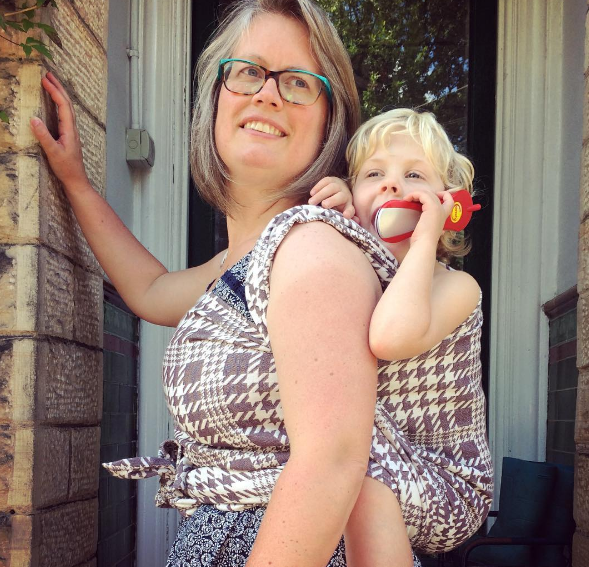
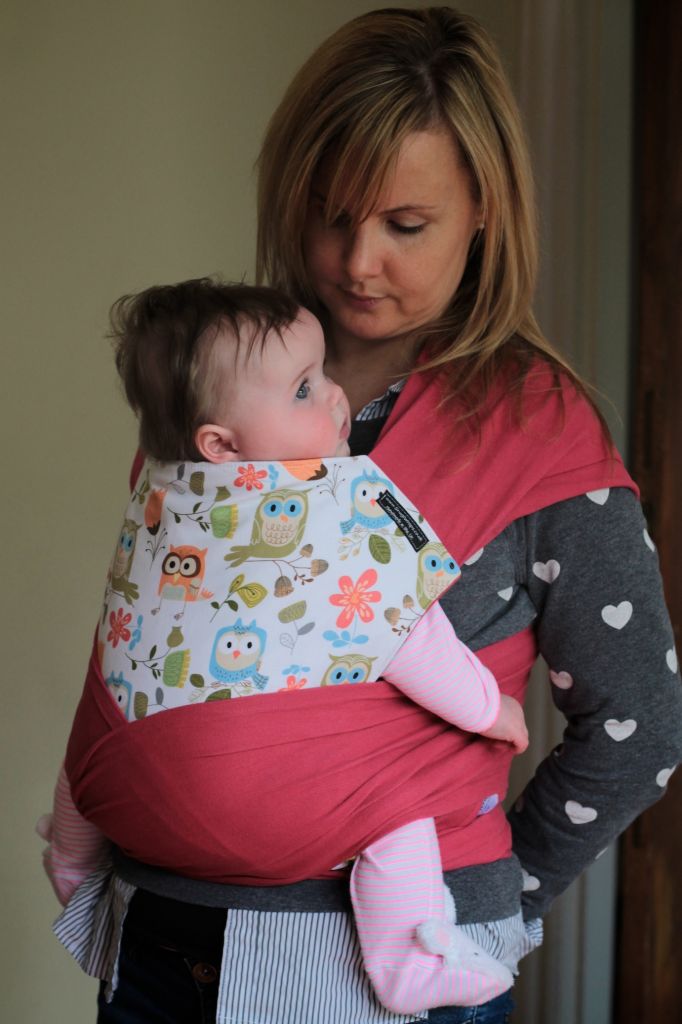
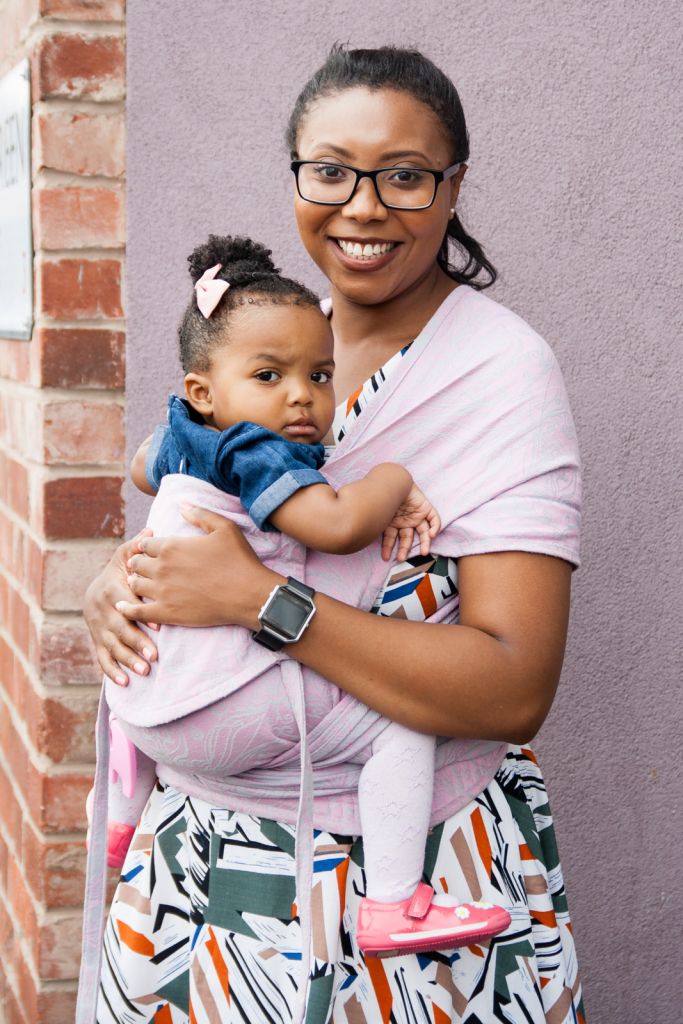
Meh Dai/Bei Dai (formerly known as Mei Tai) Carriers and variants (half buckles, onbuhimos, etc)
These are Asian inspired carriers made of soft fabric, and are popular with those who appreciate the mouldability and support of woven wraps but need something with more structure, or speed of use.
They consist of a fabric panel that has two straps at the base which are tied or buckled securely around the waist, and two straps from the top of the panel which can be wrapped around the parent and baby to ensure a snug and comfortable fit. Baby sits in the pouch created by the panel, and the long straps allow a great degree of adjustability to all shapes and sizes. They can be worn on the front, hip and back at the appropriate ages, and upright breastfeeding is often possible, if done safely with the relevant attention paid to airway protection.
Your local sling library should have a few of these to try out.
You can read more about meh dais and their variants here.
Full Buckle Carriers
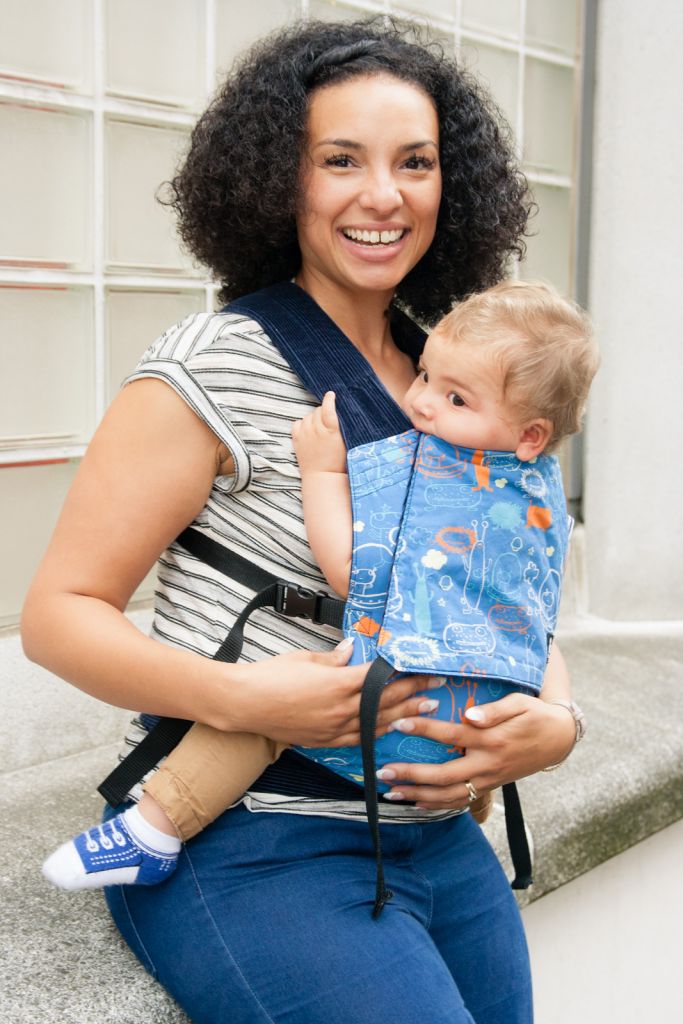
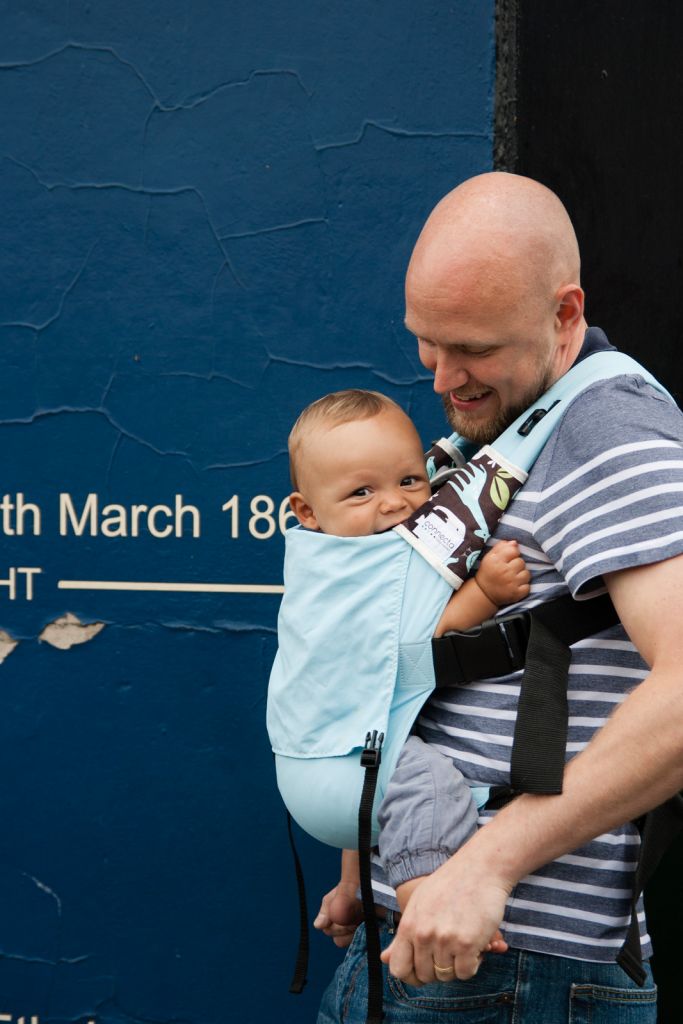
If you’re not sure about tying fabric, a good option is a full buckle carrier, which has a buckle on the waistband, and the shoulder straps buckle into the panel at the sides. Baby is seated facing the parent, inside a supportive pouch that supports them widely across the base from one knee to the other.
Waistband types vary, from the minimal to the heavily padded, and people’s preferences vary enormously. Some shoulder straps cross over on the back when baby is on the front, others are fixed into a rucksack style. The shape of adult and baby together is very individual, as is the health of the adult’s back, so what suits one pairing will not suit another. More padding does not automatically mean “better” or more comfortable, and those with back pain will not always need heavily structured slings. Good posture and general back health are important – read more about this here.
Buckle carriers can be very quick and simple to use. Often, a little practice to get the straps and positioning optimally adjusted is well worth it. Most good full buckles fit well from three months upwards; some can be adapted for younger babies by rolling the panel or by using inserts to keep baby snug, high up and visible. Many carriers will last into early toddlerhood, and some beyond that, depending on design.
Many mums find that breastfeeding in the buckle carrier is possible, if done safely with the relevant attention paid to airway protection. Most can be used on the back once babies have grown.
Some buckle carriers will allow baby to face the world. This can be great, when done safely and responsively. It is recommended only from four months upwards, not for sleeping in to protect the airway, and only for short periods of time. This is due to the reduced opportunity baby has to see and interact with his parent and learn about the world based on his parent’s response to it – this is known as social referencing. There is also reduced hip and leg support from the narrow base which can be an issue in some circumstances, as well as less comfortable for child and parent. Carriers that provide hip healthy positions facing out are generally preferred. (read more about facing out here.)
You can read more about buckle carriers here.

Fifthly, enjoy your sling and let the world see it!
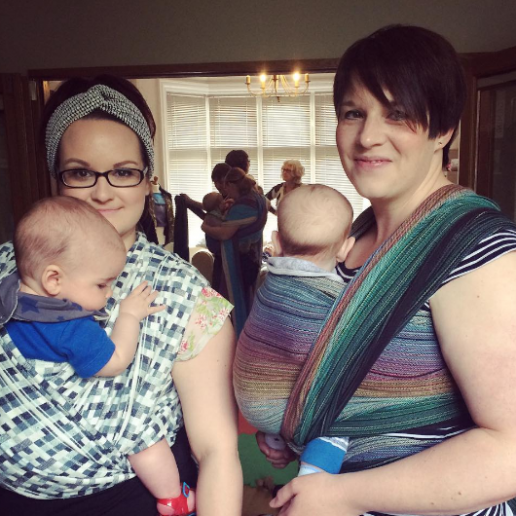
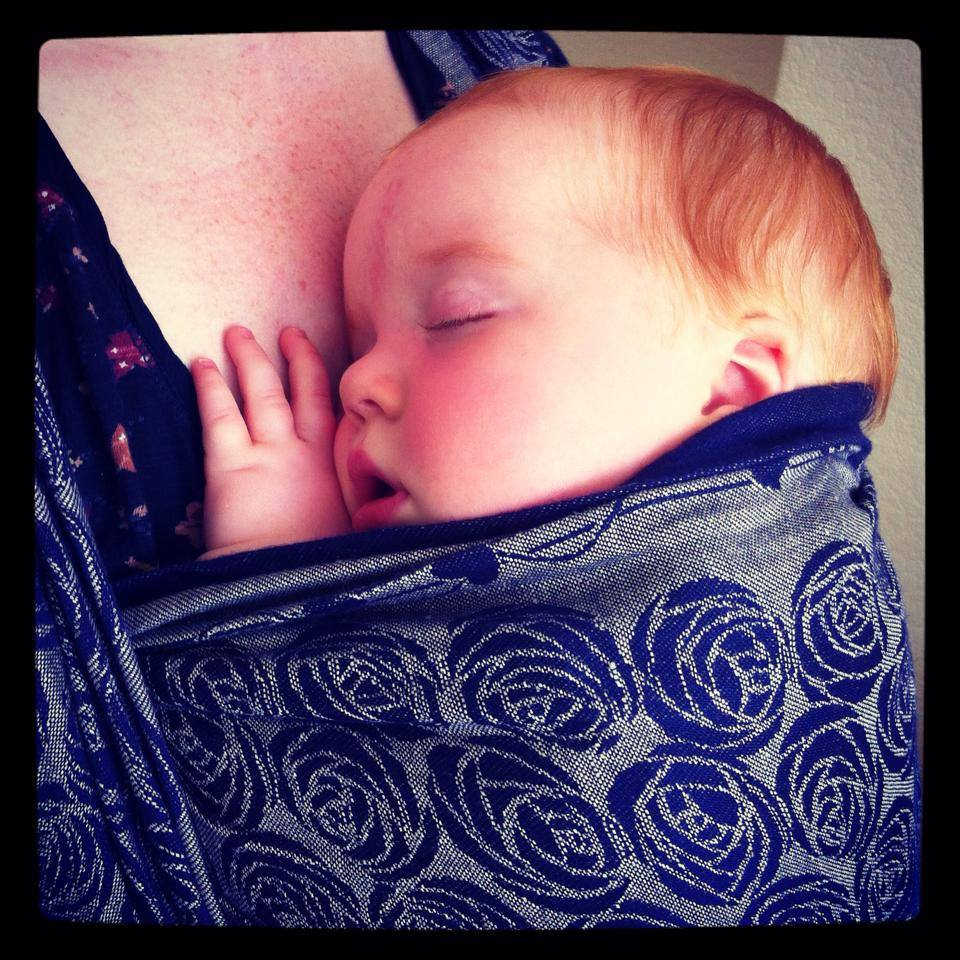
Why not share your enjoyment with the parents you meet so they can discover slings too? We all carry our babies, some in arms, some in high street carriers, some in wraps, some in ring slings, some in meh dais, some in buckles. We all learn from each other; encouragement is always more productive than criticism!
Here is a lovely article from Ellie at Peekaboo Slings about the importance of no judgment; “We want to normalise babywearing and promote carrying your children close – put bluntly, we don’t care about the rest”.
Fourthly, be aware of the changing needs of your baby
The weather conditions may change how you carry your baby; being aware of the heat and the sun, or the cold and the rain may affect your choice of sling and your clothing.
As your baby grows, her own needs will change. She may want to sleep less and look around more. She may prefer hip carries, or even back carries, so she can see into the world into which she is being carried. As she gets heavier, the carrier you began with may begin to feel less supportive for you and for her; for many this marks a move towards “toddler-worthy” carriers. This may be different ways of tying your woven wrap, learning how to adjust the straps on your meh dai to ensure knee to knee support, or moving up to a bigger, toddler-sized (or even preschooler!) carrier when you need to. Your “baby” sized carrier will often last a lot longer than you think.
You will not spoil your baby or make him clingy by carrying him as he grows. Big kids need cuddles too – loving contact is vital to our emotional health and security, from cradle to grave. You can read more about carrying older children here, and your local sling library or consultant should be able to help you make the most of your carrier.
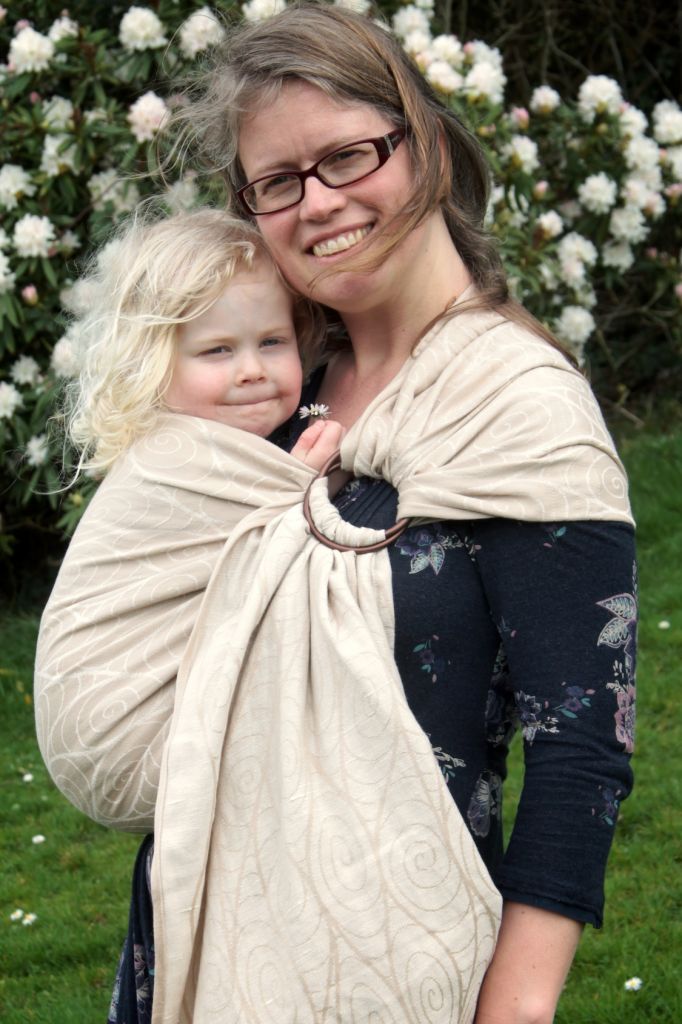
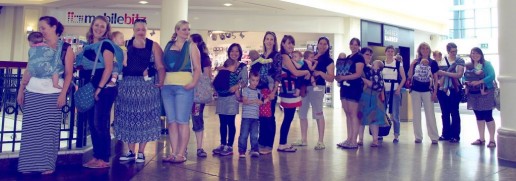
How to Choose a Sling
I have met thousands of parents over the years, wanting help with choosing a sling. It’s fantastic to support them in their desire to carry their child close, with all the great things this will bring the whole family. For many, they can feel utterly overwhelmed by the huge range of options on offer (see here for a quick introduction to carrying, and here for a quick overview of the major types of sling).
Very often, they will ask me what I would recommend.. and this is a very hard question to answer, one that I usually respond to with more questions! Everyone’s choice of carrier is unique for themselves; and their initial choice will often change as they try things out.
Initially, when it comes to choosing a sling,
many people will look for a carrier that isn’t especially expensive, to see “if they get on with carrying.” Others will pick something that has been marketed by a mass-manufacturer in mainstream stores or at trade shows as being the best option available or will have picked something recommended on social media (please be aware of the fact that many of these influencers have no idea how to use a carrier well or safely), or will choose something for the specific features listed, such as the ability to carry a baby in multiple positions, or being described as “the best”. Some may have been given carriers by their friends from several years ago (often hardly used “as it just didn’t work for us”), or bagged some ultra-cheap ones on Ebay/Vinted.
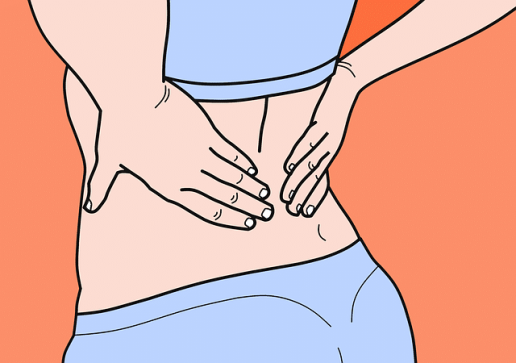
This can sometimes lead to problems, as such carriers may not have been specifically designed to work with parent and child anatomy and can thus often be uncomfortable after only a short time. They may be worn too loose or baby may be too low, causing back pain from the strain of the carrying or the hunching that can ensue (as well as potentially posing an airway risk – also see here for more about carriers being too big). This can lead to a belief that that baby is too heavy or that the parent isn’t strong enough (neither is usually true!) and carrying journeys come to a premature end. At this point, those who want to make carrying work for them will often look for support from someone like me to find something that works. Of course, some parents will come straight to us right at the start!
A good carrier should be comfortable for both baby and parent. It should support baby safely, protecting their airway and allowing easy breathing, in just the same way as when you hold them upright on your chest in your arms.
A good carrier should hold baby in the anatomically appropriate spread-squat position that respects infant and child spine physiology, and it should be snug against parent/caregivers chest for weight distribution. Carrying in this fashion is safe, and is usually much more comfortable and allows longer duration of sling use than in-arms or in a poorly fitting carrier. (Do remember to build up your carrying muscles day by day. It is exercise and gets easier with repetition, just like training for a race.)
People end up choosing their main carrier for many different reasons – and each individual will have different priorities, which will lead to their own personal choice. When I am asked what I would recommend myself, I often describe a bar chart like the one below, which shows just how variable things can be, and what suits me won’t suit them. Some people will prioritise comfort and longevity over pricing and simplicity; some value customisability and appearance more than pricing or resale value, everyone is different. People may end up choosing alternative carriers that they had originally envisaged, based on their “list of requirements”, due to how the sling feels for baby and parent when it is fitted.

This is why one “size does not fit all” and why many of us in the sling world use an analogy of shoe fitting, jeans or wedding dresses when it comes to trying a carrier. Everyone ends up with something difference. Cheap shoes bought over the internet often don’t fit your feet and can cause blisters. Jimmy Choos, Louboutins or Doc Martens really do not work for everyone, however desirable or pretty or cool they may be. What works for your friend, or for a large number of enthusiastic sling owners on the internet, or an experienced sling professional may not work for you. Current trends or famous brands don’t equate to an instant “perfect fit” and no one carrier can claim to be “the ultimate” or “the best.”
Trying a few things out before you commit yourself to a purchase that can feel expensive is very useful, and it is often worth spending more on a good quality carrier that fits you well, to ensure you and your baby are both comfortable and that it will last for some time. Many people find, however, once they have the right sling, it gets used daily, and the cost per use per day comes down to pence. Don’t be tempted to buy an extremely cheap carrier that may well be a fake (Ergobaby is the best known carrier to have been counterfeited) – always ask for proof of purchase from an authorised retailer when buying second hand. Your child’s safety isn’t worth the risk. Buyer beware!
Once you’ve recognised the benefits of carrying as comfortably as possible, how do you begin to choose?
I highly recommend visiting your local sling library to try out several options; there will be someone there with training and experience to help you navigate the choices. Some people will have a “shopping list” of requirements for their ideal carrier, based on what they have read online or been advocated by a friend or an internet group. Of course, such recommendations can be helpful, but a one-size-fits-all approach rarely works in practice. Every baby-parent dyad is unique, with their own personal stories that influence how they stand, how they carry, how they prefer to be held, for example, and particular features that seemed desirable on paper may not feel quite right in person. If you think your other half is likely to carry too, do bring them along to try things themselves; it is very hard to guess what will work.
For example, some people will love the feel of thicker, more padded waistbands, while others will find them bulky and restrictive. Some will prefer straps that cross over, others find this can ride up to the neck. Some find rucksack style straps hard to do up. Some inserts are simple to use, others more complex, many don’t like inserts at all. Some people find meh dais and woven wraps more comfortable than carriers. It is generally a good idea to have an open mind; you may be surprised to find some things work much better than you had imagined, while others just don’t feel quite right.
Bulky carriers may not necessarily equal greater support or comfort for everyone, and too much bulk can be unhelpful for some. Knowing how to achieve good positioning and how high and tight to have a carrier are very effective tools for successfully distributing weight comfortably.
A good sling librarian or peer supporter will be able to show you how to position your child, as well as tips and tricks that can make things much easier (such as how to put on fiddly straps, or how to make sure your stretchy wrap is tight enough, or how to ensure your ring sling feels secure). Sling libraries are fantastic resources.
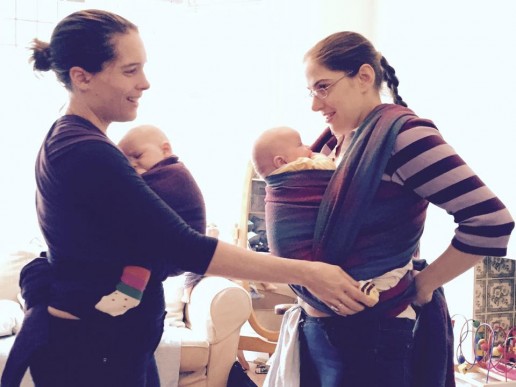
It is worth being aware that knowledge about sling safety and best practice positioning is improving all the time. Older carriers and older brands may have instructions that are no longer part of current safety guidelines; social media is often marketing focused and wildly inaccurate, feeding and sleeping positions in slings are often out of date. Do check with your local sling professional if you have any concerns at all, they will be only too pleased to support you and your child.
Your sling should bring you and your child great enjoyment and should not cause you pain or be uncomfortable. Furthermore, as a family’s familiarity with slings grows and as their baby gets bigger, their choices can change. They may move from things that are especially designed for small babies, or carriers that are as simple as can be, on to things that they find increasingly versatile and comfortable. Babies may wish to change how they are carried, desiring greater visibility, for example. Each parent may have different shapes too, and families may decide to have different carriers for different situations (eg a simple buckled carrier for use on a school run or on a muddy day, or a woven wrap for a long sleep-inducing walk, for example). There are no “perfect” answers, but options that end up being the best choice for the circumstances.
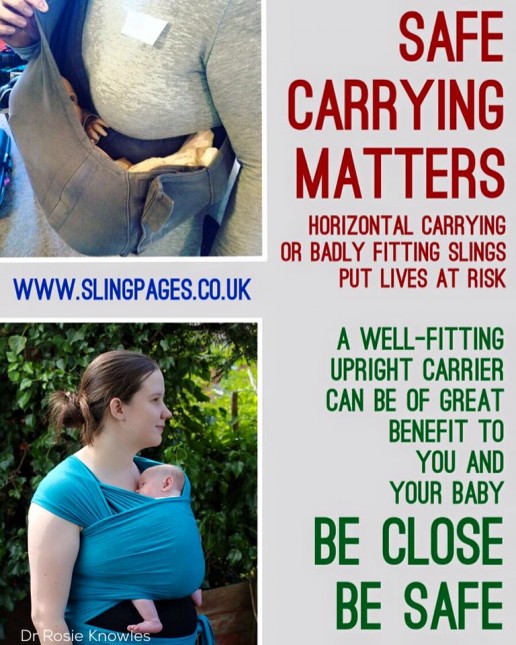
Sling Safety Matters - How to Use a Sling Safely
Sling safety matters. Carrying our children in a sling safely can be one of the most precious experiences we ever have as parents or caregivers. There really is something very special about the bond that builds from keeping your child close.
However fantastic it may be, it must be done safely, for your baby’s health and your own. As parents of small babies and bigger ones, one of our greatest priorities is to keep our children safe. A good, correctly fitting sling can be a very helpful tool for this; keeping a child safe while daily life continues.
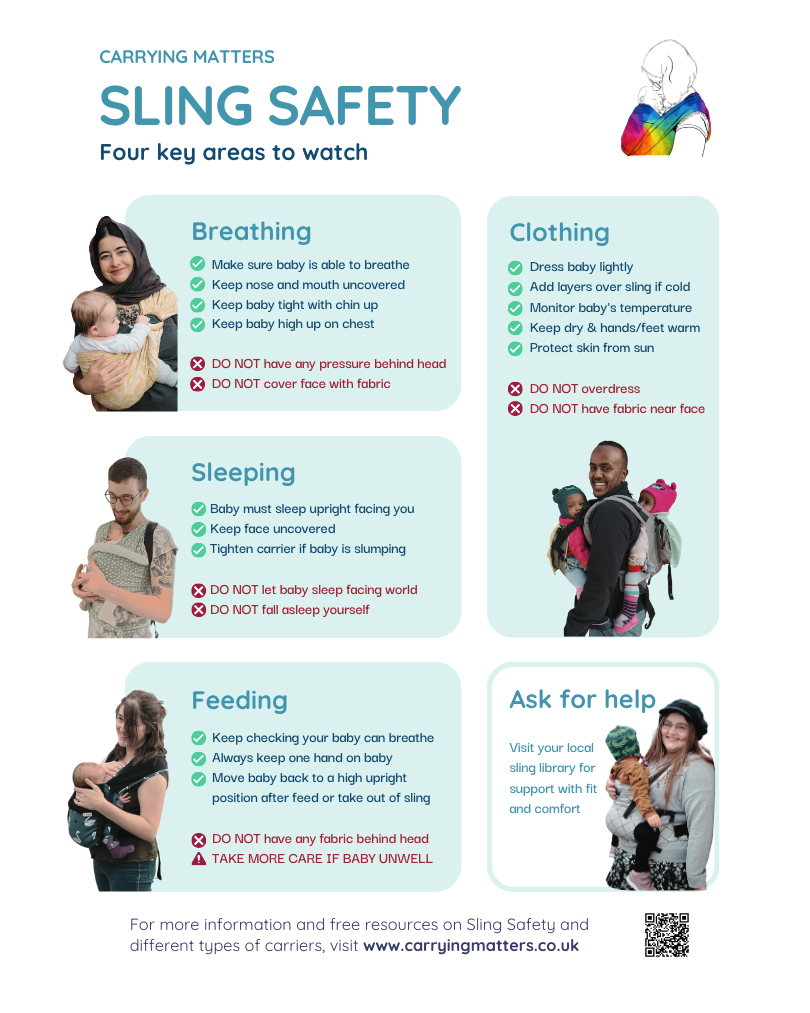
Four key areas to watch – see more detail of this image at the link here
Sling use for very young babies (birth to four months)
This is becoming increasingly popular around the more developed world; a practice that has in fact been universal for thousands of years. Families that live in extended communities or “villages” are usually able to share well-honed, tried and tested knowledge down the generations and provide easily accessible advice and support. This kind of local support is much harder to come by in our more fragmented societies, which means we often turn to books or the internet to fill the gaps in our knowledge and provide us with reassurance we are doing it right. Unfortunately, sometimes these sources of information are out-of-date, incorrect or even dangerous, and can lead to problems with the use of any kind of baby equipment. Manufacturer instructions can be slow to be updated with new “best-practice” guidelines and YouTube videos not made by professionals can often be misleading and miss out important information.
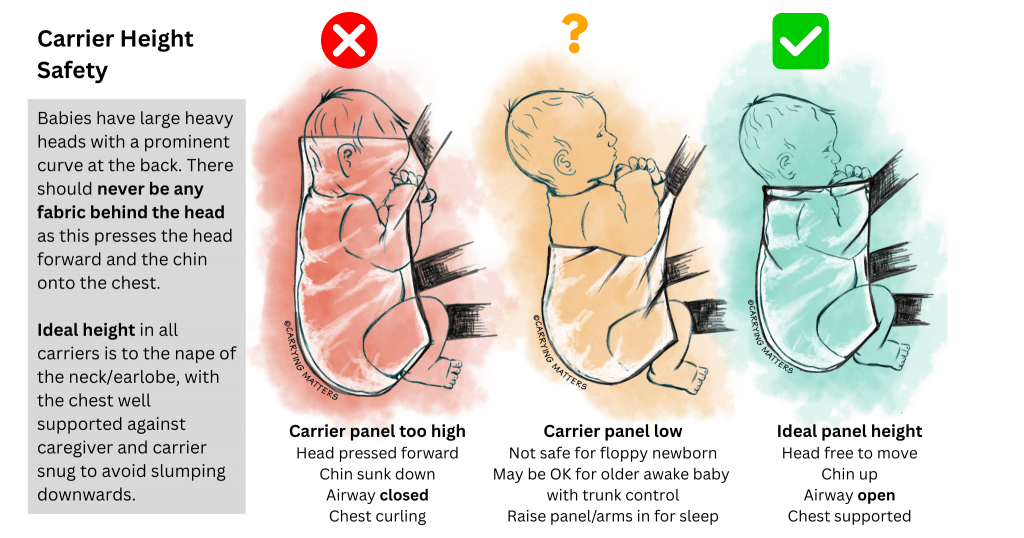
Many carriers on the market hold babies very low down and loose, which will allow young bodies with little muscle tone (especially during sleep) to slump and end up with nose and mouth pressed against fabric. This is an airway risk. They often talk about “head support” but use rigid high backed panels that tip baby’s large head and chin forwards onto their chest. This is not wise or responsible. Read more here.
 Very few manufacturers advise about monitoring baby’s temperature in baby carriers; which is important, as overheating is risky.
Why bother with a sling at all if there are any risks?
There are many benefits to using a sling with a very young baby; in fact. many hospitals use them in the practice known as “Kangaroo Care”, and there is much evidence to suggest this skin to skin contact between mother and newborn (especially premature babies) can confer great benefits to both.
The baby gains assistance with their physiological regulation of breathing and heart rates, temperature control is improved, and the contact helps to establish breastfeeding and promote more rapid growth compared to babies who are not held as close for as long. Furthermore, the baby will feel more secure in their developing relationship with his caregiver, due to the time spent in close contact.
The caregiver may find that he/she is able to bond with her baby, due to the increased release of oxytocin, and post-natal depression may be reduced. Being able to be “hands-free” can really make a difference to a family’s ability to get around with their new baby, keeping them active and engaging with normal life.
The key is to know how to use the sling in a safe and secure way, just as you may practise learning to ride a bicycle, or drive a car. Familiarity and practice make perfect. All baby equipment should be used safely, and it is an unfortunate fact that sometimes things are not fit for purpose, or the instructions that come with equipment are inadequate. Babies should be able to breathe easily, be at a comfortable temperature, and held in positions that are healthy and beneficial for them.

How can I ensure I am using my sling safely?
A good sling should mimic the natural, in-arms upright position for carrying babies, ensuring the caregiver can see and sense the baby at all times, and thus able to be quickly aware of and rapidly responsive to any changes.
I see a lot of parents with newborn babies wanting to learn how to use a sling, and the photos and the position diagrams here are the first thing we look at.
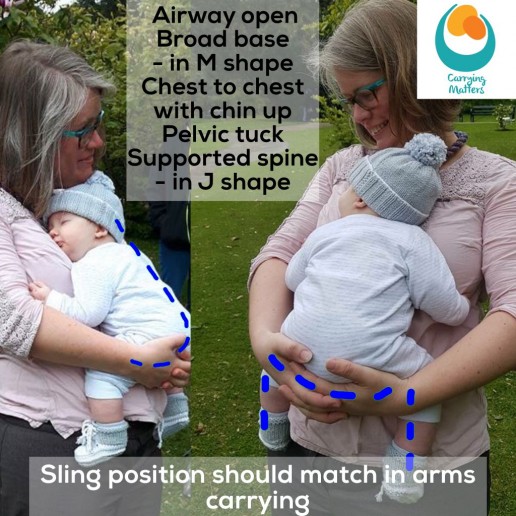
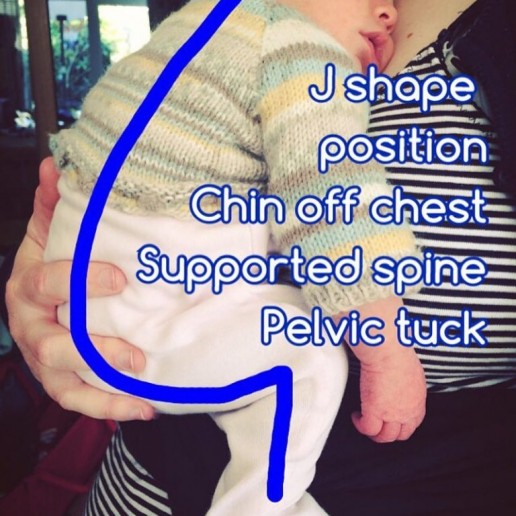
Babies grow in tucked positions, and after birth, they tend to maintain this gentle curve to their spines for several months due their lack of muscle tone or strength to their head and neck and upper torso. It is not till they are older that they have the strength to hold their spine in a straightened posture. It is not till they can crawl and stand and are beginning to walk that their muscles and ligaments hold the spine in the more adult S shape. While babies are young, holding them in their naturally adopted tucked positions is both comfortable for them and also more comfortable for you. If their backs are well supported, their heads do not need rigid support, do not be tempted to raise head rests or sink babies down inside panels. Babies will rapidly develop head control – here is some guidance about managing a “floppy head” without compromising airway. As they grow and begin to develop their strength and clinging ability, their needs will change.
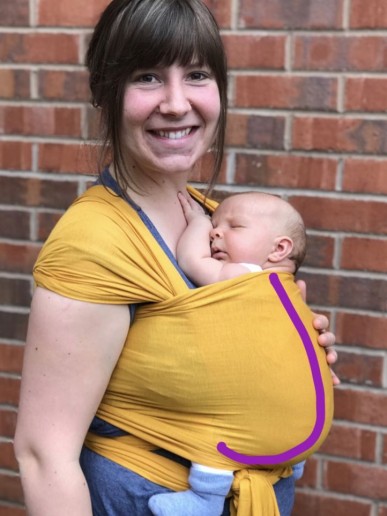
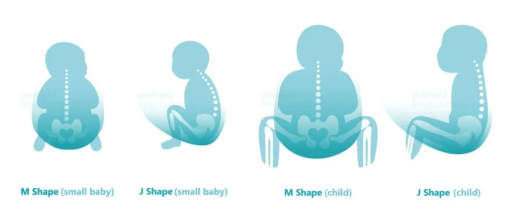
Young babies who are seated in the “squat” position or the M shape (looks like a J shape from the side) will have a broader, more stable base to rest on than a narrow perch. This position, with the curve mainly at the base also helps to keep the chest flat against the parent’s body and thus in an expanded position for good airflow.
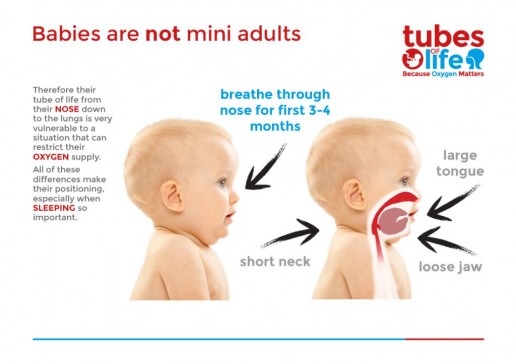
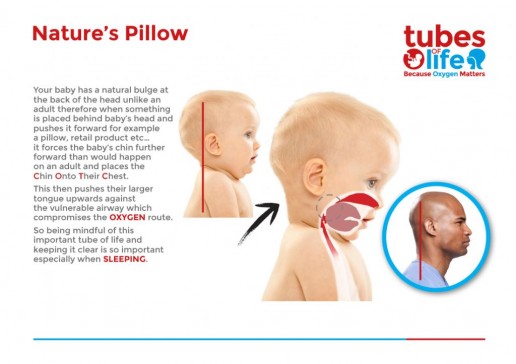
Babies under 3 to 4 months are most at risk of airway compromise when chin can sink onto their chests; so a good carrier will hold baby’s chest snugly against yours to keep the chest cavity uncurled and the chin off the chest. It is important to ensure no slumping and that there is no fabric over the face and there is a good air supply. Babies have a disproportionately large occiput (the back of the skull) and a short neck, along with lower muscle strength and co-ordination compared to adults. Rigid surfaces behind the back of their heads tend to push the skull forwards so chin sinks onto chest and can obstruct airway. This is is why upper back and neck support (no further up than the earlobes) is so important, rather than using headrests which can be risky.
Stabilising a child’s body with a broad base and good upper back and neck support is key in the early months.
This also applies to car seat usage; rigid shells with a hard back holding babies at 40 degree angles can also push a baby’s chin onto their chest and is why it is not recommended for newborns to sleep for long periods in car seats.
Babies should be dressed appropriately to ensure they do not get too warm; people are often surprised how quickly everyone can warm up when in close contact. Please do not use thick, furry or padded snowsuits and dress down. You can always add more layers over the top.
Respectful, anatomically appropriate positioning
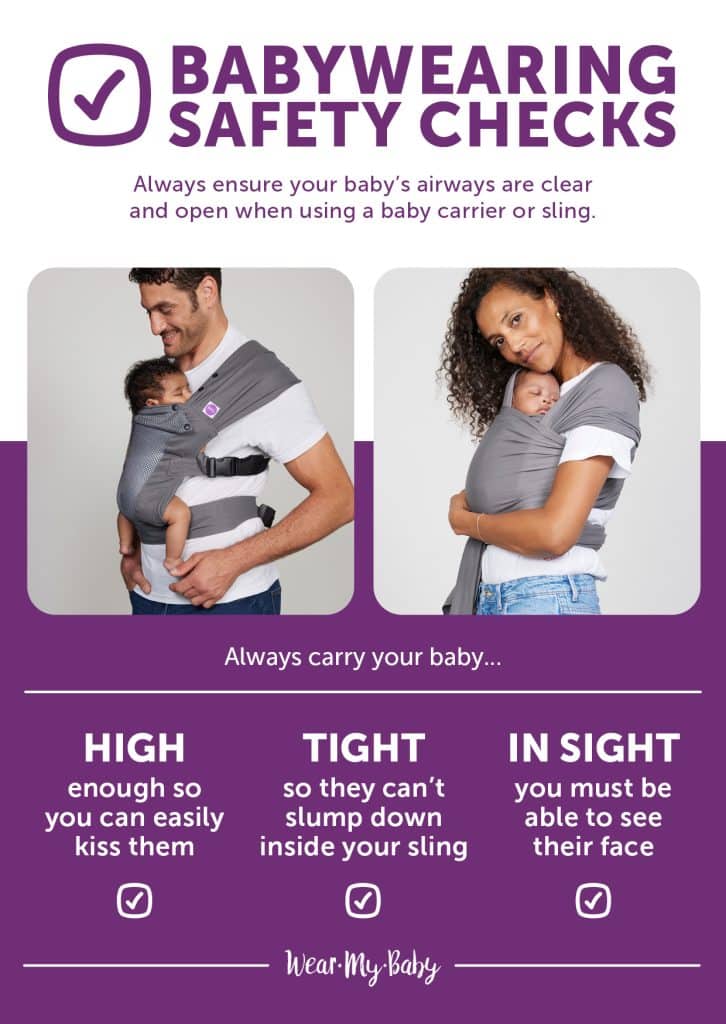
High, Tight, In Sight
This is a common phrase used by many sling libraries to help parents remember the key things for safety sling use. This was created by Hannah Wallace of Wear my Baby in the UK.
Visible and Kissable
This is the phrase used by the Baby Carrier Industry Alliance, their PDF can be found here.
Visible – Baby’s eyes and nose should be easy to see and above the top edge of the carrier.
Kissable – Position baby in the carrier as you would in your arms: head at your collarbone; bum above your waist.
After securing the carrier, hug the baby. If you instinctively move them higher or closer, adjust carrier until it holds baby in the position you use when carrying them in your arms.
ABC is the basic first-aid mnemonic
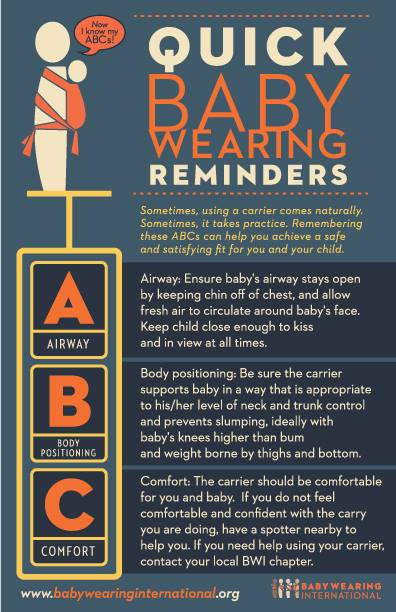
This has been adapted for safe sling use and was commonly used by Babywearing International organisation before it closed – the principles are easy to remember.
AIRWAY is vital. Babies’ heads are heavy and it takes time for their muscle strength and tone to develop enough to hold up their heads and support their own airways; until then, it is our job as parents to be as caring and careful as we can. A baby’s head should be resting against the caregiver’s chest, with the windpipe straight, not curled over. A good guide is at least two fingers being able to fit between baby’s chin and his chest. Air should be able to circulate freely and the face should not be obscured by fabric, or buried within cleavage. Baby’s cheek can rest against parent’s chest, and hands should be accessible to the mouth for sucking if needed (and not trapped down the side of the sling)
BODY POSITION is important to protect the airway as well. The upper body should be supported against parent’s chest, to ensure no slumping (this is why carriers should be tight, to make sure that babies do not roll up into a ball). The pelvic tuck into the M shape with knees higher than bottom will help support baby’s back as well as being very comfortable. The neck should be supported where possible to avoid backwards lolling but the back of the head should never be tilted forwards (see the image above – babies have a larger occiput, shorter neck and less-strong neck muscles than adults). The pelvic tilt and using a rolled muslin cushion (to rest below the earlobes) can be helpful if babies resist head support. See the diagrams above for the correct shaping.
COMFORT comes last – I would rather see a child in an uncomfortable carrier that was safe, than fast asleep slumped into a tight ball or folded over in a cradle carry, however comfortable it is. However, you and your child are likely to enjoy and appreciate a carrier that is pleasant to use, fits well and does not cause back pain. Here is some advice about how to choose a carrier. Comfort also covers the baby’s temperature; too hot is a problem, so please layer your baby carefully and do not over-dress them.
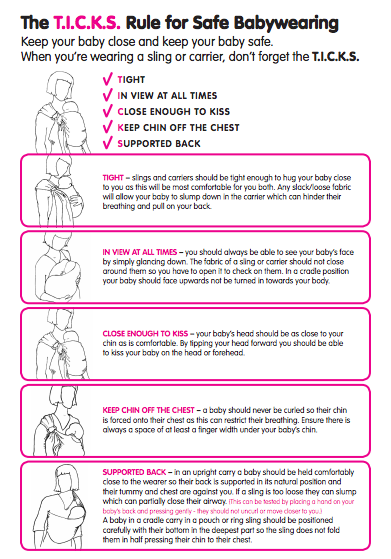
TICKS guidelines
The TICKS guidelines – Tight, In View, Close enough to Kiss, Keep Chin off the Chest, Supported Back are commonly used on manufacturers leaflets, having been created by various organisations as a response to deaths in horizontal baby carriers (such as the Infantino Sling Rider). They are the most well known safety guide used in the UK and are prominent on many websites, however they are difficult for parents to recall.
National UK guidance
New guidelines for use in the UK are in the process of being reviewed and updated – they should be available in late 2026. The focus is a short, easy to recall phrase that is effective at keeping young babies safe in carriers.
In summary, a baby should be tightly supported in their carrier, with a clearly open airway and their nose and mouth visible at all times. They should not have constricting tight fabric or panels behind their head. The carrier should be suitable for purpose, fitting correctly, used correctly and adjusted when needed to maintain safety at all times.
I would never recommend any kind of lying- down position in a carrier, especially where the back of the head is bent forwards to compress the airway and a child is thus not able move its head freely to clear any blockage. Bag slings, ill-fitting pouch slings and other slings used badly can be risky.
Breastfeeding is usually safest done in upright positions for this reason, and a child who falls asleep feeding in a sling should always, always be brought back into this safe upright position, to protect the airway. Babies should never be left to sleep in a cradled position inside a sling; this can be dangerous.
What about older babies beyond the early weeks and months when they are developing more control over their bodies?
As babies grow, their needs and abilities change. A baby who can maintain their own airway independently will expect more freedom and will show you this with wriggling and turning. Their wild jerky movements are how they practice muscle control and learn coordination. Movement is important, babies should be given the opportunity to explore their bodies whenever possible. Parents and carers will need to find a happy balance between the need for safe and comfortable transportation, a place to sleep or feed, and their baby’s need to move. It’s worth being aware that prolonged, unchanged positioning isn’t good for anyone and even adults are being encouraged to move every 45 minutes. Children’s bodies are still growing!
Try to change positions, try in arms carrying, swap with other carers, use a buggy, to give children a variety of experiences and positions.
Top Tips
Position matters
- Your child must be able to breathe safely in the sling. Their chin should not be touching their chest (a good guide is a space two finger-widths or more) or lolling back too far. (Try it yourself! Can you swallow your saliva with your chin too close to your chest or lolling all the way back?)
- To ensure no slumping, position your child correctly against your body, chest well against yours, and bring the carrier over your baby as you hold them. This video will help you to ensure no slump.
- A child whose bottom and legs are well supported from knee to knee in a “spread squat” or “M position” is in a more stable position and will be less likely to fold up or slump over.
Know your sling and know your baby
- Always familiarise yourself with your carrier before you use it for the first time. Ensure you have a good idea how to use it. Some people like to practice with a teddy bear near a bed and with a mirror to see what is happening.
- Always check your carrier before use for any wear and tear, that all component parts are present and fit for purpose (eg is the chest belt in place? Are any buckles in the right places and not broken, are the seams are intact?)
- Check your baby is willing to be carried. The only “unsafe” carry is one with an unwilling baby. If baby seems unkeen, can you establish why? For example, is he hungry? Is she wet or dirty? Does he have reflux or does he find certain positions uncomfortable? Does she want to do something else? Is he too hot or cold? Is she in pain? If he or she cries in a sling, read here about some of the many other reasons a baby may express distress.
Dress appropriately
- Ensure appropriate clothing – the sling may add additional warmth, so layering is a good idea.
- In cold weather there is a temptation to wrap up extra warm but this needs to be done with care. Too-warm babies are less likely to wake if their breathing slows. Don't be tempted to over-dress!! You can always add more layers over the top if babies really are cold.
- Many people find baby leggings, gloves on strings, well fitting hats and tie-on warm booties to be especially helpful in the chill. Thin layering is key.
- Read more about the risks of snowsuits here.
- Don’t forget to ensure your baby doesn’t get too hot in the summer; protect your baby from sunburn and to keep well hydrated in warm weather.
- An useful tip, if you dress your baby in a bodysuit with feet, is to choose a larger size than for ordinary wear, as the fabric will ride up a little with the sling and may squash tiny toes.
Be alert at all times
- It is important to be aware of your child at all times; if you feel something is different, check! Some people like to carry a small pocket mirror so they can check on children riding on the back.
- It is wise to consider what physical activity you wish to do while babywearing; will it hinder your awareness of your child in the sling or hamper your ability to deal with any problems? Your baby will be at a height in the sling and may be able to reach for unexpected items – awareness and attention is vital.
- Be very cautious when engaging in any form of exercise or dance with your baby in the carrier; many manufacturers do not recommend this, and there are risks with young babies and untrained class leaders. Read more about slings and exercise here.
- Your sling is NOT a substitute for a car seat, and you should not sleep while carrying your baby.
- Do not carry your baby facing out in a carrier before 3-4months, and avoid letting them sleep facing out. Be responsive to their needs and turn them back to face you when showing signs of weariness. Choose a carrier that will be comfortable for their spines.
Get help and support
There are many, many sling communities in the UK, sling consultants like myself who offer one to one sessions where you can look through the options and practice using a carrier safely, sling libraries with trained peer supporters where you can try out slings and get some advice, and sociable sling meets that will serve a “village” purpose for parents to share their growing knowledge/personal journeys and offer support. Don’t rely on books/pamphlets/the internet – be armed with education and take advantage of the experience you will find in your local resources.
If you are unsure, do find your local sling professional at the Sling Pages – we are always happy to help.
Further reading
Breast and Bottle Feeding Safely in a Sling
Carrying babies is a wonderful way to encourage successful and more long-lasting breastfeeding, as the frequent skin to skin contact and the building of loving relationships help to stimulate oxytocin release.
Oxytocin release (which stimulates let-down) becomes conditioned to the mother’s experience and emotions; the touch, sight, smell or cry of her baby, as well as thoughts of her baby and the natural rhythm and expectation that baby will be hungry soon.
A sling that allows ease of access to the breast encourages responsive feeding, helping the harmonious nurturing relationship to flourish.
Mothers can go about their daily tasks or care for older children while their child’s need for nurture and nourishment can continue uninterrupted. This is normal human behaviour.
If the mother is in distress, unwell, or struggling with postnatal depression or anxiety, her feelings will inhibit oxytocin release and have an impact on breastfeeding. Close physical contact with her child as well as effective emotional support can help a feeding relationship to recover.
A comfortable baby carrier can thus be an excellent solution for a breastfeeding mother and baby who have had a complex start. This can be especially valuable after a difficult labour and birth or a prolonged separation for medical reasons.
The carrier can help create a safe space for the dyad, keeping them close together, allowing them to heal each other, encouraging the hormones of love and bonding to flow. This has a positive impact on breastfeeding.
If breastfeeding comes to an end, the baby carrier can preserve the growing relationship by keeping mother and baby in close contact and help it to continue to blossom.
There is always more of a risk to safety when combining breastfeeding with babywearing and it must be done well. Here’s my guide to safe breast and bottle feeding in a sling!
I meet a lot of pregnant ladies in the course of my varied roles, and many new mums, and one of the questions I am most frequently asked is “Will I be able to feed my baby in a sling?”
It’s an important question to deal with, as it crops up so regularly, and for some, is one of the criteria for choosing the right sling for their needs. The simplest answer is that, “Yes, many parents are able to feed their babies in slings, from the breast or from the bottle.”
But this then leads to other vital questions…
1. “Why might you want to be able to feed in a sling?”
2. “How can you keep your baby safe while feeding?”
3. “How can you make feeding in a sling as easy as possible?”
4. “What slings can be helpful for feeding?”
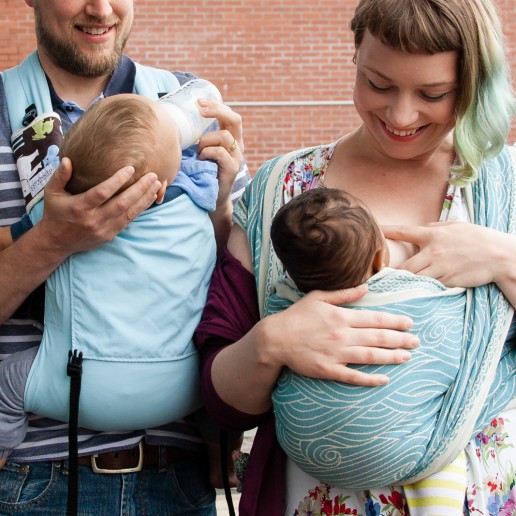
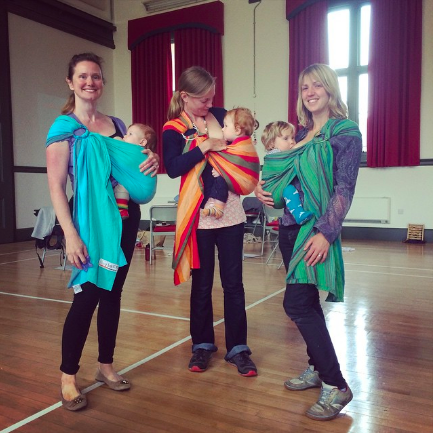
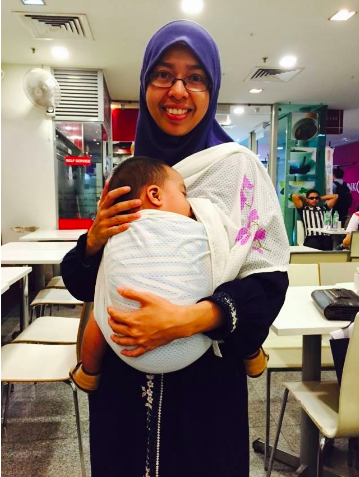
1) Why might you want to feed in a sling?
Most commonly, mums of more than one child find being able to feed the baby on the go very useful. This is especially so if they are feeding responsively, as recommended by the WHO, and have an older child who needs their parent just as much. Quite often, they will have had some experience of breast or bottle feeding already, and may be very familiar with their sling, and will be “old hands” at combining the two skills.
Mums of older children who can feed quickly in a sitting upright position may also find a sling an invaluable and very convenient tool for getting on with daily life.
For mums of small babies, it may be that the sling will be useful to carry their child to a place where they can be taken out to feed in peace and comfort. For others, being able to have baby partly supported with the sling and with one arm may allow a “third hand” to work on achieving latch, and can prove very useful for facilitating feeding. For others and once feeding is established, it can allow some simple multi-tasking rather than being pinned to the sofa.
On the whole, it may help to consider each element as a separate skill to master – how to feed, and how to use the sling, and learn how to combine them safely, however, for some, the sling can actually be an aid to achieving latch. Practice will, of course, be needed, like with every new accomplishment!
2) How can you keep your baby safe while feeding?
All the basic rules of sling safety apply when carrying a baby. The TICKS guidelines and the ABC reminders are below. However, there are different considerations needed with feeding in slings (as baby may not be close enough to kiss, for example). As always, protecting the airway and ensuring breathing is unobstructed is of paramount importance.
Babies are not mini-adults and are not able to breathe easily through their mouths for the first few months of their lives. They breathe mostly through their noses (allowing them to breathe while feeding), so unobstructed nasal airways are really important. This is why babies may struggle more than older children with mild respiratory infections affecting the small nasal passages, and explains why simple colds and respiratory viruses (eg RSV) can have serious impacts on newborns, as can any sinking of the chin onto the chest, closing the airway. Increased vigilance is needed during sleep, as muscle tone relaxes further. Feeding of any type in the carrier must be done with great caution as babies can slip into sleep as they finish their feed and airway can become obstructed. This is why we are always so careful to mention no fabric behind the head at any time, a fact often missed by carrier companies who focus on “head and neck support”.
Therefore, while a baby’s mouth is engaged with the process of sucking and swallowing, his only patent airway is his nose. It is important for the carer to be consciously aware of any potential obstruction, either external (from sling fabric, or breast tissue, or clothing ) or internal (neck bent over too far) and able to rectify it rapidly when required.
Large occiput can compress and obstruct airway if fabric behind head
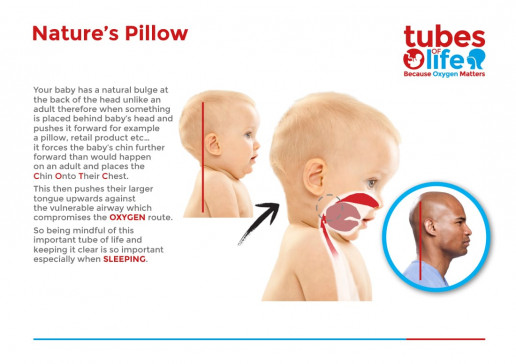
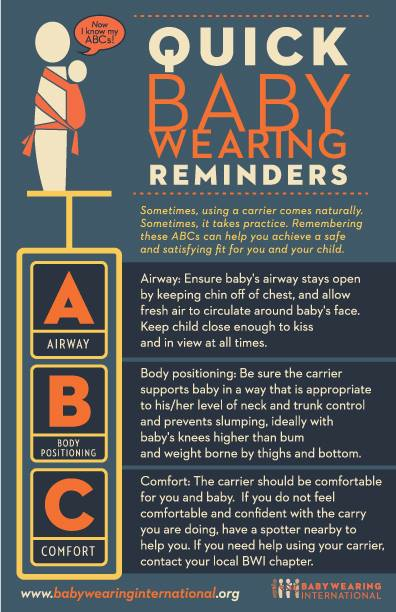
Whether feeding upright, or slightly reclined, the safest positions are…
-
those in which the parent is actively engaged and frequently checking on their child, and able to recognise any changes
-
those that ensure a good air supply at all times with no fabric over the head and chin off the chest (check you can fit two fingers underneath if you are unsure)
-
those in which baby’s head is aligned with their spine and only turned slightly to one side if needed
-
those in which baby’s back and occiput (lower part of the back of the head) are appropriately supported
-
those in which baby’s knees are above the bottom and hips are flexed (bent upwards)
-
those that ensure that a baby who has finished feeding or has fallen asleep is returned to the most optimal upright position to keep airway supported and open.
The choice of best position will vary from person to person, depending on the individual circumstances, however, the majority of successful “on-the-go” feeding is done in the upright position.
In my opinion, the greatest risk comes from breastfeeding in positions where baby is held face inwards towards the breast, with sling fabric pulled up over the back of the head, so the face is pressed firmly into breast tissue or the child is curled over into a ball.
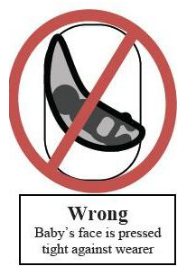
Please note this dangerous position is not the same typical gentle reclining in-arms “cradle” positions where the head is well supported in the crook of the elbow and the chin is not on the chest. This is the most common breastfeeding position, with a sling adding a little support, almost like a cushion or a hammock, to take some of the weight off the supporting arm and give you one hand free.
What should a feeding carry look like?
Baby’s head should be completely free of fabric, being supported by the sling up to the nape of the neck, able to latch and delatch as needed. Their lower body should be well supported from knee to knee, either by wrap fabric well and snugly tucked up between your bodies, or a well tied/securely buckled waistband. Both of baby’s arms should be positioned around the feeding breast or bottle, just as if in arms, and the head should not be at an awkward angle. Feet should be free of fabric and baby should be comfortable and easily able to reach the nipple. If baby is able to achieve a good latch from this position, he/she should be able to feed if ready. Some practice may be needed for both of you!
Feeding in slings is more risky if you have a snuffly baby who is needing to delatch frequently for some mouth breathing, and finds herself unable to do so as her head is not free to pull backwards for a little extra air.
Babies should never be left to sleep in feeding positions as their disproportionally heavy heads can too easily droop or be folded over, with subsequent obstruction of their airways.
**Please remember that loosened slings with longer tails can present a trip hazard if you are feeding on the move.**
In general, it can help to think of the sling as a third hand to help support baby in position while you work on achieving a latch. Many people manage to feed happily and safely in slings, once they are armed with good information, and know what to watch out for. It usually works best with older children, too. If you feel unsure about feeding your child in your carrier, do get in touch with a professional who can give you some one-to-one help and advice.
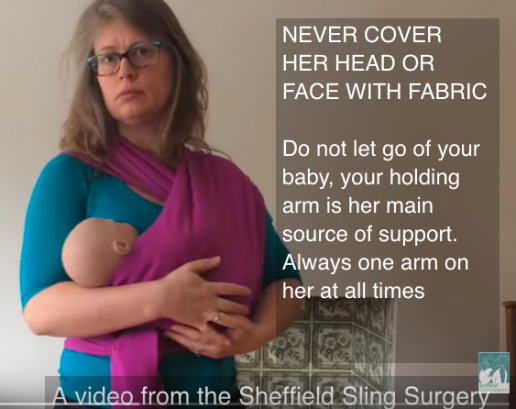
A hip carry may work well (with a wrap/ring sling/cross strap buckle carrier/meh dai).
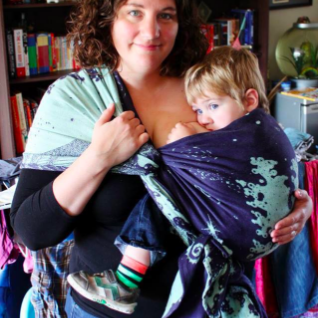
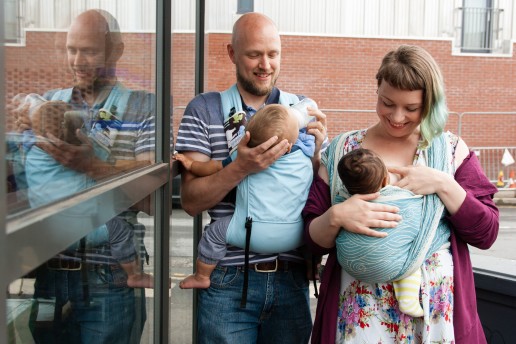
3) How can you make feeding in a sling as easy as possible?
For breastfeeding, think about ensuring easy access for your baby. Your choice of clothes can make things a lot easier. Loose fronted tops that can be easily moved out of the way, pulled down or lifted up, or those that open and close with zips or poppers, rather than buttons can help. Many mums swear by a combination of a loose shirt that can be lifted up/pulled down with a stretchy camisole or vest underneath that can be lifted up/pulled down. Such layering often provides good cover, if required. Bras that are easy to undo one handed (while your other hand supports baby”s head) are also helpful. Some mums find latching on more successful if they lean forwards slightly to bring the breast up to baby’s mouth, and many need to hold their breast up with one hand for the duration of the feed. Hoods can help with providing some discreet coverage, but remember that temperatures inside slings rise quickly if air cannot circulate freely, and carbon dioxide levels in rebreathed air are raised.
4) What kind of slings are good for breastfeeding in?
It is usually possible to feed a baby in most slings, with a bit of care. I don’t think there is really any such thing as hands-free feeding, as one hand or arm should always be on your baby to provide support, especially before they have excellent head control. But one hand free is better than none! Breast size, shape, flexibiliity and nipple position varies from woman to woman, and from stage to stage in the breastfeeding journey, so each dyad will need practice to work out which height works best for them. Larger breasts may prove more tricky for some.
Please remember that baby’s back and occiput should be well supported with no curling over and his chin should not be resting on his own chest, and once finished feeding, baby will need to be returned to his previous snug, upright and close position, by adjusting the sling appropriately.
Feeding in Stretchy Wraps
There are many different ways to feed in a stretchy wrap. Some methods are safer than others. On the whole, stretchy wraps are mostly used with small babies in the classic upright “hug hold” also known as the “pocket wrap cross carry”. It is these young babies from birth to four months who have the greatest risk of airway obstruction, so it is worth visiting your local babywearing consultant to get some advice and support if you can. I can’t stress enough how important it is to ensure your baby’s back and head is well supported, but still able to move freely to create an effective latch (and delatch), and that baby’s face is visible, not covered with fabric and their nose is clear. Once the feed is over, baby MUST be returned to the previous snug, close, upright seated squat position. There should NEVER be any fabric behind the back of baby’s head.
The video shows how to use a stretchy as a breastfeeding aid. You can see how baby is in the classic tummy to mummy position as the fabric is removed.
I usually advise parents to see their stretchy wrap as a breastfeeding aid. It can add a layer of extra support and spread some of the weight to the non cradling shoulder, and allow a short period of moving around while their child is feeding. It is not hands-free.
Feeding in ring slings
Ring Slings and upright feeding
From a good seated squat position, the pouch can be gently and slowly loosened by lifting the uppermost ring up carefully, so that baby is lowered slightly down your body. Ensure that the loosening is equal across the width of the sling so that baby’s upright seated squat position is maintained. Bring your child to the breast up so he is able to latch on without twisting his neck.
- Bottle feeders may not need to lower their baby as much, but some loosening will help to ensure baby does not have to twist his head to the side too much for teat access.
.
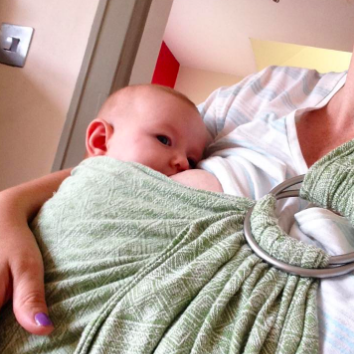
Ring Slings and slightly reclined feeding
From the snug seated squat position, loosen the fabric slowly and carefully to lower baby just a little. Lean forwards slightly and support baby’s upper body with one hand. Gently recline your baby into the waiting crook of your arm as you bring his far leg around to your front so both legs are together. Ensure the pouch of fabric is well tucked up between your baby’s side and your tummy so he is resting as if in a hammock, slightly turned towards you, bent knees above bottom, feet outside the carrier, with his head and neck resting on your arm. Adjust his location in this position so his mouth is able to reach your nipple – it should look and feel just as if you were holding him in your arms to feed. Keep the top rail of fabric under baby’s neck, do not pull it over his head.
- Bottle feeding is similar, but baby’s head will be facing the ceiling.
Feeding in Woven Wraps
Woven wraps and upright feeding
Carries such as the Front Wrap Cross Carry and its variants can be easily adjusted for feeding. The knot at the back (or side) can be loosened just a little, with the resulting small amount of slack worked equally and evenly back along the fabric so baby is sitting in a lower pouch with mouth above nipple, but still snug and supported, and in the spread squat position. The whole carry can be moved slightly across to one side or the other, and the baby can then be brought to to the breast. It is easy to switch sides.
Hip carries (especially those with slip knots) are easy to feed from one side.
Bottle feeding is similar, but baby may not need to be lowered quite as much, and may need a little more space at the top edge for the bottle to be accessible without baby’s head having to turn too far.
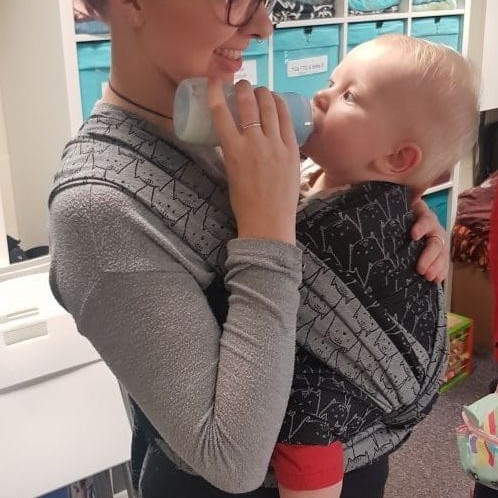
Woven Wraps and slightly reclined feeding
This works best with carries that do not have cross passes under baby’s legs, so baby can be gently tilted to one side to rest on your feeding arm. The FWCC can be partially untied so the long tails are hanging down over the shoulders and baby is sitting just in the horizontal pass. He can then be carefully gathered to one side with his far leg brought round to the front, his body turned to face the parent, bent knees above bottom, feet out and head and neck resting on your arm. Adjust his location in this position so his mouth is able to reach your nipple – it should look and feel just as if you were holding him in your arms to feed. Keep the top rail of fabric under baby’s neck, do not pull it over his head. The long tails are usually best left loose as retying them will mean you are not in control of baby’s head during the process.
- Bottle feeding is similar, but baby’s head will be facing the ceiling.
Feeding in soft structured carriers
Soft structured carriers (mei tais, half buckles, full buckles) and upright feeding
This can work well for bigger babies who have some head control. Baby should be in the carrier at the height she would normally be carried, with back and legs comfy in the seated squat position. To feed, slightly loosen the waistband gently and lower it a couple of inches and retighten, then loosen the side buckles or ties one by one to lower baby to the required position. One side may need to be loosened more than the other as baby feeds from that side. The breast can then be brought to the mouth. It is usually easy to switch sides with the straps being adjusted each time to allow baby to move. Baby’s back and occiput should be well supported with no curling over and his chin should not be resting on his own chest.
- Bottle feeding is similar, but baby may not need to be lowered quite as much, and may need a little more space at the top edge for the bottle to be accessible without baby’s head having to turn too far.
Once finished feeding, baby will need to be returned to the previous snug, upright and close position, by adjusting the sling appropriately.
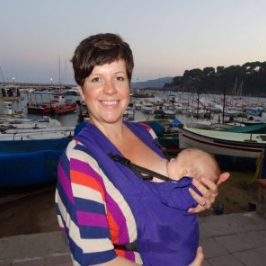
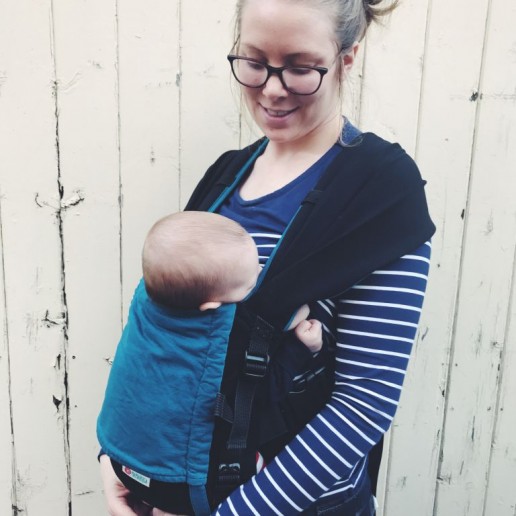
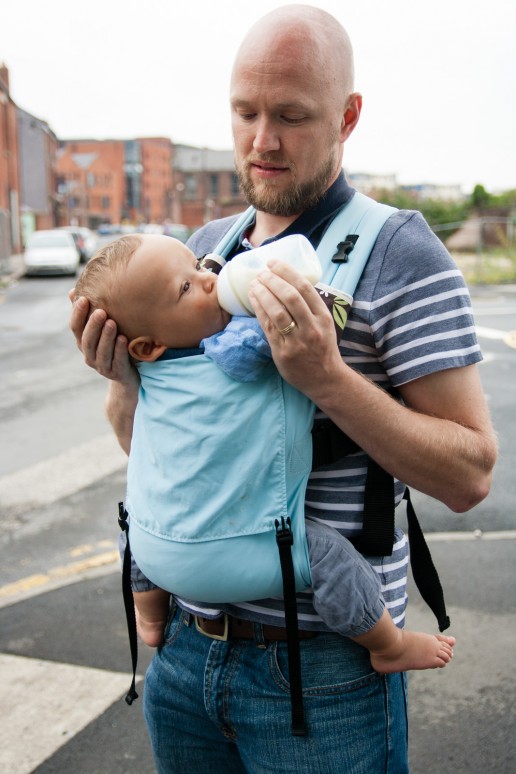
So in summary.. “Can I feed my child in my sling?” The answer is a resounding YES YOU CAN, from newborn to toddler, in lots of positions, from breast and from bottle. The key to doing it well is to ask questions about how to do it safely and empower yourself with knowledge to make a choice about how you wish to feed and then practice. It’s all about the AIRWAY! Do ask your local sling professional for some support…. – and enjoy!
Some further reading;
Seven Reasons Why Carrying is Great for Breastfeeding Mothers (Jess Hippey for Oscha Slings)